Auto Loans
Secured financing, negative equity, the dealer's rate markup, pre-approval, and both auto contracts decoded — with four borrowers navigating the real buying process.
- Explain what makes an auto loan "secured" and why that lowers the rate while also meaning the lender can repossess the car if you stop paying.
- Calculate the amount financed from price, down payment, and trade-in, and predict how the APR and term move both the monthly payment and the total interest.
- Compare new vs. used vehicles across depreciation, rate, and the 2026 OBBBA interest-deduction rules.
- Identify the credit-score tiers that drive auto-loan rates, and explain how LTV, term, and lender type also move the rate.
- Define negative equity, trace how a long term and small down payment create it, and name the three concrete situations where it hurts.
- Read a buyer's order and a Retail Installment Sale Contract field by field — spotting rolled-in negative equity, packed add-ons, and the security and deficiency clauses.
- Recognize yo-yo financing and buy-here-pay-here tactics, and explain why the no-cooling-off rule makes preparation — not recourse — your real defense.
Opening
Most people meet an auto loan as their second or third real experience with borrowing — after a credit card, maybe after the personal loan from the last lesson. It feels straightforward: pick a car, sign some papers, drive away. But an auto loan has one structural feature that changes everything about it, and a sales environment engineered to move your attention away from the numbers that matter. This lesson separates the two. The loan itself is simple and often a genuinely good deal; the dealer's finance desk is where ordinary buyers lose thousands without noticing. We'll build up from what the loan actually is, then walk straight into the room where it gets reshaped.
What an auto loan is — and why "secured" changes everything
An auto loan is an installment loan: you borrow a fixed amount, then repay it in equal monthly payments over a fixed number of months until it's gone. In that much, it's identical to the personal loan from Lesson 7. The decisive difference is one word — an auto loan is secured.
Here's what "secured" actually means, because the whole lesson hangs on it. When a loan is secured, you pledge something you own as a guarantee that you'll repay — and with an auto loan, the thing you pledge is the car itself. Concretely, the lender records a lien on the car's title. A title is the legal document that proves who owns the vehicle; a lien is a legal claim placed on that title, so that until the loan is fully paid, the lender is listed as having a stake in the car. The practical consequence — and the reason this matters to you as the borrower — is that if you stop making payments, the lender has the right to repossess the car: to legally take it back to recover the money it's owed. You don't hold the car free and clear until the final payment clears the lien off the title.
That single feature cuts both ways, and understanding the trade is the foundation for every decision later in the lesson:
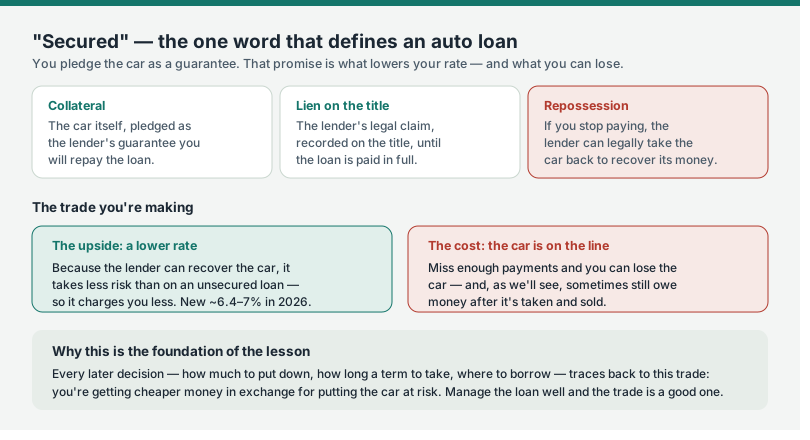
The reason auto-loan rates run lower than the unsecured personal-loan rates from Lesson 7 comes straight out of that pledge: when the lender can fall back on the car, it's taking less risk, and less risk means a lower price for the money — new-car loans averaged roughly 6.4–7% in 2026, well under typical unsecured rates. That's the upside, and for most buyers it makes an auto loan a sensible deal. The cost side is equally concrete: because the car is the collateral, missing payments doesn't just hurt your credit — it can cost you the vehicle through repossession, and (as §11's contract will show) sometimes leave you owing money even after the car is gone. This trade — cheaper borrowing in exchange for putting the car at stake — is the lens for everything that follows, because the amount you borrow, the term you choose, and where you get the loan all change how exposed you are to the downside. And the amount you borrow starts with a simple piece of arithmetic.
The anatomy of the loan — how the payment is actually built
Four numbers determine an auto loan, and they assemble in a specific order. First comes the amount financed — the sum you actually borrow — which is not the car's price. It's the price minus anything you bring to the table: your cash down payment, plus the value of any trade-in (an old car you hand over and get credit toward the purchase). Price minus down payment minus trade-in equals the amount financed. Then the APR (the all-in yearly cost) and the term (the number of months) act on that financed amount to produce the fourth number — your monthly payment — and, along the way, the total interest you'll pay.
We'll follow Maya through this lesson — she's 24, a dental hygienist in Columbus, with a near-prime credit score that's been climbing. In Lesson 1 she financed a $16,000 car with $2,000 down, borrowing $14,000 at 11% over 60 months. Those are her real numbers; the calculator sits on them so you can see how each lever moves the result:
Auto loan anatomy — Maya's car (her Lesson 1 numbers)
Watch the order: price – down – trade-in = amount financed. Then APR and term set the payment.
Monthly Payment
$304
Total Interest
$4,264
Total Paid
$18,264
Maya's actual numbers show the anatomy clearly: financing $14,000 at 11% over 60 months costs her $304 a month and $4,264 in interest, for $18,264 all in. Two of the four levers are ones she genuinely controls, and they're the ones worth understanding deeply because the rest of the lesson builds on them. The down payment does something simple and powerful: every dollar she puts down is a dollar she doesn't borrow, so it shrinks the loan, lowers the payment, and reduces the total interest — and, as §5 will show, it also protects her from a specific trap. The term is the deceptive one. Stretching it from 60 to 72 or 84 months makes the monthly payment shrink, which feels like the loan got cheaper — but it does the opposite to the total cost, piling on interest, and it keeps her owing for longer than the car stays valuable. That tension between a smaller payment and a larger total cost is exactly where the next sections live. But before the loan's mechanics, there's the choice that sits in front of all of them: what kind of car to finance in the first place.
New or used — the choice that happens before the loan
Before any financing question, there's the choice of what to buy, and it matters more than most first-time buyers realize because of one property of cars: depreciation. Depreciation is the loss of value an asset suffers over time. A car is a depreciating asset — unlike a house, which often gains value, a car is worth less every year you own it, because it wears, accumulates miles, and is replaced by newer models. What makes this central to financing is the shape of the loss: a new car sheds value fastest at the very beginning, dropping roughly 20% in its first year (a chunk of that the instant it's driven off the lot and legally becomes "used"), and around 60% by year five. Why this matters to a borrower specifically: if the car's value falls faster than you pay the loan down, you can end up owing more than it's worth — a trap we'll quantify in §5 — and it's the entire reason a used car can be the smarter buy.
That sets up the real trade between new and used, plus a genuinely new 2026 tax wrinkle worth understanding:
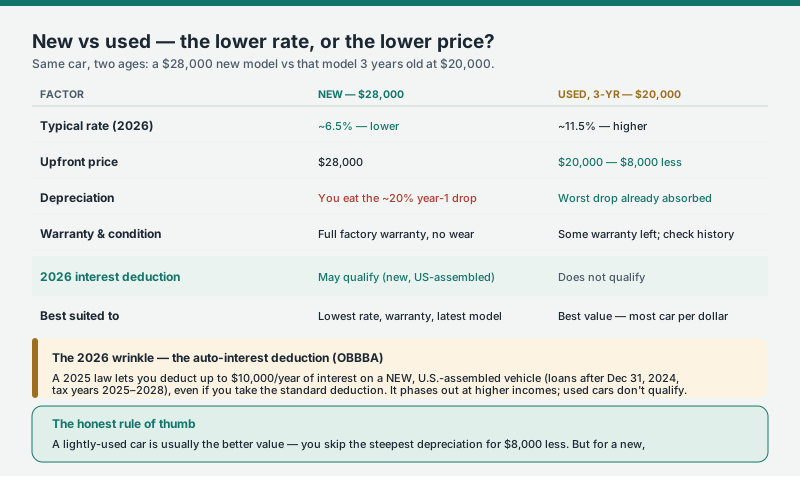
The honest rule of thumb is that a lightly-used car — two to three years old — is usually the better value, because the original owner has already absorbed that brutal first-year depreciation, so the same model can cost $8,000 less while still having most of its useful life (and often some factory warranty) ahead of it. A new car buys you the lowest rate, a full warranty, and the latest features, but you pay for the privilege of taking that first-year value drop yourself. The 2026 wrinkle is worth understanding properly, because it's genuinely new and can tilt the math: the One Big Beautiful Bill Act, signed in 2025, created a tax deduction of up to $10,000 a year of auto-loan interest — but it's narrow. It applies only to a new, U.S.-assembled vehicle, only for loans taken after December 31, 2024, only for tax years 2025 through 2028, and it phases out at higher incomes. What it does for a qualifying buyer is lower the effective cost of financing a new American-made car (and unusually, you get it even if you take the standard deduction rather than itemizing) — which can narrow the new-vs-used gap enough that it's worth running both ways rather than assuming used always wins.
But whichever car a buyer picks, the single biggest factor in what the loan costs isn't the car at all — it's their credit.
What sets your rate — the same loan, very different prices
The dominant lever on an auto-loan rate is the borrower's credit score, and lenders sort scores into named bands called tiers — super-prime, prime, near-prime, subprime, and deep subprime — each priced differently because each represents a different level of risk to the lender. The spread between the top and bottom tiers is large enough to dwarf the new-versus-used decision entirely. Slide through the bands and watch the same $20,000 loan reprice; the four buyers are marked where they fall:
Your score sets your tier — the same $20,000 over 60 months
Drag the score. The tier, the typical auto APR, and what the loan costs all move together.
Darnell ~580 · Maya ~670 · Sofia ~785
Tier
Near-prime
Typical APR
11.0%
Payment
$435
Interest
$6,091
The spread is the whole point: the identical $20,000 car loan costs Sofia (super-prime, ~5%) roughly $2,645 in interest, costs Maya (near-prime, ~11% — exactly her Lesson 1 rate) about $6,090, and costs Darnell (subprime, ~15%) around $8,500 — a swing of nearly $6,000 in interest for the same money and the same car, driven almost entirely by the three-digit score. Beyond the score itself, four other levers move a rate, and they're worth knowing because they're things a buyer can act on. A bigger down payment lowers the rate by improving the loan-to-value ratio (LTV) — that's the size of the loan compared to the car's value; a smaller loan against the same car means less risk to the lender, so a lower rate. A shorter term rates lower than a long one, a newer car lower than an old one, and — critically for the rest of this lesson — a credit-union or bank loan beats dealer financing, which tends to carry the highest rate of all. That last lever isn't just about who has the best advertised rate; it's about when and where you arrange the money, which turns out to be the buyer's single strongest protection against the dealer's most profitable tactics.
The term trap and negative equity — owing more than the car is worth
Recall the deceptive lever from §2: a longer term shrinks the monthly payment. That's what makes 72- and 84-month loans so easy to sell — "$380 a month" sounds better than "$460 a month." But stretching the term does two costly things, and the second one is the one nobody mentions on the lot. The first is obvious in hindsight: more months of interest means a larger total cost. The second is negative equity.
Here's what negative equity is, built up plainly, because it's the central trap of auto financing. Equity in a car is the part you actually own free of debt — the car's current value minus what you still owe on it. When that number is positive, the car is worth more than your loan balance and you have real ownership in it. When it's negative — when you owe more than the car is worth — you're "underwater" or "upside down." This happens because of the depreciation curve from §3: a car loses value fast early on, and if your loan balance is falling slower than the car's value (which is exactly what a small down payment and a long term cause), then for a stretch of time you owe more than the thing is worth. Why this matters in concrete, painful ways: if the car is totaled in an accident, your insurance pays only the car's current value, leaving you to cover the gap out of pocket on a car you no longer have; if you need to sell or trade it, you must come up with the difference in cash to clear the loan; and you're effectively trapped in the vehicle until your balance finally drops below its value. Watch the underwater stretch open and close as you change the loan:
Negative equity — when do you owe more than the car is worth?
A small down payment + long term keeps you underwater longer. More down + a shorter term fixes it.
Loan term — the red stretch is when you owe more than the car is worth:
Underwater For
~11 months
Worst Gap (Owe – Worth)
~$165
The red stretch is the danger zone made visible. With only $2,000 down on a $25,000 car over 72 months, a buyer is underwater for roughly two years — and during that window, any accident that totals the car, or any need to sell it, means writing a check for thousands just to get free of a car they no longer have. Now drag the down payment up to $5,000 and the term down to 60 months and watch the red shrink dramatically or disappear entirely: that's the antidote working. A bigger down payment starts the loan closer to (or even below) the car's value, so there's little or no gap to begin with; a shorter term pays the balance down fast enough to keep pace with depreciation. This is the deeper reason — beyond just a smaller payment — that putting real money down matters: it keeps you from being trapped in a vehicle you can't afford to get out of. And how much you need to borrow connects directly to the next question, because where you arrange that borrowing is where the dealer's most profitable trick lives.
Where to borrow — and why pre-approval is the buyer's shield
A car buyer can get the loan from one of three kinds of lender, and the choice matters as much as their credit score. The trap is concentrated in dealer financing, and it has a specific name: the rate markup, also called the dealer reserve. Here's exactly how it works, because most buyers have no idea it's happening. When you apply for financing through the dealer, the dealer sends your application to a lender, and the lender returns the rate you actually qualify for — this is called the "buy rate." The dealer is then permitted to quote you a higher rate — the "sell rate" — and keep the difference as profit. So a buyer who qualifies for 8% might be quoted 10% and never know that 2-point gap is pure dealer margin. Surveys have found that roughly 79% of buyers don't know dealers can do this at all, and victims of the worst version (the yo-yo scam in §11) end up paying about five points more than they should.
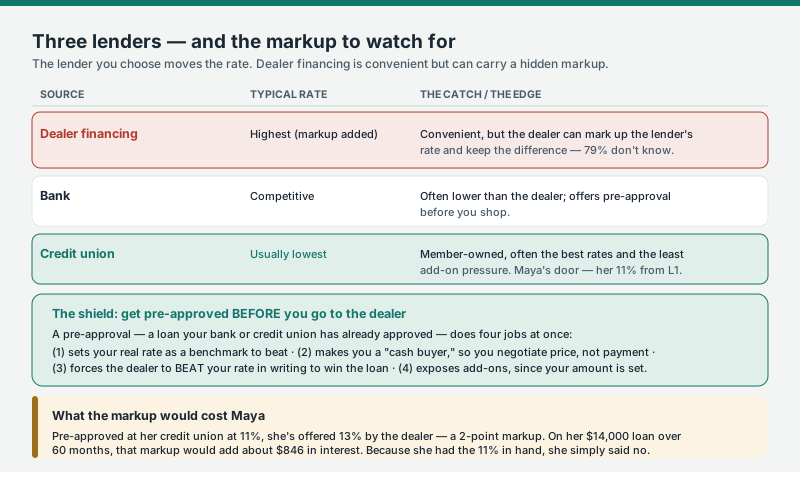
The defense against all of this is a single, powerful move: get pre-approved by a bank or credit union before going to the dealership. A pre-approval is a loan your own lender has already agreed to give you, at a stated rate, before you set foot on the lot — and it does four distinct jobs that protect a buyer. First, it sets a real rate as a benchmark, so any dealer quote can be measured against a number you trust. Second, it makes you effectively a "cash buyer," which lets you keep the negotiation about the car's price rather than getting pulled into the "what monthly payment do you want?" game. Third, it forces the dealer to genuinely beat your rate in writing if they want to win your financing — which is fine, because a real lower offer is a win for you. Fourth, because your loan amount is already locked, it exposes any add-ons or markup the dealer tries to slip in, since they'd have to push your financed total above what you arrived with. Maya's pre-approval is exactly what saved her: her credit union approved 11%, the dealer quoted 13% — a 2-point markup that would have quietly cost her about $846 in extra interest over her $14,000 loan — and because she walked in with the 11% in hand, she could simply decline. That same finance desk where the markup hides is also where the add-ons get packed onto the loan, which is the next layer of cost to understand.
Manufacturer incentives — 0% financing or the cash rebate?
On new cars, automakers regularly offer incentives — special deals designed to move inventory — and they usually come in one of two forms. The first is 0% financing: a loan, made through the manufacturer's own financing arm, that charges no interest at all. The second is a cash rebate: a flat amount knocked off the car's price, often a few thousand dollars. The catch that trips people up is that you typically have to choose one or the other — you can't take the rebate and the 0% loan — and the marketing is designed to make each sound like the obvious winner in isolation. The only way to actually know which is better is to compare the total amount you'd pay each way, because the answer genuinely flips depending on the numbers. We'll follow Sofia here — she's 41, a teacher in San Antonio with a super-prime score, shopping a $30,000 car offered with either 0% financing or a $3,000 rebate:
0% financing vs the cash rebate — which actually costs less?
You pick one, not both. Compare the total you'd really pay. Sofia's $30,000 car.
Take 0% Financing
full price, no interest
$30,000
Take the Rebate
$27,000 financed + interest
$31,319
0% financing wins by ~$1,319.
The decision rule comes straight out of comparing totals. With 0% financing, Sofia pays the full $30,000 but never a cent of interest — so her total is $30,000. With the $3,000 rebate, her price drops to $27,000, but she then has to finance that at a real rate, and the interest she pays on it can eat up — or even exceed — the rebate she got. At these numbers it's close to a tie, which is exactly the lesson: the right answer isn't fixed, it depends on the rebate's size, the financing rate, and the term. The rebate wins when it's large and the rate is low — and there's a clever version where it wins decisively: take the rebate to shrink the price, then finance it with a cheap loan from your own credit union, capturing both the discount and a low rate. 0% wins when the rebate is small or the alternative rate is high, especially over longer terms where all that avoided interest stacks up. The one move that never fails is to refuse to evaluate either offer in isolation — make the dealer show you the total each way. And that same instinct, to demand the itemized total and question every line, is exactly what's needed for the place the dealer makes its quietest profit: the add-ons.
Add-ons and loan packing — what's worth it, what's pure margin
Once the price and financing are settled, the buyer is handed off to the F&I office — short for finance and insurance — where a new menu of products appears: extended warranties, GAP coverage, VIN etching, paint and fabric protection, "market adjustment" fees. The practice of sliding these onto the deal is called loan packing: the extras get rolled into the amount financed, which means two bad things happen at once — the buyer pays interest on them across the whole loan, and because they're buried in a slightly larger monthly payment, they're easy to miss. Most of these are heavily marked up; a couple can genuinely be worth it, but only bought the right way. Here's the menu, decoded:
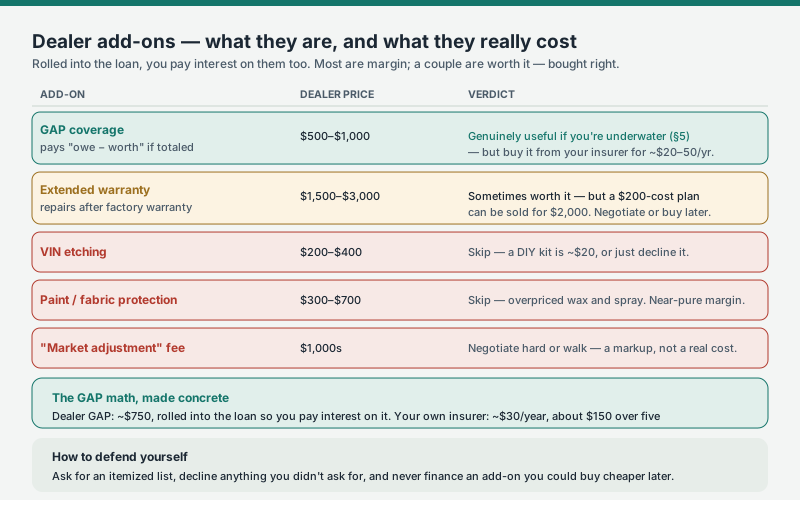
The pattern across the whole F&I menu is consistent, and once you see it you can't unsee it: the dealer's version is marked up, financed (so interest piles onto the markup), and usually duplicates something available cheaper elsewhere. GAP coverage is the one that's genuinely useful — it's insurance that pays the gap between what you owe and what the car is worth if it's totaled, which is exactly the underwater risk from §5 — but at the dealer's roughly $750 rolled into the loan, it costs about five times what your own auto insurer charges (~$30/year, around $150 over five years) for identical protection, so the move is to decline it here and add it to your existing policy. Extended warranties, which cover repairs after the factory warranty expires, can occasionally make sense, but a plan that costs the dealer a couple hundred dollars gets sold for $2,000, so they're negotiable and rarely a now-or-never decision. The rest — VIN etching, paint and fabric protection, "market adjustment" fees — are close to pure margin and worth declining outright. The defense is simple and it's the same discipline running through this entire lesson: ask for an itemized list, decline anything you didn't ask for, and never finance an add-on you could buy cheaper later. This is also precisely why pre-approval matters so much — when your loan amount is already locked in, every one of these packed extras has to show itself instead of vanishing into a slightly larger payment. Which brings the whole purchase together into the actual sequence of buying the car.
The buying process — the sequence that keeps you in control
The order in which you do things at a dealership is itself a defense. Followed in the right sequence, you settle each number on its own terms; done the dealer's way, the figures get blended together until you're negotiating the wrong thing entirely. Maya's path, with her pre-approval already in hand:
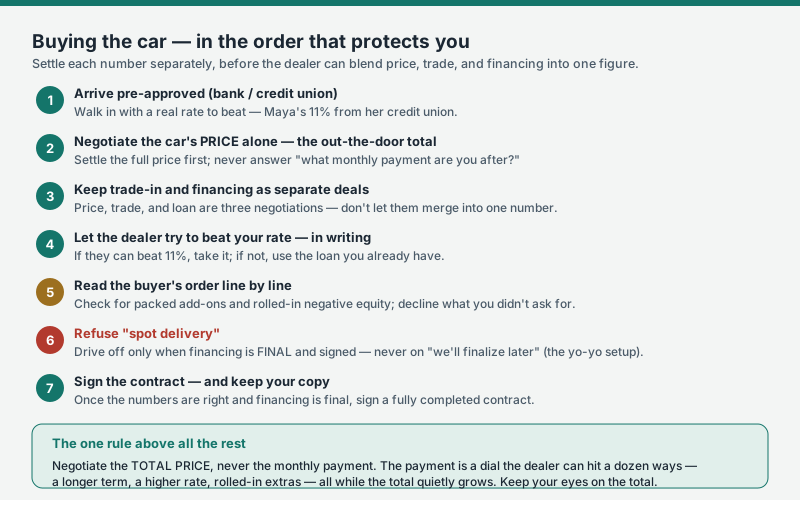
Two moves in that sequence do most of the protecting, and both deserve to be understood fully. The first is the one rule: negotiate the total price, never the monthly payment. When a salesperson asks "what payment are you looking for?", that's the moment to redirect — because the monthly payment is a dial the dealer can hit a dozen different ways. They can stretch the term, nudge the rate up, or roll in add-ons, and every one of those hits your target payment while quietly growing the total you pay. A buyer anchored on "$400 a month" can be sold a far more expensive deal than one anchored on "$24,000 out the door," because the payment hides the total and the total is what actually costs you. The second is refusing spot delivery — the practice of letting you drive the car home before the financing is finalized. It's pitched as a convenience ("take it tonight, we'll wrap up the paperwork later"), but it's the precise setup for the yo-yo scam in §11: a few days later the dealer calls to say the financing "fell through" and pressures you — now emotionally attached to the car, maybe having already shown it off — into accepting worse terms. The rule is firm: the car does not leave with you until the financing is final and signed. And the document where every one of these numbers comes together — where packing and rolled-in negative equity either hide or get caught — is the buyer's order.
Document Walkthrough — the buyer's order (the itemized deal)
Where you meet it, and how (venue and mode). Before the financing contract is drawn up, the dealer presents the buyer's order — also called the purchase order or deal sheet — an itemized worksheet, printed or shown on screen at the sales desk, that adds up the entire purchase: the car's price, the trade-in, every add-on, the fees and taxes, and the bottom-line figure that gets financed. This is the document where the §8 packing and the §5 negative equity appear in writing, which means reading it slowly, line by line, is exactly where a buyer catches them — while it's still a worksheet that can be changed, not yet a binding contract. We'll read Hector's — he's 28, a line cook in Phoenix, trading in a car he still owes money on:
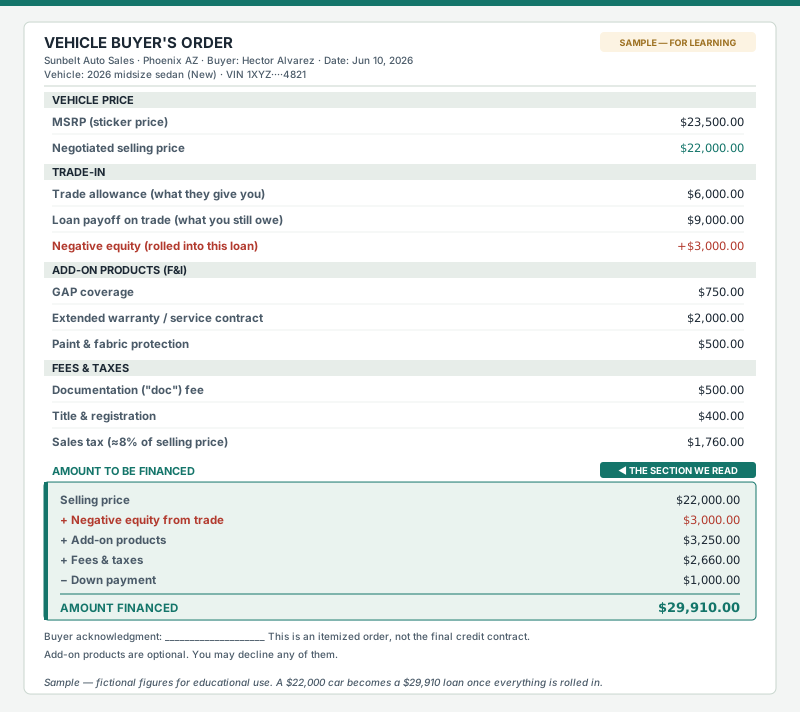
Complete total-coverage breakdown, in reading order — every line explained as what it is, what it does for Hector, and why it matters, with the two traps flagged where they live.
The document — "Vehicle Buyer's Order": this is the itemized worksheet that totals the entire purchase before any financing contract is signed. What it does for Hector is lay out every component of the deal — price, trade, add-ons, fees, taxes — as separate, inspectable lines that add up to the figure he'll finance. Why it matters: this is his last clear look at the deal as individual items before they get folded into a binding contract where they're far harder to challenge. The note at the bottom — "not the final credit contract" — confirms this is still the stage where lines can be struck, which is exactly why reading it slowly here, rather than at signing, is where money gets saved.
Dealer, buyer, date, vehicle, VIN: the header names the seller, the buyer, and the exact car. The VIN is the Vehicle Identification Number — a unique 17-character code stamped on every vehicle, functioning like a fingerprint for the car. What it does for Hector is guarantee that every dollar figure on this sheet attaches to the specific vehicle he's buying, not a similar one on the lot. Why it matters: if there's ever a recall, a title issue, or a dispute, the VIN is how the car is identified in every system, so he should confirm it matches the car he actually test-drove.
MSRP — $23,500: MSRP stands for Manufacturer's Suggested Retail Price — the "sticker price" printed on the window by the automaker. The word a beginner must catch is suggested: this is a starting point for negotiation, not a fixed price. What it does for Hector is mark the ceiling — the most he'd pay — against which his real deal is measured. Why it matters: buyers who don't know the sticker is negotiable often pay it in full, and seeing MSRP listed separately from the selling price below is the proof that negotiation actually happened.
Negotiated selling price — $22,000: this is what Hector actually agreed to pay for the car, $1,500 under sticker. What it does is establish the honest base of the entire deal — the true price of the vehicle itself, before trades, extras, and taxes complicate things. Why it matters: this is the number §9 told him to focus on, and it's the figure every other line should be judged against. When the financed total at the bottom balloons far above it, this is the number that reveals by how much.
Trade allowance — $6,000: this is the credit the dealer is giving Hector for his old car — what they're effectively "paying" him for it, applied toward the purchase. What it does is reduce the cash he needs to bring. Why it matters: the allowance is itself negotiable and can be quietly lowered to fund an apparent discount elsewhere (the shell game §6 warned about), so he should know his old car's independent market value before accepting this figure.
Loan payoff on trade — $9,000: here's the uncomfortable fact this line surfaces — Hector still owes $9,000 on the car he's trading in, which is $3,000 more than it's worth. What it does is state the debt that has to be cleared before the trade can happen. Why it matters: this is the §5 "underwater" situation, in writing, on his own deal — and it sets up the trap in the very next line.
Negative equity (rolled into this loan) — +$3,000: ↳ this is the single most important line on the page to catch. Because his payoff ($9,000) exceeds his trade allowance ($6,000), Hector is $3,000 short on his old car. What this line does is take that $3,000 shortfall and add it onto his new loan instead of asking him to pay it in cash. Why it matters enormously: he'll now pay interest on that $3,000 for years, attached to a new car, and he starts the new loan already underwater — owing more than the car is worth from day one. ↳ It's usually disguised as a slightly bigger monthly payment rather than shown as a lump. The defense: if he can possibly pay that $3,000 in cash, or wait to trade until his old car isn't underwater, he avoids financing a debt for a car he no longer owns.
GAP coverage — $750: GAP stands for Guaranteed Asset Protection — insurance that covers the gap between what he still owes on the loan and what the car is actually worth, if it's totaled or stolen. What it does: without it, if his financed car were wrecked while he's underwater, ordinary insurance would pay only the car's current value, leaving him owing the difference out of pocket; GAP covers that difference. Why it matters here specifically: because Hector is underwater, GAP is genuinely useful for him — but ↳ the dealer's $750 is roughly five times what his own auto insurer charges (~$20–50/year), so the smart move is to decline it on this sheet and add it to his existing policy.
Extended warranty / service contract — $2,000: this pays for certain repairs after the manufacturer's factory warranty runs out. What it does is shield him from a potential large repair bill years down the road. Why it matters / the catch: these are heavily marked up — a contract that costs the dealer a couple hundred dollars can be sold for $2,000 and financed, so he'd pay interest on it too. ↳ It's negotiable and can be bought later or elsewhere; despite the pressure, it's rarely a now-or-never decision, so "I'll think about it" is a complete answer.
Paint & fabric protection — $500: a coating applied to the paint and upholstery, pitched as guarding against stains and weathering. What it does in practice is very little that ordinary care doesn't — it's essentially overpriced wax and spray. Why it matters: at $500 financed, it's close to pure dealer margin for negligible real value. This is a decline.
Documentation ("doc") fee — $500: the dealer's charge for preparing and processing the sale paperwork. What it does is compensate the dealership for the administrative work. Why it matters: unlike taxes, this is partly a profit line and it varies widely — some states cap it, some don't — so ↳ it's sometimes negotiable and always worth questioning if it looks high. It is not a fixed government charge, even though it's often presented right alongside ones that are.
Title & registration — $400: these are government fees, not dealer charges, and they're worth understanding individually. The title is the official legal document proving ownership of the car; transferring it into Hector's name (with the lender's lien recorded on it) is what makes him the recognized owner. Registration is what licenses the car to be legally driven on public roads, producing his license plates and tags. What they do for him: the title secures his ownership, the registration keeps him legal to drive. Why they matter: these are genuine, fixed, state-mandated costs every buyer pays — so unlike the doc fee, there's no negotiating them away; they simply belong on the sheet.
Sales tax (≈8% of selling price) — $1,760: the state and local tax on the purchase, calculated as a percentage of the selling price. What it does is collect the government's cut of the transaction. Why it matters: like title and registration, it's unavoidable and set by law, not by the dealer — but because it's figured on the car's price, negotiating the price down also shaves the tax, a small bonus of haggling well.
Amount to Be Financed (the tinted focus) — the buildup to $29,910: this section assembles everything above into the loan total, line by line: selling price ($22,000) + rolled-in negative equity ($3,000) + add-ons ($3,250) + fees & taxes ($2,660) − down payment ($1,000) = $29,910. What it does is reveal the true size of the debt Hector is being asked to take on. Why it matters — and this is the whole lesson of the document: he came in to buy a $22,000 car and the sheet has him financing $29,910, nearly $8,000 more. Crucially, most of that excess is avoidable — the $3,000 negative equity plus $3,250 in optional add-ons total $6,250 he could strip out, dropping the loan to roughly $23,660 and saving years of interest on top. Reading this one tinted total against the price he agreed to is exactly how he catches an inflated deal before it hardens into a contract.
Buyer acknowledgment & "add-on products are optional": the signature line confirms he's reviewed the itemized order, and the printed note that add-ons are optional and may be declined is his explicit, written permission to say no. What it does is put in writing that the F&I extras are choices, not requirements. Why it matters: dealers sometimes present add-ons as though they're baked in, and this line is Hector's documentation that they aren't — and that declining them is squarely his right.
Read in full, the buyer's order is the X-ray of the deal: the honest, unavoidable numbers (price, taxes, title) sit right next to the avoidable ones (rolled-in negative equity, packed add-ons), and the financed total at the bottom is the proof of how far the deal has drifted from the car's actual price. Catching it here, on the worksheet, is far easier than after it's baked into the binding contract — which is the document we read next.
Document Walkthrough — the Retail Installment Sale Contract
Where Hector meets it, and how (venue and mode). Once the buyer's order is settled, the dealer's F&I office produces the Retail Installment Sale Contract (RISC) — the binding agreement he e-signs or signs on paper. This is the legal document, not the worksheet: the buyer's order was where the numbers got agreed; the RISC is what he's bound by, with the car pledged as collateral. Its heart is the federally required Truth in Lending (TILA) box — the same four-number disclosure from Lessons 2 and 7, here inside the auto contract. Reading it confirms the contract matches the corrected deal — Hector has declined the packed add-ons, so this reflects the cleaner, smaller loan. The full contract:
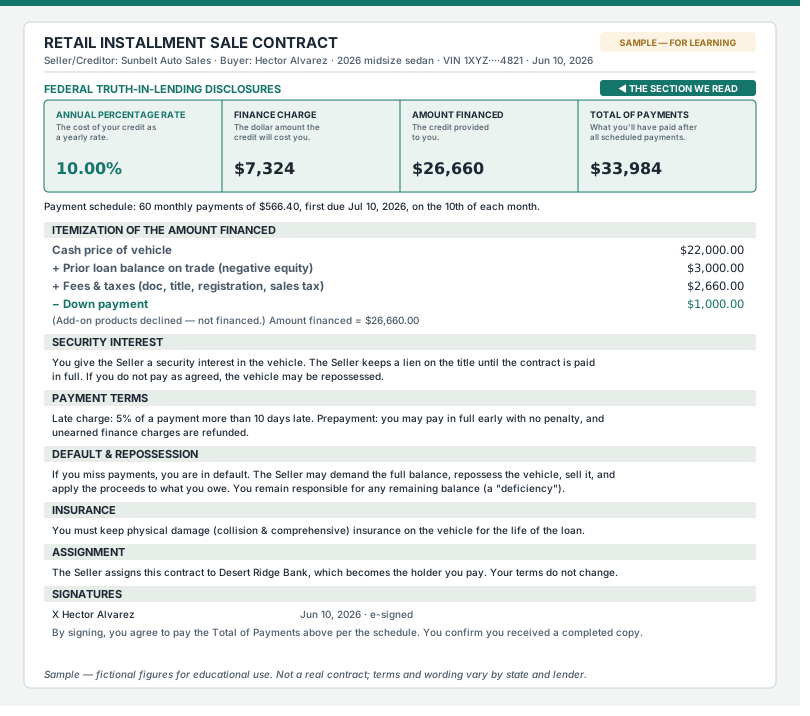
Complete total-coverage breakdown, in reading order — every part explained so Hector signs understanding what he's agreeing to.
The document — "Retail Installment Sale Contract": this is the legally binding agreement to buy the car on credit and pay it off over time — a sale and a financing contract fused into one. What it does for Hector is convert the agreed-upon buyer's order into an enforceable obligation; this is the moment the deal stops being a worksheet and becomes a debt he's legally committed to. Why it matters: everything in here is binding, so it's the document where he must confirm that the numbers match what he agreed to — because once signed, changing them is far harder than striking a line on a worksheet.
Seller/Creditor, Buyer, vehicle, VIN, date: identifies the dealer extending the credit (the "Creditor"), Hector as buyer, and the exact car by VIN. What it does is name the legal parties and bind the contract to one specific vehicle. Why it matters: note that the dealer is the named creditor even though a bank will ultimately hold the loan — a detail the Assignment section explains, and understanding it now prevents confusion when his first bill arrives from a company he never spoke to.
Federal Truth-in-Lending Disclosures (the tinted TILA box): federal law requires these four numbers, in this exact standardized format, on every consumer credit contract — specifically so the true cost can't be buried and so borrowers can compare offers on equal footing. Reading these four boxes is reading the real cost of the loan:
Annual Percentage Rate — 10.00%: defined right in the box as "the cost of your credit as a yearly rate." What it is: the all-in yearly cost of borrowing, expressed as one comparable percentage. What it does for Hector: it's the single number he should check against a pre-approval. Why it matters: had he secured one (§6), this is the line he'd compare it to — if a credit union offered less than 10%, this box is the proof the dealer's financing costs him more, and the cue to use his own loan instead.
Finance Charge — $7,324: defined as "the dollar amount the credit will cost you." What it is: the total interest (and any included fees) he'll pay over the entire loan, in real dollars rather than a percentage. What it does: it puts a literal price tag on borrowing. Why it matters: a percentage feels abstract, but "$7,324" is concrete and sobering — it's what financing adds on top of the car. ↳ Don't confuse this with the Total of Payments — the finance charge is only the cost of borrowing, not the money he's borrowing, which is the separate Amount Financed.
Amount Financed — $26,660: defined as "the credit provided to you." What it is: the actual loan principal, itemized just below. What it does: it's the base every other figure is built on. Why it matters here: this is the corrected number — because Hector declined the packed add-ons on the buyer's order, it's about $3,250 lower than the inflated version would have produced, visible proof that catching them earlier flowed straight through to a smaller debt.
Total of Payments — $33,984: defined as "what you'll have paid after all scheduled payments." What it is: every dollar that will leave his pocket across the five years — arithmetically just the Amount Financed ($26,660) plus the Finance Charge ($7,324). What it does: it gives him the complete, all-in cost in one figure. Why it matters: it's the honest answer to "what is this financed car really going to cost me?" — and seeing it next to the $22,000 sticker is a clear-eyed view of what credit adds.
Payment schedule — 60 payments of $566.40: what it is — the precise plan for paying that total, with the count, the amount, and the start date. What it does: it removes all ambiguity about his obligation. Why it matters: this is the number that has to fit his monthly budget, and the date he must never miss; the rest of the box describes the cost, but this describes the commitment.
Itemization of the Amount Financed: this breaks the $26,660 into its parts and ties the contract back to the buyer's order — cash price ($22,000) + rolled-in negative equity ($3,000) + fees & taxes ($2,660) − down payment ($1,000). What it does is show Hector exactly what he's financing, with no mystery dollars. Why it matters: the note that the add-ons were declined and are not financed is the documented payoff of reading the worksheet carefully — the savings made it into the binding contract. The one trap that survived is the $3,000 negative equity (he couldn't pay it in cash), and seeing it itemized here is an honest reminder that he's carrying it.
Security Interest — the clause that defines an auto loan: "You give the Seller a security interest in the vehicle… keeps a lien on the title… may be repossessed." What it is: Hector pledging the car itself as collateral, with the lender recording a lien (a legal claim) on the title that stays until the loan is paid. What it does for him: this pledge is why his rate is lower than an unsecured personal loan — the lender's risk is backed by a car it can reclaim. Why it matters, stated plainly: the car can be repossessed if he stops paying, and he doesn't own it free and clear until the final payment clears the lien. This single clause is the entire trade-off of a secured loan in one sentence.
Payment Terms — late charge and prepayment: the late charge (5% of a payment more than 10 days late) is what a late payment costs him, with a 10-day grace window first. The prepayment terms are genuinely good news: he may pay the loan off early with no penalty, and he gets back unearned finance charges — meaning he's only charged interest for the time he actually has the money borrowed, so paying off early refunds the interest he'd otherwise have owed for the remaining months. Why it matters: extra payments and early payoff are rewarded, not punished, so throwing extra money at this loan genuinely saves him.
Default & Repossession — the real stakes, fully spelled out: "If you miss payments, you are in default. The Seller may demand the full balance, repossess the vehicle, sell it… you remain responsible for any remaining balance (a deficiency)." What it is: the consequences of not paying. What it does: it lays out a chain — miss payments → declared in default → the entire balance can be demanded at once → the car can be repossessed and sold. Why the last part matters most, and is the line beginners miss: the deficiency. If the repossessed car sells at auction for less than Hector still owes — common, because cars lose value — he can be billed for the shortfall. ↳ The dangerous misconception is "they take the car, so the debt is settled." Not necessarily — he could lose the car and still owe a deficiency balance. This is exactly why staying current, and calling the lender early if money gets tight (a later lesson), matters so much.
Insurance requirement: "You must keep physical damage (collision & comprehensive) insurance… for the life of the loan." What it is: a contractual duty to insure the car against damage and theft the whole time he owes on it. What it does: it protects the lender's collateral — if the car (their security) is wrecked, insurance makes them whole. Why it matters to Hector specifically: if he lets his coverage lapse, the lender can buy force-placed insurance on his behalf and add the cost — usually far pricier and worse than his own — to his loan. Keeping his own policy active avoids that costly surprise.
Assignment — who actually holds the loan: "The Seller assigns this contract to Desert Ridge Bank… your terms do not change." What it is: the dealer originates the contract, then sells (assigns) it to a bank, which becomes the holder — the party Hector actually pays. What it does: it transfers the right to collect his payments from the dealer to the bank. Why it matters / what to expect: his APR, balance, and schedule stay exactly the same — only the payee changes — so it's normal and nothing to fear, but it explains why his first statement may come from a bank he never met at the dealership.
Signatures & "you received a completed copy": his signature is binding consent to the whole contract, and the affirmation that he received a completed copy is more important than it looks. What it does: it confirms the deal is final and documented. Why it matters, as a concrete protection: ↳ a completed contract has no blank spaces — signing one with blanks is a classic trap, because figures can be filled in later without his knowledge. He should confirm every number is filled in before signing, and keep his copy as proof of the agreed terms.
Read in full, the RISC is the corrected deal made binding — the TILA box proving the true cost, the security and default clauses making clear the car backs the loan and a repossession can still leave a deficiency, and the assignment explaining who he'll really pay. Because Hector caught the add-ons on the worksheet, the contract he signs is thousands lighter than the one the dealer first drew up — which is the whole payoff of reading both documents.
Predator Watch — the traps built for the subprime buyer
The auto-finance predators concentrate on the buyer with the weakest hand — someone with poor or thin credit, who's been turned down elsewhere and is anxious to drive away in something. That's Darnell's situation: rebuilding from a low score, he's exactly who these tactics are designed for. There are two main traps, plus the markup from §6 in its most aggressive form.
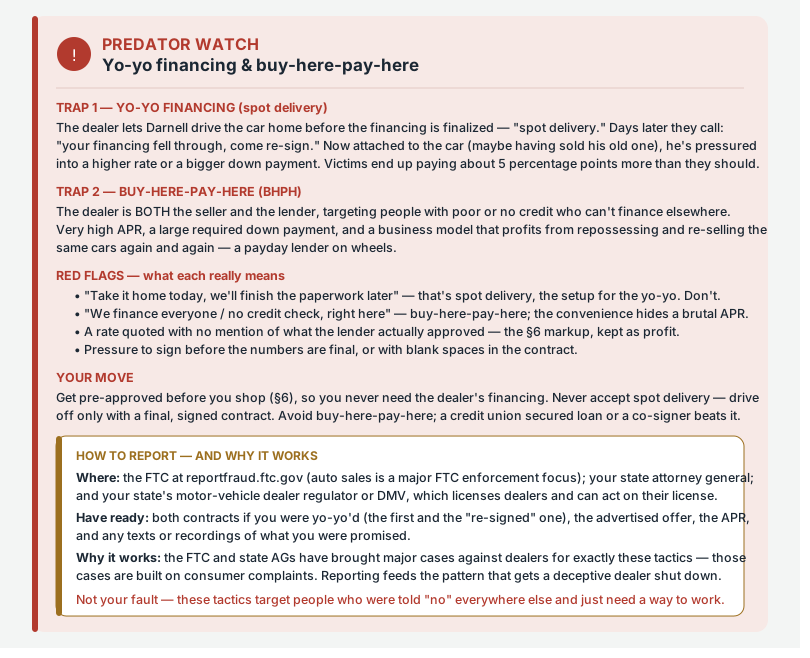
The two traps work differently but prey on the same vulnerability. Yo-yo financing exploits attachment: the dealer hands Darnell the keys before the financing is actually finalized — a practice called spot delivery — and once he's driven the car home, shown his family, maybe sold or traded his old car, the dealer calls to say the financing "fell through" and that he needs to come back and re-sign at a worse rate or larger down payment. Because backing out now means returning a car he's emotionally and logistically committed to, most people cave, and victims end up paying roughly five points more than they should. The defense is the §9 rule, stated as an absolute: never accept spot delivery — the car doesn't leave with you until the financing is final and signed. Buy-here-pay-here exploits desperation: at these lots the dealer is both the seller and the lender, openly targeting people with poor or no credit who've been refused everywhere else. The price of that easy approval is a brutal APR, a large required down payment, and a business model that actually profits when the borrower defaults — they repossess and re-sell the same car over and over, which is why it's fairly described as a payday lender on wheels. The way out for Darnell is the same as the way out of every other trap in this lesson: get pre-approved at a credit union before shopping (a secured loan or a co-signer will beat buy-here-pay-here), so he never has to walk through that door at all.
And for the buyer who's already caught in one of these:
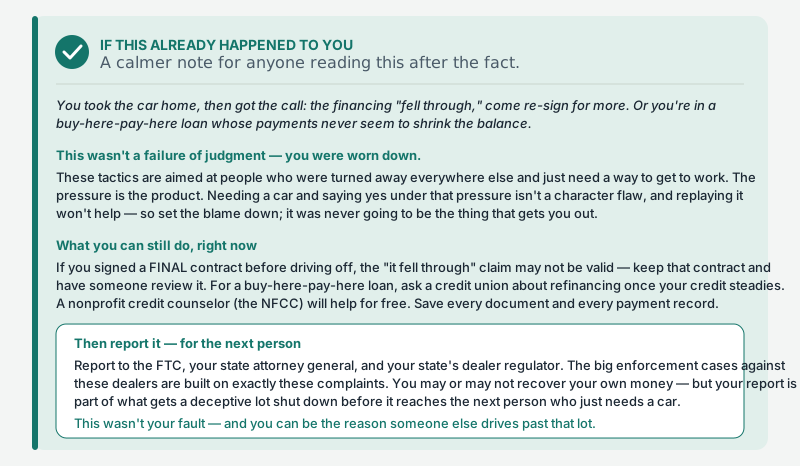
The reassurance beat does the job the warning can't: it reaches the person already inside the deal, who's likely blaming themselves. The honest truth it offers is that these tactics are engineered to target people who were told "no" everywhere else and simply need a way to get to work — the pressure is the product, not a sign of weak judgment — and that self-blame is the one thing that won't help them get out. What will help is concrete: if they signed a final contract before driving off, the "it fell through" story may not legally hold, so that contract is worth keeping and having reviewed; a buy-here-pay-here loan can often be refinanced at a credit union once credit steadies; and a nonprofit counselor will help for free. Reporting it isn't a chore either — the major FTC and state cases against these dealers are built on exactly these complaints. Which leads to where to take that complaint, and one myth about car buying worth correcting before anyone counts on it.
Where to turn — the recourse stack, and the cooling-off myth
For an ordinary auto loan, problems are rare. But when a deal goes wrong, there's a clear ladder of who to contact — and one widespread misconception that traps people who assume they can simply undo a purchase.
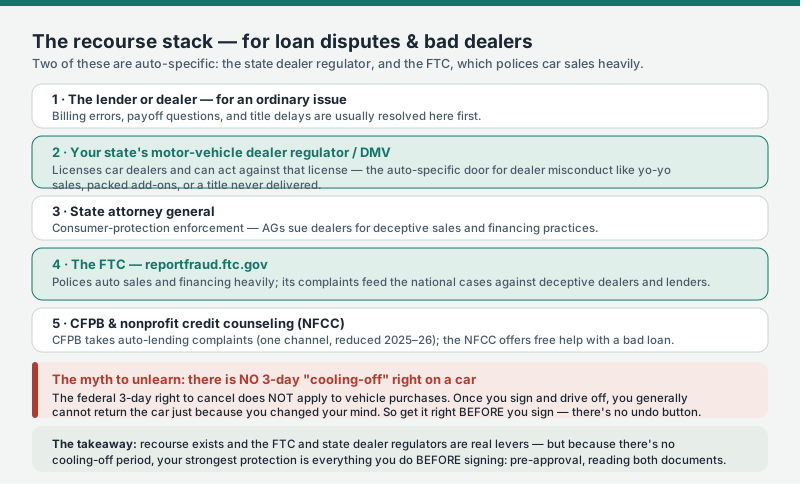
Two rungs on this ladder are specific to cars and worth knowing about. The first is your state's motor-vehicle dealer regulator or DMV — a body that licenses car dealers and can take action against that license, which makes it the natural place to report dealer-specific misconduct like a yo-yo sale, packed add-ons, or a title that was never delivered. The second is the FTC, which polices auto sales and financing unusually heavily; its complaint records feed the national enforcement cases against deceptive dealers and lenders, so a report there genuinely contributes. But the single most important thing in this section is the myth to unlearn: there is no three-day "cooling-off" right on a car purchase. Many people believe a federal rule lets them cancel any purchase within three days — it exists for certain door-to-door sales, but it does not apply to vehicles. Once you sign the contract and drive off, you generally cannot return the car simply because you changed your mind or found a better deal. That fact reframes the entire lesson: because there's no undo button after signing, a buyer's real protection is everything done before the pen touches the paper — arriving pre-approved, negotiating the total price, and reading both documents line by line. Recourse is a backstop; preparation is the actual defense.
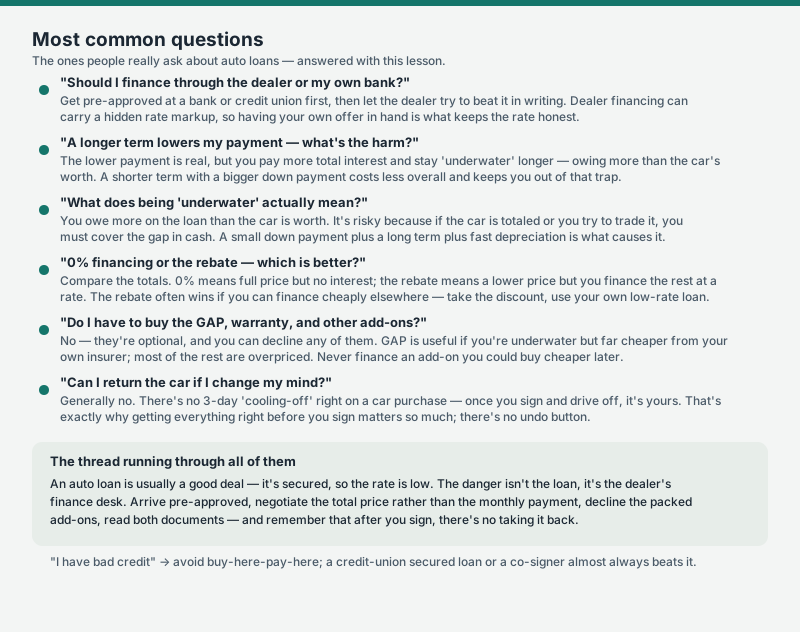
Most common questions
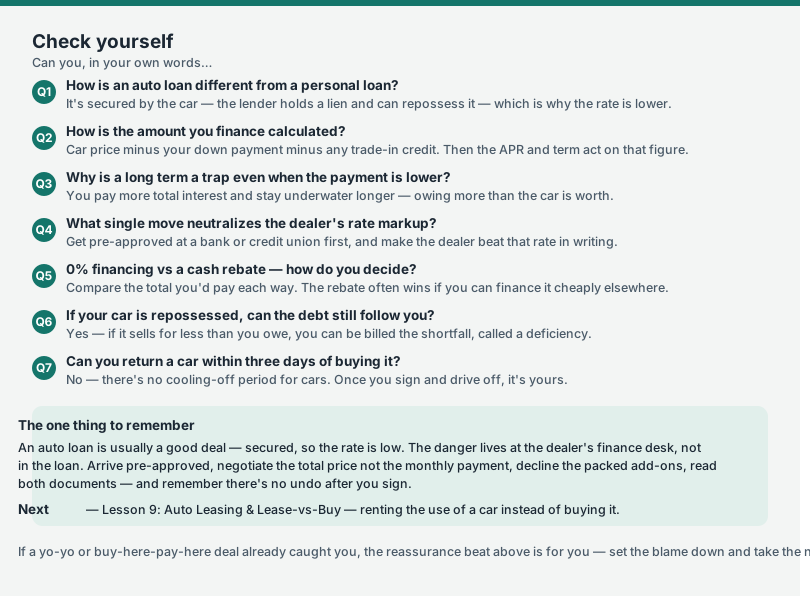
Check yourself
Key Takeaways
- An auto loan is secured by the car — the lender holds a lien on the title until the loan is paid, and can repossess the vehicle if you default.
- Your amount financed is car price minus down payment and trade-in — every dollar down is a dollar you don't borrow or pay interest on.
- A longer term shrinks the payment but creates negative equity: you can owe more than the car is worth for years, leaving you trapped if you need to sell or the car is totaled.
- Get pre-approved at a bank or credit union before the dealership. A pre-approval is your benchmark rate, negotiation anchor, and shield against the rate markup.
- The buyer's order is your last clear look at the deal before it becomes a binding contract — rolled-in negative equity and packed add-ons both appear there, where they can still be removed.
- The Retail Installment Sale Contract is the binding document: the TILA box confirms the true cost, the security clause confirms the car is collateral, and the deficiency clause means repossession may not end the debt.
- There is no three-day right to cancel a car purchase. Your protection is what happens before you sign: pre-approval, total-price negotiation, and reading both documents line by line.
Quiz — 6 Questions
Answer one at a timeWhat makes an auto loan "secured"?