Student Loans
Federal vs private — subsidized vs unsubsidized interest accrual, PLUS loans, private loan underwriting, and the borrowing decisions made at 18 that shape the decade after graduation.
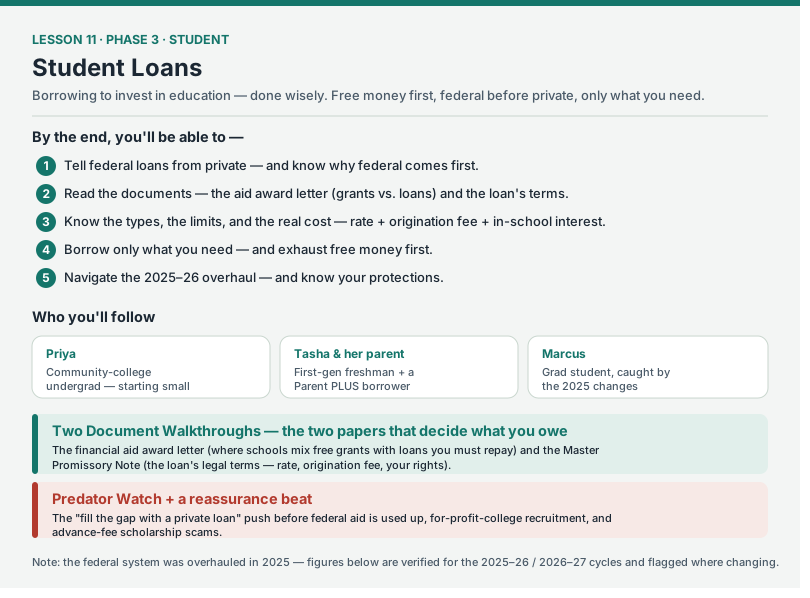
- Explain the dual nature of a student loan — investment in future earnings and inescapable debt with collection powers that reach wages, tax refunds, and Social Security — and why holding both halves in mind is the whole skill.
- Apply the federal-first rule: take federal loans before private, understand why the safety net (income-driven repayment, deferment, forgiveness) usually outweighs a rate advantage, and account for the 2025 One Big Beautiful Bill Act changes (Grad PLUS elimination, new caps, effective July 1, 2026).
- File the FAFSA correctly and explain what the Student Aid Index (SAI) produces — the gate to Pell Grants, work-study, federal loans, and most state and institutional aid, including non-need-based unsubsidized loans.
- Identify the four federal loan types in borrowing order (subsidized, unsubsidized, Parent PLUS, Grad PLUS), calculate the full three-layer cost (rate + origination fee + in-school accrual), and explain how capitalization enlarges an unsubsidized balance.
- Read a financial aid award letter by re-sorting every line into free (grants/scholarships), earned (work-study), and borrowed (loans) — and read a Master Promissory Note by locating each right (grace period, IDR, deferment, cancel, prepay) and each consequence (acceleration, garnishment, bankruptcy bar).
- Apply the financing hierarchy — free money first, then federal, then private for a genuine gap only — right-size borrowing to the net gap and the salary test, and evaluate parent borrowing with the retirement-protection rule.
- Recognize the three student-loan predator patterns (private-loan push, for-profit recruitment, advance-fee scam), report them to the FTC, CFPB, and state AG without shame, and know which protections are reliable in 2026 (state-first, given CFPB cutbacks) and which discharge remedies exist.
Opening
A student loan is, at heart, borrowing to invest in yourself — money to buy an education that, for most people, raises lifetime earnings enough to be worth the cost. So the first thing to say, as with every lesson in this course, is that there's no shame in needing one. The large majority of students borrow; it's how higher education is financed in this country, and doing it is normal and often genuinely wise. But a student loan has a dual nature that makes it different from almost every other debt in this course, and holding both halves in mind is the whole skill. It's an investment — but it's also debt that follows you, and it follows you harder than most: it's extremely difficult to discharge in bankruptcy, it can stretch across decades, and over-borrowing — taking more than the education actually requires — is one of the most common and lasting financial mistakes a young person can make. The goal of this lesson is not to scare anyone away from borrowing for school; it's to make sure that when Priya, Tasha, and Marcus do borrow, they borrow wisely.
"Wisely" turns out to have a clear spine, four rules that run through everything ahead. Free money first — grants, scholarships, and work-study are money you never repay, so they come before any loan. Federal before private — federal loans carry fixed rates, repayment protections, and forgiveness options that private loans largely don't, so they're the default and private is the last resort. Borrow only what you need — not the maximum a school or lender offers, because every extra dollar is a dollar (plus interest) you'll repay for years. And understand the true cost before signing — which isn't just the interest rate, but the rate plus an origination fee plus, for many loans, interest that quietly piles up while you're still in school. Most of this lesson is those four rules made concrete.
The most fundamental distinction — the one the whole lesson pivots on — is federal vs. private. A federal student loan comes from the U.S. Department of Education with a rate fixed by law, broad borrower protections (income-driven repayment, deferment, potential forgiveness), and generally no credit check for the main types. A private student loan comes from a bank or lender, is priced on your credit (so a student usually needs a creditworthy cosigner), and carries far fewer protections. That divide is why the order matters: federal first, private only to fill a genuine remaining gap.
And here is what makes this lesson unusually time-sensitive: the federal student-loan system was just overhauled, and the biggest changes take effect in a matter of weeks. The 2025 budget law — the One Big Beautiful Bill Act, signed into law on July 4, 2025 — restructured federal borrowing, and most of its provisions take effect July 1, 2026, which from where this lesson sits is imminent. Three pieces matter most up front. First, the Grad PLUS loan program is being eliminated for new borrowers as of that date — graduate students who begin programs after June 30, 2026, will no longer be eligible for Grad PLUS loans, though "legacy" provisions protect many current borrowers — which lands squarely on Marcus. Second, new caps arrive: graduate students will be limited to $20,500 a year ($100,000 aggregate), professional students to $50,000 a year ($200,000 aggregate), and Parent PLUS loans to $20,000 per student per year with a $65,000 lifetime cap per dependent, all under a new $257,500 lifetime limit on all federal student loans (excluding Parent PLUS) — caps that hit Tasha's parent and Marcus. Third, and reassuringly for Priya, there are no changes to undergraduate loan limits, and Pell Grants are unchanged. The practical upshot is that who you are (undergrad, grad, professional, or parent) and when you borrow (before or after July 1, 2026) now shape your options dramatically — this lesson is being taught right at the hinge.
The cost picture is the other thing to anchor at the outset, because federal rates are fixed at disbursement and you can't negotiate or shop them. For loans first disbursed in the 2025–26 year, the rates are 6.39% for undergraduates, 7.94% for graduate students, and 8.94% for PLUS loans — the first drop since 2020–21 — but they're rising again: for 2026–27, undergraduate loans carry 6.52%, graduate loans 8.07%, and PLUS loans 9.07%. On top of the rate sits an origination fee deducted from every disbursement — currently 1.057% for Direct Subsidized and Unsubsidized loans and 4.228% for PLUS loans — which means you receive less than you borrow: the 4.228% fee on a $25,000 PLUS loan means you receive $23,943 but repay $25,000 plus interest. And for many loans, interest accrues while you're still in school — the subsidized-vs-unsubsidized distinction we'll take apart in §5. Rate, plus fee, plus in-school interest: that's the true cost, and most students see only the first of the three.
Those forces fall differently on the three people you'll follow, which is exactly why we follow three. Priya, at community college, borrows small federal amounts and is the "do it right from the start" case — untouched by the 2025 caps, learning the FAFSA and the subsidized/unsubsidized choice. Tasha, a first-gen freshman at a state university, faces the harder version — a real funding gap, a parent weighing a newly-capped Parent PLUS loan, and the predators who circle students in exactly her position. And Marcus, starting graduate school, is the borrower the 2025 changes hit hardest — Grad PLUS gone, hard caps in place, and private loans pushed from "supplement" to "core part of the plan." By the end, each of them — and you — should be able to read the two documents that decide what's owed, tell free money from debt, pick federal over private for the right reasons, borrow only what's needed, and know the protections that still hold. It starts with what a student loan actually is, and how it differs from every other debt in this course. That's §1.
1. What a student loan is — and why it's unlike any other debt here
A student loan is money borrowed specifically to pay for education — tuition and fees, but also books, supplies, and living costs while enrolled, together called the cost of attendance. The money is usually disbursed to the school first to cover tuition and fees, with any remainder refunded to the student for other expenses. That purpose-restriction is the least of what makes it distinctive, though. Set a student loan beside the credit cards, payday loans, and auto loans from earlier lessons and it inverts almost every intuition those built:
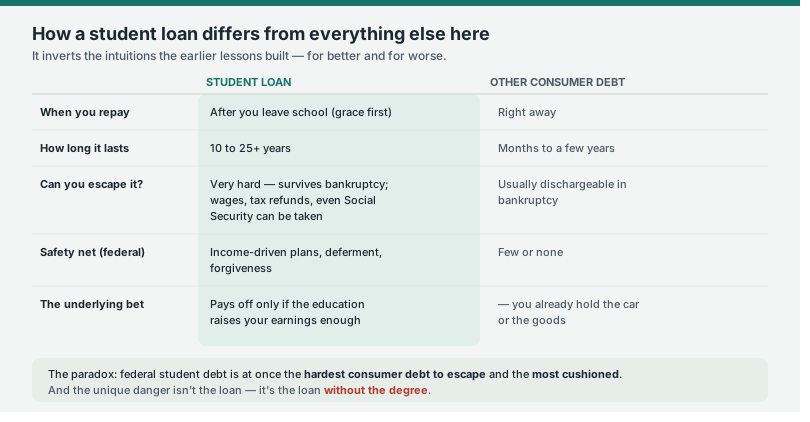
Walk the differences, because each one reshapes how Priya, Tasha, and Marcus should think about borrowing. The first is timing: you repay later, not now. Unlike a car loan that bills you the month you drive off the lot, a student loan defers repayment while you're enrolled at least half-time, and federal loans add a grace period (typically six months) after you leave before the first bill arrives. The logic is the investment logic — you borrow now and repay after the education has (ideally) raised your income — which is humane, but it also means the debt is quietly growing in the background for years before Tasha ever makes a payment, a dynamic §5 and §16 will make concrete.
The second is the horizon: it lasts a very long time. Standard federal repayment runs ten years, and income-driven and extended plans can stretch it to twenty, twenty-five, or more. Outside of a mortgage, a student loan is the longest-lived debt most people take on — Marcus could plausibly still be repaying graduate loans into his forties. A decision made at eighteen or twenty-two can shape a third of a working life, which is exactly why "borrow only what you need" carries more weight here than anywhere else in the course.
The third is the one that changes everything, and it's the red thread of the panel: it is extraordinarily hard to escape. Where credit-card and medical debt (and even the payday and title debt of Lesson 10) can ultimately be discharged in bankruptcy, student loans generally cannot — discharging them requires proving "undue hardship," a deliberately high legal bar most borrowers never clear. And federal student loans come with collection powers no ordinary creditor has: on default, the government can garnish wages, intercept tax refunds, and even withhold a portion of Social Security benefits, without first suing you. This is the single most important fact in the lesson. It means a student loan is not a debt you can walk away from if the bet goes wrong; it follows you, with teeth, sometimes for life. It also reframes a word the earlier lessons taught: a student loan is unsecured — there's no car or house to repossess — but "unsecured" here does not mean "limited downside" the way it did for a pawn loan. The lender doesn't need collateral precisely because the law makes the debt nearly inescapable. Unsecured and inescapable at once.
The fourth difference is the counterweight, and it's why federal loans sit in a category of their own: the safety net. Federal student loans carry protections no other debt in this course offers — income-driven repayment plans that size the payment to what you earn, deferment and forbearance for hard times, forgiveness pathways (public service, long-term repayment), and discharge on death or total disability. These are the subject of Lesson 12, but they belong in the definition, because they create a genuine paradox: federal student debt is simultaneously the hardest consumer debt to escape and the most cushioned while you carry it. That paradox is exactly why the federal-vs-private divide (§2) is the lesson's hinge — these protections attach to federal loans and largely vanish on private ones, which are inescapable without the cushion.
And underneath all of it is the fifth difference, the one that makes a student loan an investment rather than just a purchase: the bet. When Maya bought a car (Lesson 1), she got the car; the loan's value was certain because the asset was in her driveway. A student loan buys something less certain — a future of higher earnings that only materializes if the education actually pays off. Usually it does; on average, degree-holders earn substantially more. But not always, and the failure mode is specific and brutal: the debt without the degree. A student who borrows heavily and doesn't finish, or finishes a low-value credential (the for-profit-college trap of §17), ends up with the inescapable debt and none of the earnings that were supposed to repay it — the worst possible version of this loan. The unique danger of student borrowing isn't the loan in the abstract; it's the loan uncoupled from the payoff it was supposed to fund.
Two further realities complete the picture. Federal student loans are typically taken on young and somewhat blind — at eighteen, with little financial experience, in large cumulative sums, for a benefit years away — which is a profound information asymmetry and the reason a lesson like this exists. And the money is purpose-bound but fungible in practice: disbursed to the school for tuition first, with any refund meant for education costs, though a refund check can tempt over-borrowing for lifestyle rather than need. Put together, these features explain why student loans get their own phase in this curriculum: they're a long-horizon, hard-to-escape, investment-backed debt taken young, where the right moves — federal first, free money first, only what you need, eyes open on the cost — matter more and for longer than almost anywhere else. That hinge — federal versus private, where the protections live and where they vanish — is the next section. That's §2.
2. Federal vs. private — the divide everything else turns on
If you remember one distinction from this lesson, make it this one. A federal student loan comes from the U.S. Department of Education; a private student loan comes from a bank, credit union, or online lender. They are priced differently, protected differently, and qualify for differently — and the gap between them is wide enough that it should drive the order in which Priya, Tasha, and Marcus borrow. Side by side:
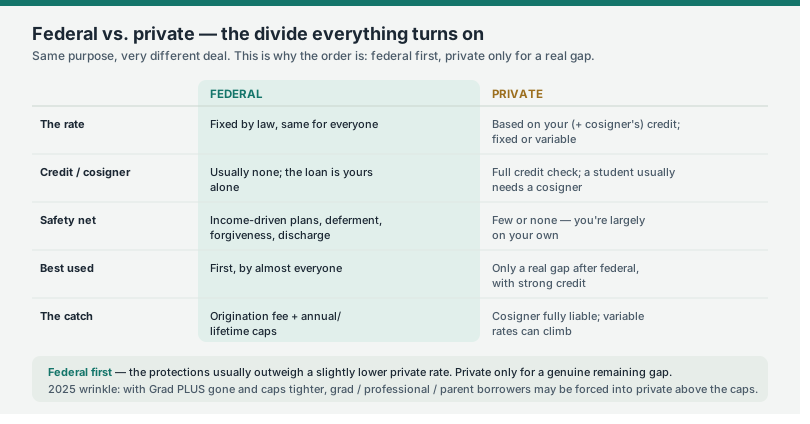
Take the federal side first, because it's the default for a reason. The rate is fixed by law and identical for every borrower — Priya, with a thin file, gets the same 6.39% (for a 2025–26 undergraduate loan) as a student with a perfect credit history, because there's no credit-based pricing at all; you can't shop it, negotiate it, or be penalized for young credit. For the main types — Direct Subsidized and Unsubsidized loans — there's generally no credit check, which matters enormously for an eighteen-year-old: the loan is Priya's alone, with no one else on the hook. (The exception is PLUS loans, which check for adverse credit history but don't price by score.) Federal loans carry an origination fee and the annual and lifetime caps from §6, and the money isn't free — but the decisive feature is the safety net: income-driven repayment that sizes the payment to what you earn, deferment and forbearance for hard times, forgiveness pathways, and discharge on death or disability (all the subject of Lesson 12). That net is the thing private loans can't match, and it's why federal comes first.
The private side is a different instrument. The rate is credit-based — it depends on the borrower's and any cosigner's credit, and it can be fixed or variable, ranging from quite low for excellent credit to high for thin or poor credit. Because most undergraduates have little credit history, a private student loan almost always requires a creditworthy cosigner — usually a parent — and here's the part that's easy to miss: a cosigner is fully and equally liable for the whole debt. If Tasha can't pay, the lender comes for her parent, the missed payments damage both their credit, and cosigner release (getting the parent off the loan later) is notoriously hard to obtain. Private loans also carry few of the federal protections — typically no income-driven repayment, limited or no forgiveness, less flexible hardship options — so if the borrower loses a job, there's little cushion. And a variable private rate adds a risk federal loans don't have: it can climb over the life of the loan, turning a low teaser rate into something much higher. None of this makes private loans evil — but it makes them a narrower tool than they appear.
From that contrast comes the federal-first rule, the spine of the lesson: borrow federal before private, and turn to private only to fill a genuine remaining gap after federal aid is exhausted. The reasoning isn't just "federal is cheaper" — sometimes a private rate, for a borrower with excellent credit, is actually lower than the federal rate. The reasoning is that the federal protections are usually worth more than a modest rate difference, especially for someone young with an uncertain future. Priya doesn't know today whether she'll finish, what she'll earn, or whether she'll hit a rough patch — and income-driven repayment, deferment, and forgiveness are insurance against exactly those unknowns. A slightly lower private rate that strips away that insurance is rarely a good trade for an eighteen-year-old. The honest exceptions are narrow: private can make sense when you've truly exhausted federal options, when you (or a cosigner) have strong enough credit to get a meaningfully lower rate, and when you're confident you won't need the federal safety net.
That's the rule in normal times — but the 2025 changes sharpen it, which is the panel's bottom line and where Marcus comes in. With Grad PLUS eliminated for new borrowers as of July 1, 2026, and hard caps now limiting graduate borrowers to $20,500 a year and parents to $20,000 per student, the federal option simply stops at a ceiling that often falls short of what graduate, professional, and some parent borrowers need. For Marcus, whose program may cost well above $20,500 a year, federal-first still holds — he takes the capped federal loan first, for its protections — but the amount above the cap now has nowhere to go except private. Private student lending has, by law, shifted from a supplement to a core part of the funding plan for grad, professional, and parent borrowers. And there's a genuine math wrinkle in his favor: with federal grad and PLUS rates now in the 8–9%+ range, a borrower like Marcus with strong credit (or a strong cosigner) might find a private fixed rate that's actually lower — so for the above-cap portion, private isn't just unavoidable, it can occasionally be the rational choice. The rule adapts but doesn't break: take the protected federal money first, up to the cap; fill any real remaining gap with private, eyes open on the rate, the cosigner liability, and the missing safety net.
For the three borrowers, the divide sorts cleanly. Priya borrows modest federal amounts, well within limits, and never needs private at all — the clean federal case. Tasha takes federal Stafford loans first, then faces a gap her family must decide how to bridge — a federal Parent PLUS loan, a private loan, or (better) more free money and less borrowing — which is exactly where the §17 predators wait. And Marcus lives the post-2025 reality: capped federal first, private for the rest, weighing rate against protection. Every one of them starts the same way, though — by filing the one form that unlocks all the federal options in the first place. That's the FAFSA, and it's §3.
3. The FAFSA — the one free form that unlocks everything
Before any of the three borrowers can take out a federal loan, receive a grant, or get work-study, they have to file one form: the Free Application for Federal Student Aid, the FAFSA. It is, quite literally, the gateway — and the single most common, most costly mistake students make in this whole area is simply not filing it. Here's what that one free form opens:
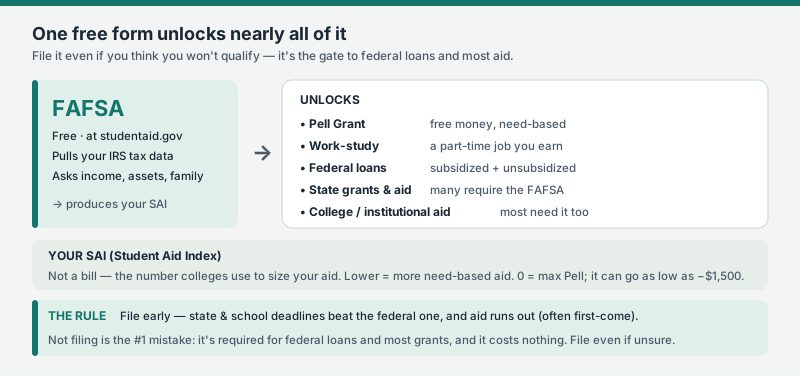
The FAFSA is free, filed online at studentaid.gov, and deliberately not the ordeal it used to be — under the FAFSA Simplification Act it now pulls the family's tax information directly from the IRS and asks far fewer questions than the old form. Priya, Tasha, and Marcus each complete it (grad students like Marcus file as independent, reporting their own income rather than a parent's), and the form produces a single number: the Student Aid Index, or SAI. This is the most misunderstood piece, so it's worth pinning down. The Student Aid Index replaced the Expected Family Contribution as part of the FAFSA Simplification Act, and it is not a bill — it's not what the family will pay. It's an index colleges use to estimate how much the family can contribute, and the lower it is, the more need-based aid the student qualifies for. If the student is eligible for the maximum Pell Grant, the SAI is set to 0, and the formula can even go as low as −$1,500 for the highest-need students — a more granular measure than the old EFC, designed to target aid more precisely.
What the SAI then unlocks is the whole right column of that panel, and this is why filing matters even for families who assume they won't qualify for need-based help. The FAFSA is the gate to the Pell Grant (free, need-based money that never repays), to work-study (a subsidized part-time job), to federal student loans — and here's the crucial part — to the unsubsidized loans that aren't need-based at all, plus most state grants and most college and institutional aid and scholarships, the vast majority of which require a FAFSA on file. So even a higher-income family that expects zero Pell still needs to file, because without it Tasha can't access a federal Stafford loan, can't be considered for her state's grant program, and may be locked out of her own school's aid. Not filing doesn't just forfeit need-based money — it forfeits access to the entire federal loan system and most everything else. That's why the rule is blunt: file, even if you're sure you won't qualify, and file early. The federal deadline is generous, but state and individual school deadlines are often much earlier, and a good deal of aid is awarded first-come, first-served until it runs out — so a student who files in October is in a far better position than one who files in April.
A few 2026–27 specifics are worth flagging, because the 2025 law touched Pell eligibility. An applicant whose SAI is equal to or greater than twice the maximum Pell Grant amount is now ineligible for a Pell Grant; for 2026–27, that threshold is $14,790 — a new ceiling that screens some higher-SAI students out of Pell entirely. Students whose non-federal scholarships or grants fully cover their cost of attendance are also now ineligible for Pell — a wrinkle that can matter for a heavily-scholarshipped student. And the law eliminated the "sibling loophole," so the number of children a family has in college no longer divides the parent contribution — which means families with multiple kids in college at once may see less aid per student than under the old formula, a real change for households like Tasha's if she has siblings. For most filers, though, the simplified form and the IRS data transfer make the FAFSA easier than it's ever been, and the upside of filing dwarfs the effort.
For the three borrowers, the FAFSA does different work. For Priya, it's the door to a Pell Grant and subsidized loans — free and low-cost money she'd miss entirely if she skipped it, which is exactly why community-college students (who often assume aid isn't worth the paperwork) leave the most on the table. For Tasha, the SAI it produces will determine the shape of her whole aid package and the size of the gap her family must bridge. And for Marcus, it's simply the required first step to any federal grad loan, capped though those now are. In every case, the FAFSA is upstream of everything: it's what generates the document where the real decisions get made — the financial aid award letter, where schools lay out grants, work-study, and loans together, and where students so often can't tell the free money from the debt. Reading that letter correctly is the first Document Walkthrough — but first, the loan types it will offer: the federal loans themselves, and what the 2025 law did to them. That's §4.
4. The types of federal loans — a menu in transition
Federal student loans aren't one product; they're a short menu of four, and knowing which is which — and which the 2025 law just changed — is what lets each borrower take the right ones in the right order. Here's the menu as it stands for the 2025–26 year, with the changes landing July 1, 2026 flagged:
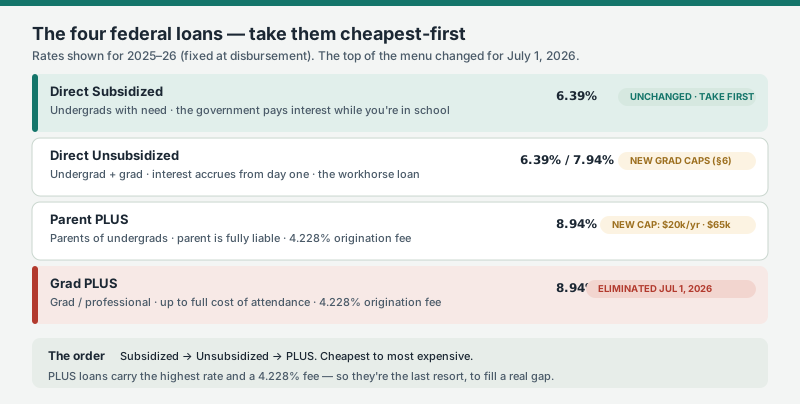
Read the menu top to bottom and it doubles as the order to borrow in, cheapest first. The Direct Subsidized loan sits at the top because it's the best loan in the entire system: it's for undergraduates with demonstrated financial need (the FAFSA's SAI decides), and the defining benefit is that the government pays the interest while you're enrolled at least half-time, plus during the grace period and approved deferments. That subsidy — which §5 takes apart — means the loan doesn't grow while Priya is in school, making it meaningfully cheaper than anything below it. It's capped at a portion of the annual limit, so there's only so much of it, but the rule is simple: take every subsidized dollar you're offered first.
The Direct Unsubsidized loan is the workhorse — available to both undergraduate and graduate students, regardless of need, which is why nearly everyone with a FAFSA on file can get one. The catch, and the difference from subsidized, is that interest accrues from the day it's disbursed: while Priya sits in class, an unsubsidized loan is quietly growing, and that accrued interest can later be added to the principal (capitalized), so she ends up paying interest on interest. It's still a federal loan with all the federal protections, and it's the second loan to take after subsidized — but it's not free money sitting idle, it's a meter running. For Marcus, post-2025, the unsubsidized loan is now the primary federal option, capped at $20,500 a year ($50,000 for professional programs), which §6 details.
The bottom two rows are the PLUS loans, and they share three features: they carry the highest federal rate, they tack on a hefty 4.228% origination fee (so a chunk is skimmed off every disbursement), and they require a check for adverse credit history. Parent PLUS lets a parent of a dependent undergraduate borrow to fill the gap — Tasha's parent is the borrower and is fully liable, which is the quiet risk of parent borrowing (§15). Grad PLUS let graduate and professional students borrow up to the full cost of attendance beyond their unsubsidized limit. Both have historically been the "fill the rest of the gap" option — and both are exactly where the 2025 law landed hardest.
That law — the panel's red and amber pills — reshaped the top of this menu, and it's worth stating precisely because it falls so unevenly. Grad PLUS is being eliminated for new borrowers as of July 1, 2026: a student like Marcus, starting a program after that date, simply cannot get one, and the federal door closes at the unsubsidized cap. (A "legacy" provision protects students who already had a Grad PLUS or Direct loan disbursed for the same program before that date, letting them keep borrowing under the old rules for up to three more years or through program completion.) Parent PLUS gets a hard cap — $20,000 per student per year and $65,000 per dependent total — where parents could previously borrow up to the full cost of attendance, so families with a large gap, like Tasha's, may hit the federal ceiling and have to look elsewhere. And the unsubsidized caps for graduate and professional students tighten, all under a new $257,500 lifetime limit. The one piece of stability: undergraduate limits are unchanged, so Priya's and Tasha's student borrowing follows the same rules it always did — it's the grad and parent rows that moved.
So the menu sorts the three borrowers cleanly. Priya takes subsidized first, then unsubsidized — both undergraduate Stafford loans, untouched by the changes. Tasha does the same on the student side, and her parent weighs a now-capped Parent PLUS loan against the gap. And Marcus is the borrower the overhaul hits hardest: unsubsidized only, Grad PLUS gone, a hard annual cap — which is precisely why private lending (§2) became unavoidable for the portion above it. The "subsidized first" instruction rests on one mechanic we've referenced but not yet opened — why a subsidized loan is so much cheaper than an unsubsidized one, and what "interest accrues from day one" actually costs. That's §5.
5. Subsidized vs. unsubsidized — the quiet cost of in-school interest
The difference between these two loans is a single sentence with a large price tag. On a subsidized loan, the government pays the interest while you're enrolled at least half-time, through the grace period, and during approved deferments — so the loan does not grow during school, and you begin repayment owing exactly what you borrowed. On an unsubsidized loan, interest accrues from the day the money is disbursed — nobody pays it for you — so it piles up quietly while you're in class, and if you don't pay it, it gets capitalized (added to the principal) when repayment begins, after which you pay interest on the interest. To see what that's worth, take the same $10,000 loan through four years of school plus the six-month grace, at the 2025–26 undergraduate rate of 6.39%:
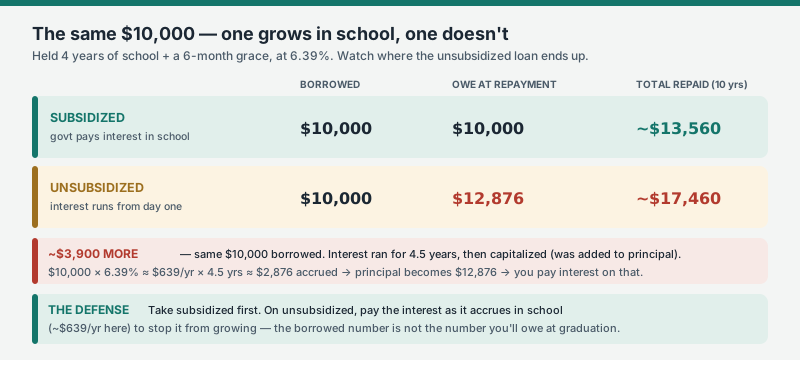
The two rows start identically — $10,000 borrowed — and end almost $3,900 apart, and nothing about that gap comes from a different rate or a different amount borrowed. It comes entirely from when the interest starts. On the subsidized loan, the government covers the interest through 4.5 years of school and grace, so Priya begins repayment owing exactly the $10,000 she borrowed, and pays it off over ten years for about $13,560. On the unsubsidized loan, that same $10,000 accrues roughly $639 a year in interest, and across the 4.5 years before repayment that's about $2,876 — which then capitalizes, getting folded into the principal so the balance at repayment isn't $10,000 but $12,876. From there she pays interest on the larger balance for ten years, repaying about $17,460. Same loan, same rate, ~$3,900 more, purely because one loan grew in the background while she was in class and the other didn't.
Capitalization is the mechanism worth naming, because it's where the real damage compounds. Accrued, unpaid interest doesn't just sit there — at the start of repayment it gets added to the principal, and from that point Priya pays interest on that interest. It's the same interest-on-interest dynamic the course flagged with carried credit-card balances (Lesson 5), but stretched over the years a student is in school, so it has a long runway to grow. The single most useful thing to understand about an unsubsidized loan follows directly: the number you borrow is not the number you'll owe at graduation. Tasha borrowing $7,500 in unsubsidized loans as a junior will owe noticeably more than $7,500 by the time her first bill arrives, and a grad student borrowing the full $20,500 will owe well over that — the loan is bigger than its sticker the moment school ends.
That points straight at the defense, which is more actionable than students realize. First, take every subsidized dollar before any unsubsidized dollar — the subsidy is free money in the form of interest someone else pays, so it's the cheapest borrowing in the whole system. Second — and this is the part most students never hear — you can pay the interest on an unsubsidized loan while you're still in school. You're not required to (that's the point of in-school deferment), but you're allowed to, and even small voluntary payments that just cover the accruing interest keep the loan from growing and prevent capitalization. Paying roughly $639 a year on that $10,000 loan — about $53 a month — would erase nearly the entire $3,900 difference. A part-time job or work-study can fund exactly that, turning an unsubsidized loan into one that behaves almost like a subsidized one. At minimum, knowing the loan is quietly growing lets a borrower plan for the larger balance instead of being blindsided by it.
Who gets which loan sharpens the stakes, and it's where Marcus diverges from Priya. Subsidized loans are undergraduate-and-need-based only — there's a limited amount, decided by the FAFSA's SAI — so Priya, with need, gets some subsidized (the cheap part) plus unsubsidized for the rest. Unsubsidized loans go to everyone, undergrad or grad, need or not. But graduate students get no subsidized loans at all — the subsidy is undergraduate-only — which means Marcus's entire federal balance is unsubsidized and accruing from day one. At the grad rate of 7.94%, a single $20,500 year accrues over $1,600 in interest annually, and across a multi-year program that in-school accrual becomes substantial. For Marcus, "pay the interest while in school if you possibly can" isn't a nice-to-have — it's the difference between a manageable balance and one that has ballooned by capitalization before he's earned his first paycheck. The subsidy that softens Priya's borrowing simply doesn't exist for him, which compounds the §4 squeeze the 2025 changes already put on graduate borrowers. Knowing which loans cost what only matters within the limits on how much of each you can take — and those limits are exactly what the 2025 law reset. That's §6.
6. Federal loan limits — a guardrail that also makes a gap
Federal borrowing isn't open-ended; it's capped at two levels — an annual limit (how much per year) and an aggregate limit (how much total, over a lifetime) — and the caps depend on who you are. The 2025 law left the undergraduate limits alone but reset the graduate, professional, and parent ceilings. Here's the full set:
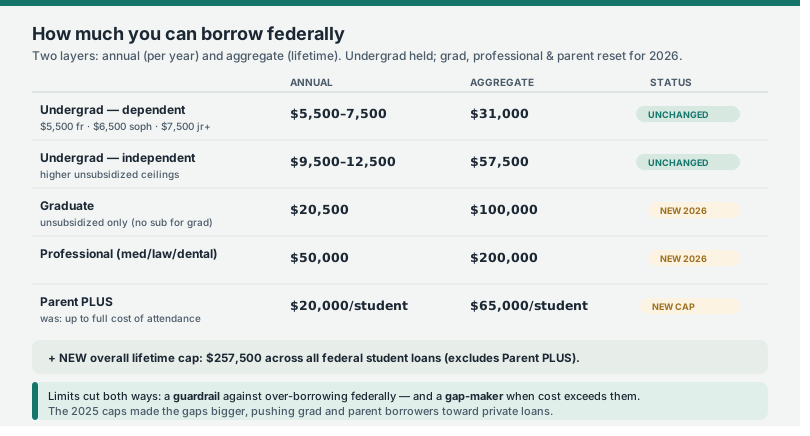
Start with the undergraduate rows, which the 2025 law left intact. A dependent undergraduate — most students under 24 whose parents support them — can borrow $5,500 as a freshman, $6,500 as a sophomore, and $7,500 as a junior or senior, up to a $31,000 aggregate across all undergraduate years. Within each annual figure sits a subsidized sub-limit (the cheaper §5 loan): up to $3,500 of that freshman $5,500 can be subsidized, rising to $5,500 of the junior figure. An independent student — one who's 24 or older, married, a veteran, has dependents, or whose parents are denied a PLUS loan — gets meaningfully higher unsubsidized ceilings ($9,500 to $12,500 a year, up to a $57,500 aggregate), on the logic that they can't lean on parental support or a Parent PLUS loan. The dependent-vs-independent line matters: it's the difference between a freshman cap of $5,500 and one of $9,500, and a student's status is set by the FAFSA, not by choice.
The rows that moved are graduate, professional, and parent — and they moved in the direction of tighter. A graduate student is now capped at $20,500 a year and $100,000 aggregate (all unsubsidized, since grad students get no subsidized loans), a professional student in medicine, law, or dentistry at $50,000 a year and $200,000 aggregate, and a parent borrowing PLUS at $20,000 per student per year, $65,000 per dependent total — where, before 2025, a parent could borrow all the way up to the full cost of attendance. Over all of it now sits a brand-new $257,500 lifetime ceiling on all federal student loans combined (Parent PLUS excluded), counting undergraduate borrowing toward the total. For graduate, professional, and parent borrowers, the federal door now has a hard stop it didn't have a year ago.
Here's the part that turns a dry table into a decision, and it's the panel's closing line: limits cut both ways. On one side, they're a guardrail — a feature, not a bug. Because Priya literally cannot borrow more than $5,500 in federal loans as a freshman, the system has a built-in brake against the runaway over-borrowing that ruins people; the cap protects her from herself in a way no payday or credit-card limit does. On the other side, the very same cap is a gap-maker: when a school costs more than the limit allows — which is common at four-year and graduate programs — the limit doesn't lower the price, it just creates a funding gap the student must fill some other way. And every one of those other ways is a step down in safety: a Parent PLUS loan (now itself capped), a private loan (with its credit-pricing and missing protections, §2), or — the better answers this lesson keeps pointing toward — more grants, a cheaper school, or simply borrowing and spending less. The 2025 changes widened those gaps precisely where they're most dangerous, by capping grad and parent borrowing, which is the structural reason private lending got pushed from supplement to staple for exactly those borrowers.
The three follow the table cleanly. Priya, at a low-cost community college, sits comfortably under her $5,500 freshman limit — no gap at all, the guardrail doing its quiet work and nothing more. Tasha, at a state university costing perhaps $28,000 a year, takes her $5,500 federal freshman loan and faces a large remaining gap — which is where her parent's now-capped Parent PLUS loan, or a private loan, or (better) more scholarship money has to come in. And Marcus, in a graduate program costing well above $20,500 a year, hits his new hard cap with a substantial gap and no Grad PLUS to bridge it — the squeeze that forces him to private. The limits tell each of them how much federal money they can get; what that money actually costs — the rate, plus the origination fee skimmed off the top, plus the in-school interest from §5 — is the full price tag, and it's §7.
7. The true cost — three layers, only one of which is advertised
When a student is told a loan's interest rate, they've been told one-third of what it costs. The real price of a federal student loan stacks in three layers — the rate, an upfront fee skimmed off the top, and (for unsubsidized loans) the interest that runs while you're in school — and a borrower who plans around only the first is consistently surprised by the total. Here are all three:
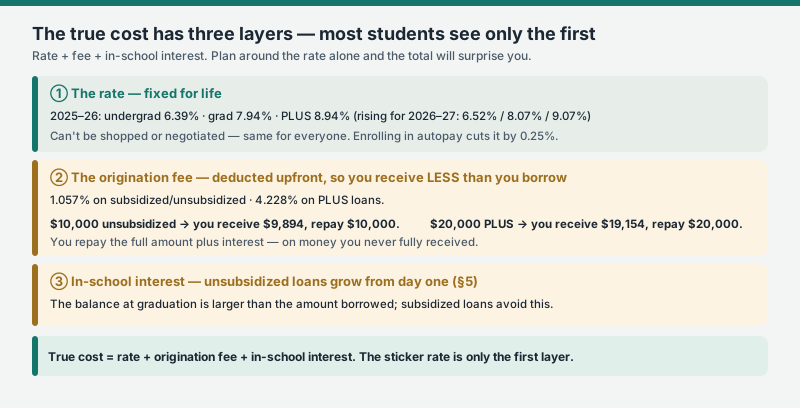
Layer one is the rate, and the unusual thing about it is what you can't do with it. A federal student loan's rate is fixed at disbursement and stays fixed for the life of the loan — it never moves with the market — and it's set once a year, each May, from a Treasury formula, so a 2025–26 undergraduate loan carries 6.39% while a 2026–27 one carries 6.52%. You cannot shop it, negotiate it, or earn a better one with good credit; everyone pays the same rate for the same loan type that year, and there are statutory ceilings (8.25% undergrad, 9.50% grad, 10.50% PLUS) the formula hasn't yet reached. Two practical consequences follow. There's one easy discount worth taking: enrolling in automatic debit payments cuts the rate by 0.25 percentage points — free money for setting up autopay, which also guards against missed payments. And because each year's borrowing locks in that year's rate, a four-year student ends up with four separate loans at four different rates — which is why a rising-rate environment quietly raises the cost of finishing a degree, even though no single loan's rate ever changes.
Layer two is the one that hides in plain sight: the origination fee. Every federal loan has a fee deducted from each disbursement before the money reaches the student or the school — currently 1.057% for subsidized and unsubsidized loans and 4.228% for PLUS loans — which produces a small but important illusion: you repay more than you received. A $10,000 unsubsidized loan loses about $106 to the fee, so roughly $9,894 actually shows up, yet Priya repays the full $10,000 plus interest. The bite is far larger on PLUS loans because the fee is four times higher: a $20,000 Parent PLUS loan for Tasha's parent loses about $846, so only about $19,154 reaches the school — and they repay $20,000 plus interest on top. This is the same upfront-fee mechanic the course flagged on other installment loans (an origination fee makes the Amount Financed smaller than the sticker), and it's almost invisible to students because it never appears as a charge — it just registers as "less money than I expected showed up." On a PLUS loan stacked on an already-high rate, that 4.228% is a real, repeated cost worth factoring into the federal-vs-private comparison.
Layer three is the in-school interest from §5, folded back in here because it belongs in any honest cost tally: an unsubsidized loan accrues from the day it's disbursed, so the balance at graduation is larger than the amount borrowed, and that growth — which a subsidized loan avoids entirely — is a genuine cost most students never count. Put the three together and the true price of a federal loan is the rate, plus the origination fee, plus the in-school accrual — and the sticker rate, the only number most borrowers ever hear, is just the first of the three.
For the three borrowers, the layers land differently. Priya's cost is the gentlest — a modest balance, a subsidized portion that skips layer three, and only the small 1.057% fee — which is exactly why borrowing small and federal at community college is so much cheaper than it looks elsewhere. Tasha's parent, weighing a Parent PLUS loan, faces the steepest version: the highest rate and the 4.228% fee and (if deferred) in-school accrual — all three layers at their largest, which is precisely why §15 will press hard on whether parent borrowing is the right move. And Marcus, in grad school, pays a high rate on an entirely unsubsidized balance that grows from day one, with the fee on top — three full layers, which is why "pay the interest while you're in school if you possibly can" matters most for him. Understanding the true cost is what makes the next document readable, because it's where the cost first appears in writing — mixed in with grants and work-study in a way that's designed to look more generous than it is. That document is the financial aid award letter, the first Document Walkthrough, and it's §8.
8. Document Walkthrough 1 — the financial aid award letter (specimen)
After Tasha is admitted and her FAFSA is processed, the university's financial aid office sends a "Financial Aid Award Notification" — posted to her student portal and mailed as a PDF, usually in the spring before she enrolls. It's the document where the family decides what to accept, and it's notorious for one reason: it tends to present grants, work-study, and loans together under the single warm heading "your aid," with a bottom line engineered to look like the cost is covered. The whole letter is the cost of attendance, the award list, and the summary framing, because the deception lives in how those three parts interact, not in any one line. Here is the whole thing:
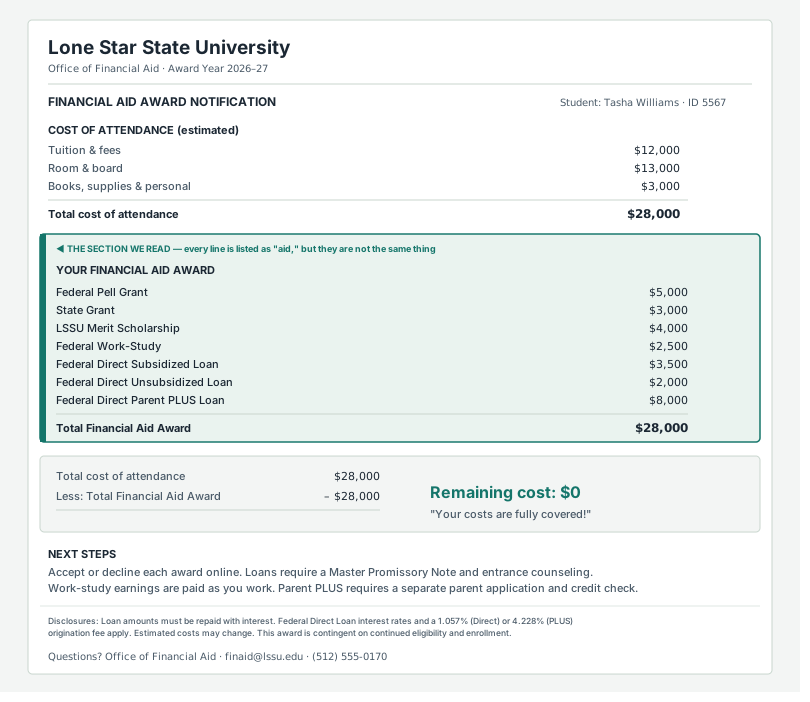
This is the whole award letter, and the trouble with it is not any single false statement — every number is technically accurate — but the framing. Read top to bottom it has a masthead and student line, a cost of attendance (the school's estimate of the full price — tuition, room and board, books and personal expenses — totaling $28,000), the tinted award list where seven different things are stacked under one heading, a summary that subtracts the award total from the cost and lands triumphantly on "Remaining cost: $0 — your costs are fully covered!", a next-steps block, and a band of fine-print disclosures at the bottom. A family glancing at this letter sees a reassuring headline: $28,000 in cost, $28,000 in aid, nothing left to pay. That impression is the problem.
Two things are worth flagging before the field-by-field breakdown takes the letter apart. First, notice that the award list mixes three fundamentally different kinds of money under the single word "aid" — the Pell Grant, state grant, and scholarship are free (never repaid); the work-study is earned (a job Tasha has to work); and three of the seven lines are loans (debt that must be repaid with interest, two by Tasha and one by her parent). The letter sorts none of this for the reader. The grants and the loans sit in the same column, in the same typeface, with the same heading, so a $5,000 Pell Grant and an $8,000 Parent PLUS loan look identical on the page — even though one is a gift and the other is thirteen years of payments. The single most important skill for reading this document is to ignore the school's grouping entirely and re-sort every line into free, earned, and borrowed.
Second — and this is where the "$0 remaining" headline does its real damage — the summary reaches "fully covered" only by counting the loans as if they were aid that erases cost. They don't erase cost; they postpone and enlarge it. Of the $28,000 "award," only $12,000 is actually free money; $2,500 is a job Tasha must work; and $13,500 is debt ($3,500 + $2,000 in student loans plus the $8,000 Parent PLUS loan). So the honest bottom line isn't "$0 remaining" — it's "$16,000 to cover by working and borrowing, of which $13,500 is debt you'll repay with interest and an origination fee." The truth is in the letter — it's in that bottom fine-print line, "loan amounts must be repaid with interest" — but it's printed small, after the celebratory headline, exactly where the eye doesn't go. The §9 breakdown re-sorts every line, computes Tasha's true free aid, true borrowing, and true net cost, and shows how to turn this letter from a sales pitch back into the budget it's supposed to be. That's next.
9. Document Walkthrough 1 — field-by-field breakdown
Masthead — "Lone Star State University · Office of Financial Aid · Award Year 2026–27." What it is: the school issuing the offer and the single year it covers. What it does for Tasha: signals that this package is specific to one school and one year — not portable, not permanent. Why it matters: award letters differ wildly from school to school, so comparing offers means comparing these letters line by line (each formats aid differently), and a generous freshman package can shrink later — front-loaded grants that don't renew are a known recruiting tactic. ↳ Check whether each grant and scholarship repeats every year, or just funds year one.
Student line — "Tasha Williams · ID 5567." What it is: whose award this is. What it does: ties the package to Tasha specifically, built from her FAFSA and SAI. Why it matters: because it's based on reported family finances, the award isn't frozen — if circumstances change (a parent's job loss), she can ask the aid office for a re-evaluation ("professional judgment"), which can increase the free aid and shrink the borrowing.
Cost of Attendance — "$28,000: tuition & fees $12,000 · room & board $13,000 · books/personal $3,000." What it is: the school's estimate of the full annual price, living costs included — not just the tuition bill. What it does for Tasha: sets the number every form of aid is measured against, and reveals that more than half the "cost" is living expenses, not tuition. Why it matters: the COA is the real denominator for everything below, and two things hide in it — it's an estimate (actual costs vary), and the living-expense portion is the most flexible part. If Tasha lives at home or chooses cheaper housing, she lowers the COA and therefore how much she needs to borrow, without touching her education at all. ↳ Room/board/personal is the part you can most cut — and cutting it cuts borrowing dollar-for-dollar.
The award list — re-sorted into three kinds of money (the focus). The letter stacks seven lines under one heading, "your aid," as if they were the same. They are three different things, and re-labeling them is the whole skill:
FREE money — Pell Grant $5,000 + State Grant $3,000 + LSSU Scholarship $4,000 = $12,000. What it is: grants and scholarships — money given, never repaid. What it does for Tasha: lowers her actual cost, no strings beyond keeping her eligibility and grades. Why it matters: this is the only part of the "award" that genuinely reduces what she pays — every free dollar is one she never borrows or repays, making it the most valuable money on the page and the part to maximize (§12). ↳ Confirm renewal: a one-year scholarship that vanishes sophomore year changes the whole math.
EARNED money — Federal Work-Study $2,500. What it is: a subsidized part-time job — money Tasha earns, paid as a paycheck as she works. What it does: it's neither free nor debt — it's income she must actually work for, and only if she takes and keeps the job. Why it matters: it's easy to read as "aid that covers cost," but it covers nothing unless she works the hours, the $2,500 is a maximum she may not fully reach, and it arrives as paychecks over the term — so it can't pay the tuition bill upfront. Useful, but it's a job, not a discount. ↳ Commonly mistaken for a grant — it's earnings, contingent on working.
DEBT — Subsidized Loan $3,500 + Unsubsidized Loan $2,000 + Parent PLUS Loan $8,000 = $13,500. What it is: three loans — money borrowed, repaid with interest and an origination fee. What it does for Tasha: makes the cost vanish today and return larger tomorrow — $5,500 is her own federal debt (the subsidized portion cheaper, §5), and $8,000 is her parent's debt (Parent PLUS, with the parent fully liable, §15). Why it matters: this is the line the letter most disguises and the one Tasha most needs to see plainly — $13,500 of debt dressed as "aid," and treating it as "covered cost" is precisely the over-borrowing mistake the lesson exists to prevent. Even within it there's an order: accept the subsidized first, the unsubsidized next, and treat the Parent PLUS as a last-resort gap-filler to question, not an automatic yes. ↳ These three are debt, not aid — re-label them the instant you read the letter.
Total Financial Aid Award — "$28,000." What it is: the sum of all seven lines. What it does: produces an impressive headline that appears to match the full cost. Why it matters: this total is the engine of the confusion, because it adds free money, earned money, and debt into one figure as though they were equivalent. A meaningful "total aid" number would count only the $12,000 of free money; the honest version of this line is "free aid: $12,000 — the rest is a job and debt." ↳ Never read "total aid" as "total free help"; sum the grants and scholarships by themselves.
The summary — "Cost $28,000 − Award $28,000 = Remaining cost: $0 · 'fully covered!'" What it is: the bottom-line framing. What it does for Tasha: tells her, in spirit falsely, that she owes nothing. Why it matters: "$0 remaining" is true only if a borrowed dollar and a worked dollar "cover" cost the same way a grant does — which is the entire sleight of hand. Her real bottom line is $12,000 free, leaving $16,000 to handle by working ($2,500) and borrowing ($13,500). The honest "net price" of a school is cost minus free money only — $16,000 here — and that's the number to compare across schools, not "$0 remaining." ↳ Compute your own net price (cost − grants/scholarships) and ignore the school's "remaining: $0."
Next steps — "Accept/decline each award; loans require an MPN + counseling; work-study paid as worked; Parent PLUS = separate application + credit check." What it is: the actions to claim each award. What it does for Tasha: reveals, almost in passing, that she can accept or decline each line individually — she is not obligated to take the loans. Why it matters: this is the most empowering sentence in the letter and the most overlooked. She can accept the grants and work-study, accept only the subsidized loan, and decline the unsubsidized and the Parent PLUS if she can close the gap another way or simply chooses to borrow less. The default the form nudges toward is "accept everything"; the smart move is to accept only what she needs (§13). ↳ Loans can be declined line by line — accepting the letter is not all-or-nothing.
Disclosures (fine print) — "Loan amounts must be repaid with interest. 1.057% / 4.228% origination fee. Costs may change. Contingent on eligibility." What it is: the legally-required truths, in the smallest type on the page. What it does: states plainly — exactly where no one reads — that the loans are debt with interest and fees, that the costs are estimates, and that the award can change. Why it matters: this is where the letter finally tells the truth its headline spent obscuring. The single sentence "loan amounts must be repaid with interest" is the direct correction to "fully covered," and the origination-fee note (§7) means even the loan dollars are worth slightly less than they appear. Reading the fine print first would have reframed the entire letter. ↳ The fine print is the honest version of the headline — read it first.
Re-sorted, the letter says something very different from "your costs are fully covered." Of Tasha's $28,000 cost, $12,000 is free, $2,500 is a job she must work, and $13,500 is debt — $5,500 her own, $8,000 her parent's, all repaid with interest and a fee. Her true net price is $16,000, and the real decision in front of her family is not "accept this generous package" but "how much of that $13,500 in offered debt do we actually take, and is the Parent PLUS portion the right way to bridge the gap?" — the questions §13 and §15 answer. The letter's job was to make the borrowing look like aid; the breakdown's job was to turn it back into a budget. The second document is the one that turns the loans on that list into a binding contract — the Master Promissory Note, where the rate, the fee, and the borrower's obligations are spelled out. That's §10.
10. Document Walkthrough 2 — the Master Promissory Note (specimen)
Once Priya accepts her federal loans on the award letter, she completes two things at studentaid.gov: required entrance counseling, and the Master Promissory Note (MPN) — a single legal contract she signs once that can cover her federal loans at that school for up to ten years, paired with a Loan Disclosure Statement that states each specific loan's terms. It's signed electronically, in a few clicks, after a quiz most students speed through — which is exactly why slowing down on it matters. The whole document is the promise to repay, the cost disclosure, the rights and responsibilities, and the default consequences — and the part that makes a federal loan unlike any private one (the safety net and the teeth) lives in that rights section, not in the rate. Here is the whole thing:
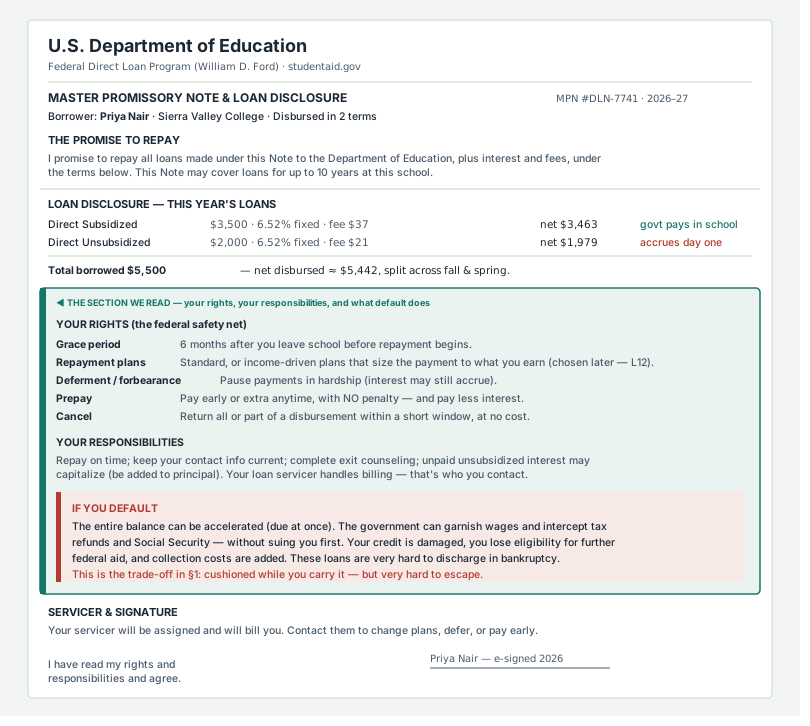
This is the whole MPN-and-disclosure package, and unlike the award letter (which obscured), this document is fairly honest — its danger is that it's signed so fast no one reads it. Top to bottom it has the masthead (the U.S. Department of Education, the Direct Loan Program), the promise to repay (the core legal commitment, covering loans for up to ten years), the loan disclosure (Priya's specific loans, with the §5 and §7 mechanics now stated in writing — the fixed rate, the origination fee, the net disbursed, and which loan accrues from day one), the tinted rights and responsibilities with the default consequences in red, and the servicer and signature block.
Two things are worth seeing before the field-by-field breakdown. First, the loan disclosure quietly confirms everything §5 and §7 taught: Priya borrows $5,500 but, after the 1.057% origination fee, only about $5,442 is disbursed — and the two loans are flagged differently, the subsidized one "govt pays in school" (in teal) and the unsubsidized one "accrues day one" (in red). The cost layers aren't hidden here; they're itemized. The document is doing its job — the comprehension gap is the reader's, which is exactly what the breakdown closes.
Second, and more important, the tinted section is the §1 paradox in contract form — and it's the part students never read. The rights half is the federal safety net made concrete: a six-month grace period, income-driven repayment plans, deferment and forbearance for hard times, the right to prepay with no penalty, and a cancellation window. The default half, in red, is the teeth: the whole balance can be accelerated, and the government can garnish wages and intercept tax refunds and even Social Security without first suing — powers no ordinary creditor has — plus credit damage, loss of further aid, added collection costs, and the near-impossibility of bankruptcy discharge. Read together, the two halves are the lesson's defining tension: a federal loan is the most cushioned consumer debt while you carry it responsibly, and the most inescapable if you don't. Priya signing her name is agreeing to both at once — which is precisely why understanding the rights (so she can use the cushion) and the consequences (so she avoids the teeth) matters far more than the rate she barely glanced at. The §11 breakdown takes every field apart — the promise, the disclosed cost, each right, each responsibility, and each default consequence — in the bulleted reading-order format the methodology specifies. That's next.
11. Document Walkthrough 2 — field-by-field breakdown
Masthead — "U.S. Department of Education · Federal Direct Loan Program (William D. Ford)." What it is: the federal lender and the specific program. What it does for Priya: confirms this is a federal loan, which is the single fact that attaches both the safety net below and the federal collection powers. Why it matters: it's the §2 divide in one line — because the masthead says "Department of Education," Priya gets income-driven repayment, deferment, and forgiveness and is subject to wage garnishment on default; a private lender's masthead would mean neither the cushion nor the teeth. ↳ Confirm it actually says "Federal Direct" — predatory private lenders sometimes mimic federal branding to look official.
The promise to repay — "I promise to repay all loans made under this Note… up to 10 years at this school." What it is: the core legal commitment. What it does: binds Priya to repay everything borrowed under this one note — and, because it's a master note, it covers future years' loans at the same school without re-signing. Why it matters: the convenience of signing once can mask accumulation — each year's loan attaches automatically (with a fresh disclosure but the same note), so Priya should track her cumulative borrowing herself rather than assume "I only signed once" means "I only borrowed once." ↳ "Master" = one signature, many loans over years; the balance grows year to year even though you sign only at the start.
Loan disclosure — "Subsidized $3,500 / Unsubsidized $2,000 · 6.52% fixed · fee $58 · net disbursed ≈ $5,442." What it is: this year's specific loans with the §5 and §7 cost layers now in writing. What it does for Priya: states her fixed rate (which she can't change or shop), the origination fee (so $5,442 of her $5,500 actually reaches the school), and which loan accrues from day one. Why it matters: this is where the three cost layers become personal and verifiable — and the doc-specific job is to check these against what she accepted on the award letter, because amounts and loan types are occasionally mis-entered, and an error caught here is trivial to fix while one caught at repayment is not. ↳ "Net disbursed" is less than "borrowed" (the origination fee, §7), and the unsubsidized line is already growing (§5) — the loan is bigger than it looks the moment she signs.
Grace period — "6 months after you leave school before repayment begins." What it is: the gap between leaving school and the first bill. What it does: gives Priya half a year to find work and get settled before payments start. Why it matters: it's a genuine cushion, but a quiet trap hides in it — interest keeps accruing during grace on her unsubsidized loan, so the balance can grow before she's made a single payment; the grace period is breathing room, not a pause on the meter. ↳ Grace is not interest-free for unsubsidized loans — paying the interest during grace, like during school, stops the balance from growing.
Repayment plans — "Standard, or income-driven plans that size the payment to what you earn (chosen later — L12)." What it is: the menu of how she'll eventually repay. What it does for Priya: tells her she isn't locked into one fixed payment — she can choose, including income-driven plans that cap the payment at a share of her income. Why it matters: this is the biggest single reason federal beats private (§2) — if Priya earns little after graduating, an income-driven plan keeps the payment affordable and a private loan offers nothing comparable, which is precisely why the federal safety net is usually worth more than a slightly lower private rate. The mechanics are Lesson 12; the right is established here. ↳ Income-driven repayment is the cushion private loans lack — knowing it exists is what makes federal borrowing lower-risk than its rate suggests.
Deferment / forbearance — "Pause payments in hardship (interest may still accrue)." What it is: the right to temporarily stop payments. What it does: lets Priya pause during unemployment or hardship without defaulting. Why it matters: it's a real protection private loans rarely match, but the caveat is essential — interest usually keeps accruing during the pause and may capitalize, so a forbearance solves a cash-flow crisis while quietly enlarging the balance; it's a tool for genuine hardship, not a convenience to lean on. ↳ Pausing payments is not pausing interest — the balance grows while paused, so use it sparingly.
Prepay — "Pay early or extra anytime, with NO penalty." What it is: the right to pay ahead. What it does: lets Priya pay extra or pay off early to cut interest. Why it matters: federal loans never penalize early payoff, so every extra dollar reduces principal and lifetime interest — and paying the unsubsidized interest during school (§5) is simply this right exercised early. The one practical wrinkle: she should tell the servicer to apply extra payments to principal, or they may just push her next due date forward instead. ↳ No prepayment penalty means extra payments always help — but specify "apply to principal" so it actually reduces the balance.
Cancel — "Return all or part of a disbursement within a short window, at no cost." What it is: the right to give back loan money she doesn't need. What it does for Priya: lets her decline or return part of a disbursement — say, a refund she didn't actually need — within the window, owing nothing on the returned amount. Why it matters: it's the cleanest antidote to over-borrowing, and almost no one knows it exists — if Priya took the full $5,500 but only needed $4,000, she can hand back the $1,500 promptly and it's as if she never borrowed it. ↳ You can return loan money you didn't need — the direct cure for the tempting refund check that funds lifestyle instead of school.
Responsibilities — "Repay on time; keep your contact info current; exit counseling; unpaid interest may capitalize; the servicer handles billing." What it is: Priya's obligations. What it does: spells out what she must do — pay, stay reachable, complete exit counseling, and understand that unpaid unsubsidized interest gets added to principal. Why it matters: the most deceptively important item is "keep your contact info current," because a large share of accidental defaults happen when borrowers move, lose track of their servicer, and simply never receive the bills — staying reachable is a real defense against defaulting by inattention. ↳ Many "I didn't know I owed" defaults trace to lost contact with the servicer — update your info every time you move.
If you default (the danger block) — "the balance is accelerated; wages, tax refunds, and Social Security can be taken without suing you; credit damaged; further aid lost; collection costs added; very hard to discharge in bankruptcy." What it is: the consequences of not paying. What it does: states the federal teeth — the whole balance comes due at once, and the government can garnish wages and intercept tax refunds and Social Security without a court judgment. Why it matters: this is the §1 inescapability written down, and the contrast with the rights just above it is the entire point of the document — the same federal status that gives Priya the cushion also gives the government extraordinary collection power if she falls through it. But the honest takeaway isn't fear; it's that because the cushion exists, default is almost always avoidable: a borrower generally reaches these teeth only by failing to use — or losing track of — the income-driven plans, deferment, and servicer contact that would have prevented it. ↳ Default is largely avoidable precisely because of the rights above it — the teeth are for those who don't use the cushion, which is why reading this section is the defense.
Servicer & signature — "your servicer bills you; Priya e-signs that she's read her rights and agrees." What it is: the billing contact and her binding signature. What it does: assigns the company she'll deal with for the life of the loan, and makes the note enforceable. Why it matters: the servicer is Priya's single most important contact for the next decade — every plan change, deferment request, and early payoff runs through them — and the signature binds her to the whole paradox at once: the cushion and the teeth, the rights and the responsibilities. Signing isn't agreeing to a rate; it's agreeing to both halves of what a federal loan is. ↳ Know your servicer's name and keep their contact saved — it's who you call for everything, and losing them is how people drift into default.
Read whole, the Master Promissory Note is the §1 paradox in legal form: a debt that is simultaneously the most cushioned consumer obligation in this course — grace, income-driven repayment, deferment, penalty-free prepayment, a cancellation window — and the most inescapable if those cushions go unused. The skill the document teaches is the opposite of how most students treat it: the rights section isn't boilerplate to click past, it's the most useful part, because it's full of tools (an income-driven plan, a paused payment, a returned over-borrow, an early principal payment) that keep Priya safely in the cushioned half and away from the teeth. She signed for both; reading her rights is how she gets to keep only the good half. With both documents read, the lesson turns from how borrowing works to how much — starting with the money that isn't a loan at all and should always come first: grants, scholarships, and work-study. That's §12.
12. Free money first — the cheapest "financing" of all
The single highest-leverage move in paying for school isn't choosing a better loan — it's not needing one, by exhausting money that never has to be repaid before borrowing a dollar. Every grant or scholarship dollar replaces a borrowed dollar that would otherwise come back with interest and an origination fee, so maximizing free money doesn't just feel good — it directly shrinks the debt and everything it costs. That logic gives the whole financing decision a strict order, cheapest first:
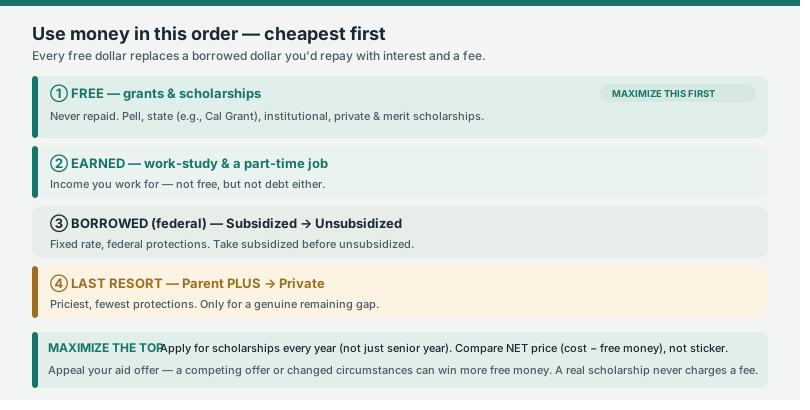
The top tier — free money — is grants and scholarships, and it's where the most money and the least effort-per-dollar live. The foundational one is the Pell Grant, federal and need-based for undergraduates, worth up to about $7,395 a year and never repaid — Priya's single largest source of free aid, awarded on her FAFSA's SAI. (The 2025 law tightened Pell eligibility at the edges, as §3 noted — an SAI at or above $14,790 now disqualifies, as does having scholarships that fully cover cost — but for most need-based students Pell is intact.) Beyond Pell sit state grants (Priya's Cal Grant, for instance), institutional grants and scholarships from the college itself, and private scholarships from foundations, employers, and community organizations — plus merit awards for grades or talent. All of it is a gift; none of it returns. The second tier, earned money, is work-study and an ordinary part-time job — income Priya works for, which the §9 breakdown carefully distinguished from both free aid and debt. It's not free (she has to show up), but it isn't borrowed either, so it reduces the loan she'd otherwise need without adding anything she repays. Only below those two tiers does borrowing begin — federal first (subsidized before unsubsidized), and Parent PLUS or private loans dead last.
Knowing the order is half the battle; maximizing the top tiers is the other half, and it's more actionable than students assume. File the FAFSA (and, where required, the CSS Profile) — it's the gate to Pell, state, and institutional aid (§3). Apply for scholarships aggressively and every year, not just as a senior — local and small awards go unclaimed all the time, they stack, and most students stop applying after freshman year exactly when many scholarships are renewable or open to upperclassmen. Compare schools by net price, not sticker price — cost minus free money — because a "pricey" college that offers large grants can genuinely cost less than a "cheap" one that offers none; the §9 net-price calculation is the right tool for choosing where to enroll, not just how to pay. And appeal the aid offer: a family can ask the financial aid office to reconsider, citing a competing offer or changed circumstances ("professional judgment"), and it sometimes yields more free money — the award letter is an opening position, not always a final one. One caution that previews the §17 predator: legitimate free money is free to pursue. A real scholarship never charges an application fee, never "guarantees" an award in exchange for payment, and never asks for bank details to "release" funds — any of those is a scam, and the search itself (through the school, Fastweb, and the like) should cost nothing.
For the three borrowers, the free-money tier separates their outcomes. Priya is the success case the whole hierarchy is built for: at a low-cost community college, her Pell Grant plus a Cal Grant cover most of her bill, leaving her borrowing little or nothing — proof that free money first plus a modest-cost school can make a degree nearly debt-free. Tasha already has $12,000 in free aid against her $28,000 cost (§9), but the lever to shrink her $13,500 of offered debt is right here: more outside scholarships, an appeal to the aid office, and a hard look at net price could each chip the borrowing down before she ever signs an MPN. And Marcus faces the tier's hardest version, because graduate students get no Pell Grant — the federal grant is undergraduate-only. His free-money equivalent is the assistantship or fellowship: a teaching or research assistantship that waives tuition and pays a stipend in exchange for work, or a competitive fellowship, both of which function as grants for grad students. With his federal borrowing now capped and Grad PLUS gone (§4, §6), pursuing assistantships and fellowships isn't optional for Marcus — it's the most important free-money move available to him, and often the difference between a manageable grad debt and a crushing one. Free money decides how much Priya, Tasha, and Marcus need to borrow; the next section sets the discipline for how much they should — the rule for borrowing only what's necessary, and the rough test for how much debt a degree can safely carry. That's §13.
13. How much to borrow — the rule, and the test
The award letter and the loan limits both hand a student a maximum — and the most consequential mistake in student borrowing is treating that maximum as a target. The rule is the opposite: borrow only what you need, not what you're offered. A loan offer is a ceiling, and §9 and §10 established the underused right to decline part of it — Tasha can accept the grants and the subsidized loan and turn down the rest. The right amount is the net gap that remains after free and earned money, and the question to ask before signing is never "how much can I get?" but "how little can I get away with?":
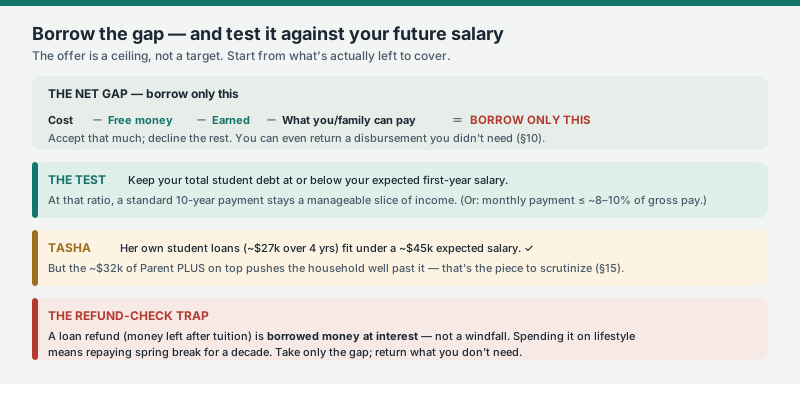
The starting point is the net gap, the panel's top strip: take the cost of attendance, subtract the free money (grants and scholarships), subtract earned money (work-study and a job), subtract whatever the student and family can genuinely pay, and what's left is the only amount to borrow. Everything above that is over-borrowing. And because the right to decline is real (§9, §10), right-sizing is a concrete action, not a wish: accept exactly the gap, decline the rest, and if a disbursement turns out larger than needed, return the excess within the window. The most common way students blow past the gap is the refund-check trap — when loans disbursed exceed the tuition bill, the school refunds the difference to the student, and that check feels like a windfall. It isn't; it's borrowed money accruing interest, and spending it on a nicer apartment, a car, or a trip means repaying that lifestyle, with interest, for a decade. The living-expense portion of the cost (§9) is the most flexible thing in the whole calculation, so living like a student — cheaper housing, used books, fewer extras, maybe living at home — directly shrinks the gap and therefore the debt, dollar for dollar.
The test for whether the resulting amount is sane is a rule of thumb worth memorizing: keep your total student debt at or below your expected first-year salary. If a graduate expects to start at $50,000, total borrowing around $50,000 or less keeps a standard ten-year payment to a manageable share of income; cross well above it and the payments start crowding out rent, savings, and life. (A tighter version aims the monthly payment at no more than roughly 8–10% of gross monthly income.) The rule isn't a law — it's a guide — and the crucial caveat is that the expected salary is a hope, not a guarantee. That's the §1 "debt without the degree" risk in budgeting form: because the loan is inescapable but the salary is uncertain, the honest move is to borrow conservatively against the salary you might earn, not optimistically against the best case — especially in uncertain fields or if there's real risk of not finishing.
The three borrowers show the rule doing different work. Priya is right-sized by circumstance — her Pell and Cal Grant cover most of community college, so she borrows little and sits comfortably under any salary test; the discipline barely has to bite because the free money and low cost did the work. Tasha is the instructive case: her own student loans, around $27,000 over four years, fit safely under a ~$45,000 expected starting salary — that part is fine. What pushes her household over the line is the $32,000 of Parent PLUS layered on top, which is exactly why the salary test flags it and why §15 scrutinizes parent borrowing specifically: the student's loans pass the test while the family's total fails it, and the failing piece is the parent debt. And Marcus faces the rule's hardest application — graduate and professional debt is large by nature, so the test becomes a program-ROI question: borrowing $70,000 for a path that pays $75,000 to start roughly passes, while borrowing $120,000 for a field that pays $55,000 fails badly, and the rule is telling him to weigh the program's return, not just whether he can get the loan. The salary test turns "how much can I borrow?" into "how much will this education actually let me repay?" — which is the right question. Right-sizing decides the amount; the remaining decision is the source of any gap that's left after federal loans run out — which means returning to the federal-vs-private choice in depth, now that the limits and costs are on the table. That's §14.
14. Deciding on private — the sequence, the cosigner, and the cautions
Section 2 drew the federal-vs-private line; this section turns it into a decision. The key move is to recognize that "federal or private?" is rarely the real question — the real question is where private fits in a sequence, and the answer is "dead last, and only for a genuine gap." Here's the sequence, and the cautions for the rare case private is warranted:
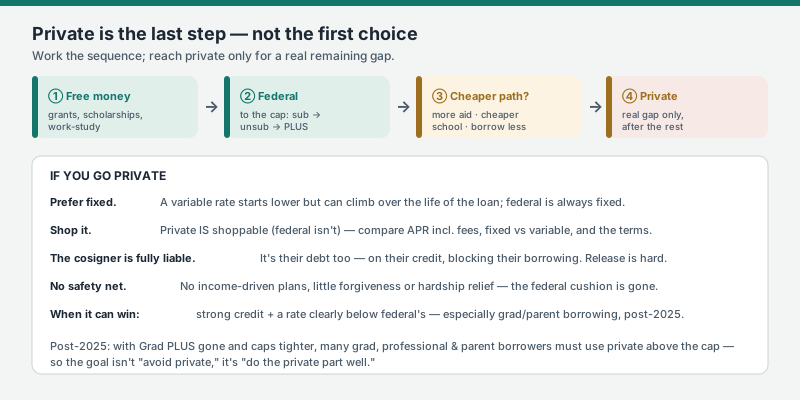
The sequence is the spine, and it puts private exactly where it belongs. Free money first (§12), then federal loans up to the cap (subsidized, then unsubsidized, then PLUS where it still exists), then — before reaching for a private loan — a hard look at the cheaper paths: more scholarships, an appeal, a less expensive school, or simply borrowing less. Only after all of that, for a genuine remaining gap, does private enter. The reason for the ordering is everything §2 established: private loans are credit-priced, cosigner-dependent, and stripped of the federal safety net, so they're the riskiest financing and therefore the last one to use. A family that jumps to a private loan to avoid the "hassle" of the FAFSA, or because a glossy ad offered a low teaser rate, has skipped three cheaper, safer steps.
There are honest cases where private makes sense, and they're narrow: when federal options are genuinely exhausted and a real gap remains; when the borrower or a cosigner has strong enough credit to get a rate meaningfully below the federal rate — which matters more now that federal grad and PLUS rates sit in the 8–9%+ range, so a well-qualified borrower might find a private fixed loan at 6–7%; and when the borrower is confident they won't need the federal protections (stable income, a short payoff horizon, no plan to pursue forgiveness). Outside those conditions, the federal protections usually outweigh a modest rate advantage.
The biggest caution is the cosigner, because most students can't qualify for a private loan on their own thin credit and so need one — usually a parent. The thing to understand is that a cosigner is fully and equally liable for the entire debt — it is, functionally, their loan too. It appears on the cosigner's credit report, counts against their debt-to-income ratio (so it can block the parent's own borrowing, for a mortgage or car), and if the student misses payments or defaults, the lender pursues the cosigner directly. Lenders advertise cosigner release — getting the parent off the loan after the student builds a payment history — but it's notoriously hard to actually obtain, with strict requirements and low approval rates, so no one should sign counting on it. And the human cost is real: a cosigned loan gone bad can damage both people's credit and the relationship between them. (Borrowers should also check the death-and-disability terms; historically some private loans pursued the cosigner or accelerated the balance if the student died, though many lenders have softened this.)
Two more practical points. The variable-rate risk: private loans often dangle a low variable rate that starts below the fixed option but can climb over the loan's life — unlike federal's permanently fixed rate — so if going private, strongly prefer fixed, and treat a variable rate as a gamble, not a deal. And unlike federal loans, private loans are shoppable — there's no single set rate — so the move is to compare lenders, getting prequalified rates (soft credit pulls), and to compare the APR including fees, fixed-vs-variable, the repayment terms, the cosigner-release policy, and any hardship or deferment options. The protections gap is the constant backdrop: private rarely offers income-driven repayment, forgiveness, or generous deferment, so the borrower is largely on their own if income falls.
The post-2025 reality reframes the whole decision for many borrowers, and it's the panel's closing line. With Grad PLUS eliminated and the federal caps tightened, private lending is no longer optional for many graduate, professional, and parent borrowers — the federal door simply closes at a ceiling below what their program costs. So for them the question stops being "federal or private" and becomes "capped federal plus private for the rest," and the skill shifts from avoiding private to doing the private part well: fixed rate, the strongest available cosigner (or none, if they qualify alone), shopped hard, terms read closely. The three borrowers map onto this cleanly. Priya never reaches step four — she's within federal limits and may never face a private loan at all. Tasha's family hits a gap and must weigh a federal Parent PLUS loan (with its 4.228% fee and 9.07% rate, but some federal protections) against a private parent loan that might price lower with strong credit but offers less cushion — a genuine §15 decision. And Marcus, post-2025, has no Grad PLUS and a capped federal loan, so private isn't a choice but a necessity for his gap — making "do it well" his entire task, and the rate-comparison potentially in his favor if his credit is strong. Tasha's family decision points straight at the next section, because the most common — and most quietly risky — way families bridge the gap is parent borrowing. What Parent PLUS really costs a parent, what the new cap changed, and the alternatives, is §15.
15. Parent borrowing — an act of love that needs a rule
When the student's own federal loans run out and a gap remains, the most common bridge is a Parent PLUS loan — a federal loan taken out by the parent of a dependent undergraduate. The defining fact, and the source of all its risk, is in that sentence: the parent is the borrower and is fully liable. This is not the student's debt with a parent helping; it is the parent's debt, on the parent's credit, repaid by the parent — often at an age when they should be saving for retirement, not signing up for a decade-plus of new payments. It deserves its own section because it's where love and finance collide, and where families do real, lasting harm out of the best intentions:
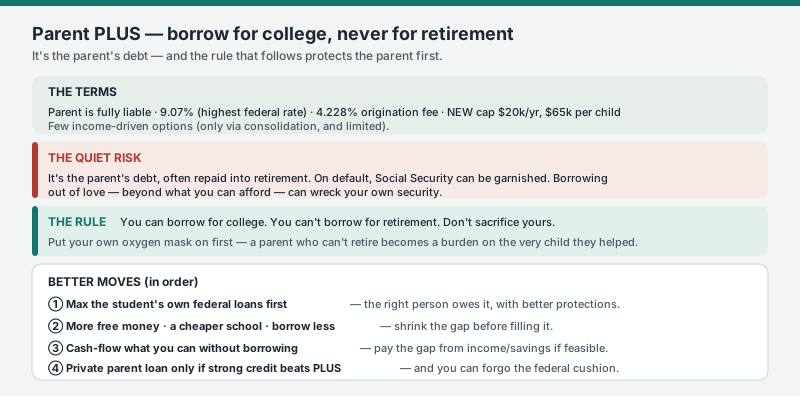
The terms explain why Parent PLUS is an expensive bridge. It carries the highest federal rate — 8.94% for 2025–26, rising to 9.07% for 2026–27 — and the steep 4.228% origination fee (so on a $20,000 loan, about $846 is skimmed before the money reaches the school, per §7). It requires a check for adverse credit history, though not a score-based underwrite, so most parents qualify. The 2025 law added a cap where there used to be none: $20,000 per student per year, $65,000 per dependent total, replacing the old "borrow up to the full cost of attendance." And crucially, Parent PLUS loans have few income-driven repayment options — they're not directly eligible for most of the affordable plans a student's loans can use, and reaching even a limited one requires consolidating first. So a parent gets the high rate and the high fee with less of the federal safety net than their child's own loans carry.
The quiet risk is the part families rarely weigh until it's too late. This is debt a parent will often be repaying into their retirement years, at exactly the stage of life when the financial priority should be building security, not taking on a decade of new payments — and because it's a federal loan, the §1 teeth apply to parents too: on default, the government can garnish a portion of Social Security benefits, a genuinely frightening prospect for a retiree. The deeper danger is emotional, not mechanical. Parents borrow for their children out of love, and that love can quietly override the math — "I'll do whatever it takes for my kid" leads a parent to borrow well beyond what they can actually afford, sacrificing their own retirement to fund the gap. And there's a cruel irony in it: a parent who can't afford to retire becomes a financial burden on the very child they were trying to help. The sacrifice can boomerang.
That's why this section has a rule, and it's the one to remember: you can borrow for college, but you cannot borrow for retirement. A student has decades of earning ahead and federal protections on their own loans; a parent nearing retirement has neither the runway nor the safety net. So the parent must put their own oxygen mask on first — protecting retirement savings is not selfish, it's the responsible move that keeps the parent from becoming a dependent later. A parent who would have to raid retirement contributions, or borrow at 9%+ into their seventies, to fund a Parent PLUS loan is being told no by this rule, however much the love says yes.
The better moves follow that rule, in order. First, max the student's own federal loans before the parent borrows a dollar — it's the student's education, the student has the longer horizon, and the student's loans carry the income-driven repayment and other protections that Parent PLUS lacks, so the right person ends up owing the debt with the better terms. Second, shrink the gap before filling it — more scholarships, an aid appeal, a cheaper school, or simply borrowing less (§12, §13), which is almost always better than financing the gap at 9%. Third, cash-flow what's feasible — a parent who can pay part of the gap from current income or savings without borrowing avoids the rate and fee entirely. And only fourth, if a parent has strong credit and can get a private parent loan at a rate clearly below Parent PLUS, and can forgo the (limited) federal protections, does private borrowing make sense — the same §14 logic, applied to the parent.
For Tasha's mother, this is a real and tender decision. Her award letter offered $8,000 a year in Parent PLUS — $32,000 over four years — to close Tasha's gap. The new $20,000 annual cap doesn't bind her at $8,000, but the $65,000 lifetime ceiling would if Tasha has siblings, and the real question isn't whether she can borrow it but whether she should. At 9.07% plus the 4.228% fee, that $32,000 will cost well over $40,000 to repay, on her credit, likely past her sixtieth birthday. The rule asks her, gently but firmly: does this borrowing threaten her retirement? Could Tasha take a bit more of her own (better-protected) federal loan, or could a cheaper housing choice or another scholarship shrink the gap, so her mother borrows $4,000 a year instead of $8,000 — or nothing? There's no shame in a parent wanting to help, and for a family that can comfortably afford it, Parent PLUS is a legitimate tool. But for many families, the healthier structure is the student carrying their own modest, protected debt while the parent guards the retirement that protects them both. Helping with college should never mean mortgaging the years when the help is supposed to flow the other way. Once the borrowing decisions are made — federal first, free money maximized, the gap right-sized, the parent's retirement protected — the money actually moves, and a new set of mechanics begins: how the loan is disbursed, the grace period before the first bill, and the interest that's already accruing. That's §16, the bridge to repayment and to Lesson 12.
16. After you borrow — how the money moves, and what comes next
Signing the Master Promissory Note isn't the end of the borrowing story; it's the start of a sequence that runs from disbursement through school and a grace period into repayment — and each stage has a mechanic worth understanding, because mistakes here (a spent refund check, an ignored servicer, capitalized interest) quietly enlarge the debt. Here's the path the money takes:
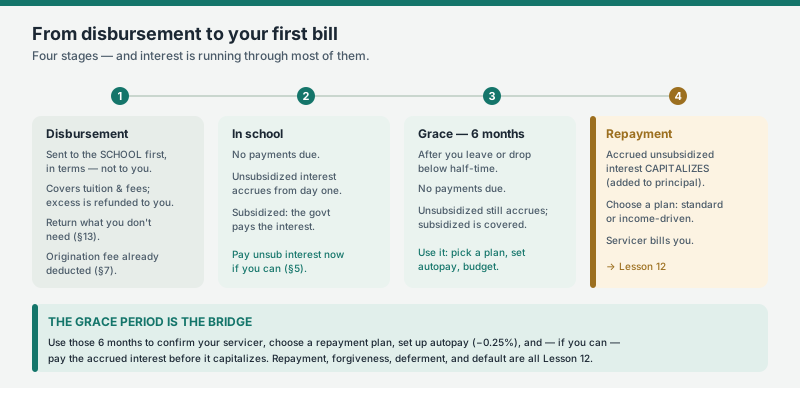
Disbursement is the first surprise for many borrowers: the loan money doesn't come to you, it goes to the school first, usually split across terms (often two disbursements for a two-semester year). The school applies it to what it's directly owed — tuition, fees, and on-campus room and board — and only if the loan plus other aid exceeds those charges does the school refund the difference to the student as a credit balance, meant for other education costs like off-campus rent, books, and supplies. That refund is the §13 trap in the flesh: it feels like a check arriving in the mail, but it's borrowed money accruing interest, and the right move is to take only what's genuinely needed and return the rest using the cancellation right from §10. Remember too that the origination fee (§7) is skimmed before disbursement, so the school receives slightly less than the borrowed amount — and first-time freshmen sometimes face a 30-day delay on their very first disbursement. For Priya, her roughly $5,442 net flows to her college in two installments; for Tasha, the larger disbursement means a larger potential refund and a larger temptation to treat it as spending money.
In school, no payments are due — but the meter described in §5 is running. The unsubsidized portion accrues interest from day one, while the subsidized portion has its interest paid by the government. This is the window to do the single most valuable optional thing: pay the unsubsidized interest as it accrues if you possibly can, which keeps the loan from growing. The grace period that follows — typically six months after leaving school or dropping below half-time — extends the no-payment window to give the borrower time to find work and get settled. But it is not an interest holiday: on unsubsidized loans, interest keeps accruing right through grace (the government covers the subsidized portion through grace as well). So the grace period is genuine breathing room, not a pause on the balance — which is exactly why it's the bridge the panel highlights, the time to confirm the servicer, choose a repayment plan, set up autopay for the 0.25% discount, build the first payment into a budget, and ideally pay down the accrued interest before the next stage hits.
That next stage is repayment, and it opens with the mechanic §5 warned about: when repayment begins, accrued unpaid interest on unsubsidized loans is typically capitalized — added to the principal — so the borrower starts repaying a larger balance and pays interest on that interest. (The rules on exactly which events trigger capitalization have been narrowed in recent years, but entering repayment with unpaid accrued interest remains the classic moment it happens.) The defense is the same one from §5: pay that interest off before this point, during school or grace, and there's nothing to capitalize. From here the borrower chooses a repayment plan — the standard ten-year plan by default, or an income-driven plan that sizes payments to earnings — and the assigned servicer begins billing. Everything past this line is Lesson 12's territory: the repayment plans in detail (including the 2025 law's overhaul of the plan menu), forgiveness pathways like Public Service Loan Forgiveness, deferment and forbearance, and what happens in default and how to recover from it. The grace period is the literal handoff between the two lessons — borrowing ends, repayment begins.
The action items across this whole bridge are worth collecting, because they're where a borrower protects themselves. In school: borrow only what's needed, and pay unsubsidized interest if possible. Throughout: know your servicer and keep your contact information current — §11's reminder that a huge share of accidental defaults trace to borrowers who simply lost touch and stopped getting bills. At graduation: complete exit counseling, choose a repayment plan deliberately rather than drifting into the default, and set up autopay. During grace: budget for the first payment and pay down accrued interest before it capitalizes. The three borrowers carry different weights across the bridge — Priya's subsidized portion sails through grace untouched while her small unsubsidized balance needs only modest attention; Tasha must resist the refund-check temptation at every disbursement; and Marcus, whose entire grad balance is unsubsidized and accruing, faces the largest capitalization at repayment and the strongest reason to pay interest early — and walks straight into Lesson 12's post-2025 repayment landscape. The remaining sections of this lesson turn from mechanics to protection: the predators who target student borrowers, and how to report them. That's §17.
17. Predator Watch — who targets student borrowers
Student borrowers are a predator's ideal target: young, often first in their family to navigate a deliberately confusing system, sitting on a gap between cost and aid, and holding access to large sums of federal money. Three patterns work that vulnerability — and they're distinct from every predator in this course so far. Tasha, as a first-generation student, fits the recruiters' profile almost exactly:
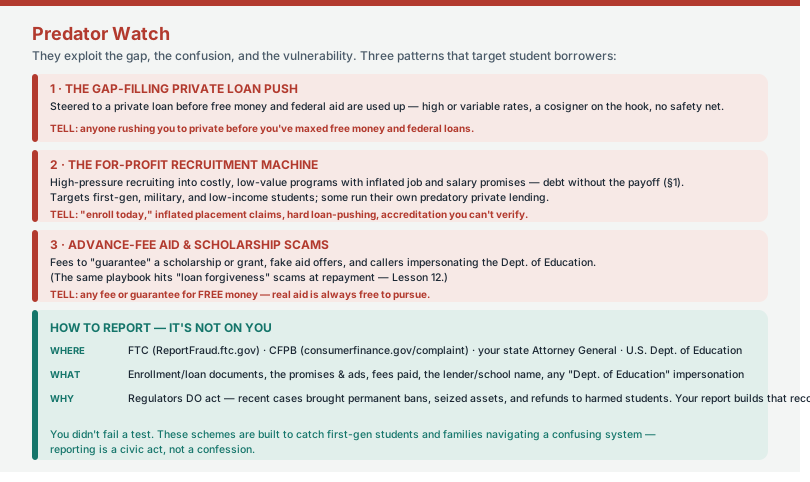
The first pattern is the gap-filling private loan push, and it's predatory not because private loans are inherently evil (§14 allowed they sometimes make sense) but because of the timing and the steering. A student with a gap is vulnerable to anyone who offers to make it disappear fast — and a lender, or a school's "preferred lender" desk, that rushes Tasha toward a private loan before she's exhausted free money and federal aid is selling her the most expensive, least-protected option as if it were the only one. The whole §12–§14 sequence — free money, then federal, then a hard look at cheaper paths — exists to be skipped, and the push is the skipping made profitable. The tell is clean: anyone hurrying you into a private loan before you've maxed free money and federal loans is serving their interest, not yours.
The second pattern is the for-profit recruitment machine, and it weaponizes the §1 risk directly — debt without the degree's payoff. Predatory for-profit schools aggressively recruit students into high-cost, low-value programs with inflated promises about jobs and salaries, and the documented targets are exactly the most vulnerable: first-generation students, military families, low-income students, and students of color — Tasha's demographic. The model loads students with debt for credentials that don't deliver the earnings that were supposed to repay them, and in some cases the school runs its own predatory private lending operation to finance the very tuition it's charging — a closed loop where the "school" profits twice, on tuition and on the loan. The tell here is behavioral: high-pressure "enroll today" recruiting, inflated job-placement and salary claims, hard loan-pushing, and accreditation you can't independently verify. A legitimate school doesn't need to rush you, and its outcomes are publicly checkable; a recruiter who manufactures urgency and won't let you verify the claims is selling debt, not education.
The third pattern is the advance-fee aid and scholarship scam, and it's defined by a single impossible promise: paying for free money. These schemes charge a fee to "guarantee" a scholarship or grant, run fake aid-application services, or have callers impersonate the U.S. Department of Education to collect "processing" fees or personal data. The enforcement record makes how prevalent — and how punished — this is vividly clear: the FTC has been shutting these operations down through 2025 and into 2026, and the details are instructive. In one case, the operators of Panda Benefit Services and affiliates pretended to be affiliated with the Department of Education, falsely guaranteed loan forgiveness, and collected more than $16.7 million in illegal advance fees before being permanently banned from the debt-relief industry and ordered to turn over their assets — and the FTC has since been sending refund money back to harmed borrowers, with new restraining orders against similar schemes entered as recently as April 2026. That enforcement targets mostly the repayment-side "forgiveness" version of the scam (Lesson 12's territory), but it runs on the identical playbook the borrowing-side scholarship scam uses — advance fees, false Department of Education affiliation, guarantees — so the tell transfers exactly: any fee or guarantee attached to free money is a scam, because real aid is always free to pursue. The FTC itself puts the rule simply: it will never demand money, make threats, or promise a prize.
That enforcement record is also why reporting these schemes is worth doing and carries no shame — the how-to-report panel is styled as the constructive civic act it is. If Tasha gets caught — pushed into a needless private loan, recruited into a debt-loaded program on false promises, or charged a fee for "guaranteed" aid — she can report it to the FTC (ReportFraud.ftc.gov), the CFPB (consumerfinance.gov/complaint, including its student-loan ombudsman), her state Attorney General, and the U.S. Department of Education for federal-aid fraud. She should keep her enrollment and loan documents, the recruiter's promises and the ads, any fees paid, the lender or school name, and any instance of someone falsely claiming Department of Education affiliation. And the reason to do it is concrete, not abstract: regulators act on these reports — the cases above ended in permanent bans, seized assets, and actual refund checks to victims — so a complaint feeds the record that stops the operation and protects the next student. The frame the whole course holds applies most sharply here: Tasha didn't fail a test. These schemes are engineered to catch first-generation students and families navigating a confusing system for the first time; being targeted is evidence of the design, not of any failing of hers, and reporting it is repair, not confession. For anyone the warning reached too late — who already signed the needless private loan, enrolled in the program, or paid the fee — the next section is the calm, concrete counterweight: the reassurance beat, with the real resources to get unstuck. That's §18.
18. Reassurance — if the warning reached you too late
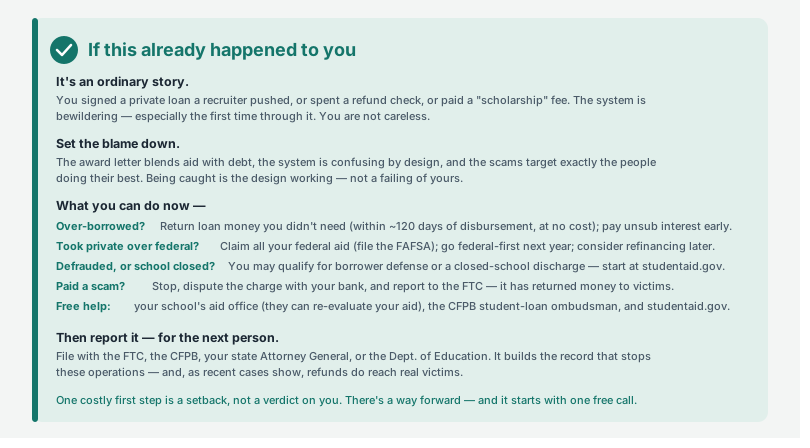
If you're reading this having already made one of these moves — you took the private loan a recruiter pushed before maxing your federal aid, you spent a refund check that was really borrowed money, you enrolled in a program that didn't deliver, or you paid a "guaranteed scholarship" fee — the first thing to hear is the gentlest: this is an ordinary story, not a personal failure. The financial aid system is genuinely bewildering, and it's hardest of all the first time through, with no one in the family who's navigated it before — which is precisely Tasha's situation, and millions of others'. The award letter itself blended grants with loans and announced "$0 remaining" over $13,500 of debt (§9); the recruiters and scam operators target exactly the students doing their earnest best to figure it out. Being caught in any of this is the system and the schemes working as designed, not evidence that you did something wrong.
So set the self-blame down, because it only keeps you stuck. "I should have read it more carefully," "I should have known that loan was a bad deal" — that instinct points at the wrong culprit. The deck was stacked: confusing documents, manufactured urgency, false Department of Education affiliation, promises engineered to be believed. Holding the shame is what stops people from taking the next steps, which are real and start now.
Here is what you can actually do, and each step is concrete. If you over-borrowed, you have a powerful and little-known right: you can return federal loan money you didn't need, generally within about 120 days of disbursement, at no interest or cost (§10) — and even past that window, paying down unsubsidized interest before it capitalizes (§5, §16) limits the damage. If you took a private loan when federal aid was available, you usually can't swap it retroactively, but you can make sure you've claimed all the federal aid you're entitled to — you can still file the FAFSA for the current year — switch to federal-first for future years, and explore refinancing the private loan later if your credit improves (Lesson 12). If a school defrauded you or closed while you were enrolled, you may qualify for borrower defense to repayment or a closed-school discharge of your federal loans — real federal remedies you start at studentaid.gov. If you paid a scam, stop paying immediately, dispute the charge with your bank or card issuer (recent charges can sometimes be reversed), and report it to the FTC — which, as the §17 cases showed, has actually returned money to victims. And underneath all of it, free help exists: your school's financial aid office can re-evaluate your aid and correct an over-borrow ("professional judgment"); the CFPB's student-loan ombudsman helps with student-loan problems at no charge; and studentaid.gov is the official federal site where everything a scam tries to charge you for is free. For the underlying budget, the NFCC (1-800-388-2227) offers free nonprofit counseling.
And when you're steadier, report it — for the next person. File with the FTC (ReportFraud.ftc.gov), the CFPB, your state Attorney General, or the Department of Education. It may not fully undo your own situation, but it builds the record regulators use to act — and the recent enforcement record proves that's not abstract: those reports led to permanent bans, seized assets, and refund checks reaching real students. Your stumble, reported, becomes the next student's protection. One costly first step is a setback, not a verdict on you — there's a path forward from every one of these, and it begins with a single free call: to your aid office, to the CFPB ombudsman, or to studentaid.gov. That care carries into the final substantive section, which arms you with the rights and protections behind several of those steps — what federal borrowers are entitled to, the student-loan ombudsman, cosigner release, private-loan disclosures, and the hard truths about discharge — so you know exactly what the law gives you. That's §19.
19. Protections and recourse — what you're entitled to, and what's reliable now
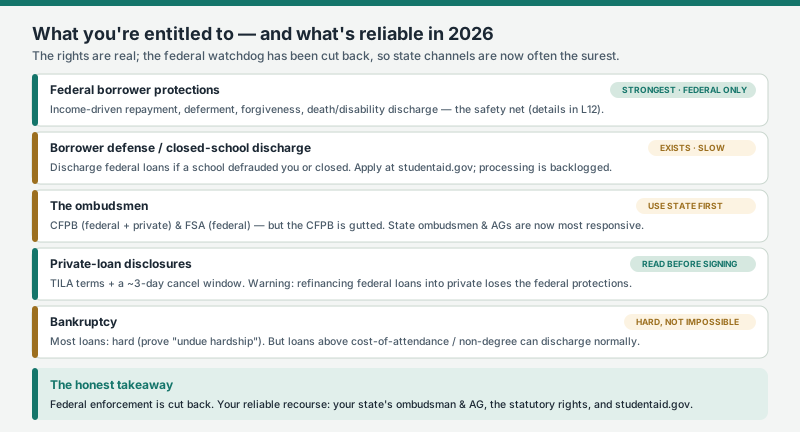
Several steps in the playbook and the reassurance beat rested on rights, and this section names them — along with a clear-eyed read of which ones actually have muscle behind them in 2026, because, as with Lesson 10's high-cost-credit protections, the most dependable recourse is no longer the federal agency you'd expect:
The strongest protections are the federal borrower protections — income-driven repayment, deferment and forbearance, forgiveness pathways, and death-and-disability discharge — the safety net that §2 called the decisive reason to choose federal over private. These are largely written into law (the Higher Education Act), and while the specific repayment-plan menu was reshuffled by the 2025 budget law (Lesson 12's territory), the existence of the cushion is what makes Priya's federal borrowing fundamentally lower-risk than a private loan. The one hard limit: they attach to federal loans only — a private loan carries none of them, which is exactly why refinancing federal into private (below) is so consequential.
For students harmed by a school, two real discharge remedies exist. Borrower defense to repayment lets Direct Loan borrowers discharge debt when school misconduct — misrepresentation, fraud, breach of contract — induced their enrollment, and closed-school discharge applies if the school shut down while they were enrolled or shortly after; both are applied for at studentaid.gov, and both are the formal recourse behind §17's for-profit predator and §18's "if you were defrauded" advice. The honest caveat is in the amber tag: these are slow and administratively turbulent right now — backlogs are long, and there have been cases where a borrower received a discharge approval and then a reversal months later. The remedy is real and worth pursuing (with reconsideration rights and parallel CFPB and state-AG complaints if denied), but it isn't fast or certain.
The ombudsmen are where the 2026 reality bites hardest. By law (the Dodd-Frank Act), there's a CFPB student-loan ombudsman who handles both federal and private loan problems (file at consumerfinance.gov/complaint or 1-855-411-2372), alongside the Federal Student Aid Ombudsman for federal-loan disputes (studentaid.gov/feedback-ombudsman or 1-877-557-2575). They can help with servicer errors, misapplied payments, forgiveness denials, payment-count disputes, unauthorized withdrawals, and credit-reporting mistakes. But the CFPB has been severely cut back under the current administration — for part of 2025 there was no ombudsman at all, a new one was designated in January 2026 just as the agency's capacity collapsed, and this came exactly as the office logged a record number of student-loan complaints. Response times are now unpredictable. The practical consequence — the panel's "use state first" tag — is that state student-loan ombudsmen and state attorneys general are frequently the most responsive channel now: a number of states have their own student-loan advocates (in AG offices or financial regulators), and with the federal watchdog hobbled, the state route often gets a faster answer. This mirrors Lesson 10's lesson exactly: when federal enforcement recedes, the durable recourse moves to the states.
On the private-loan side, the protections are mostly disclosure protections plus a cancellation window. Private student loans carry Truth-in-Lending disclosures (rate, APR, fees) and a series of required disclosures culminating in a right to cancel within about three business days of the final disclosure — a real off-ramp if a borrower has second thoughts. Cosigner-release policies must be disclosed (though they remain hard to actually obtain, per §14). And the single most important private-loan warning is the one in the panel: refinancing federal loans into a private loan permanently forfeits all the federal protections — the income-driven plans, the forgiveness, the discharges. The CFPB's own supervision found private lenders misleading borrowers on exactly this point, plus wrongly denying disability discharges and falsely claiming borrowers were ineligible for autopay discounts — so a borrower considering a private refinance (a Lesson 12 decision) should treat the loss of federal protections as the central cost, and any lender downplaying it as a red flag.
The bankruptcy reality deserves the nuance the panel flags, because the common belief — "student loans can never be discharged in bankruptcy" — is too absolute. For most federal loans and for qualified private education loans (those for cost-of-attendance at eligible schools), discharge is genuinely hard: the borrower must prove "undue hardship," a high bar — though recent federal guidance has made the process more defined, and discharges, while difficult, are not impossible. But there's a crucial exception most people never hear: loans that are not "qualified education loans" — for instance, private loans made in excess of the cost of attendance, or loans for non-degree programs and certain bootcamps — can be discharged in standard bankruptcy like ordinary unsecured debt, with no undue-hardship showing required. The CFPB has had to crack down on servicers who wrongly kept collecting on loans that bankruptcy had already discharged. So the accurate statement is: most student debt is hard (but not impossible) to discharge, while over-borrowed and non-degree private loans may be far more dischargeable than borrowers realize — a distinction worth knowing for anyone in genuine distress.
That points to the honest takeaway, the teal band and the through-line with Lesson 10: the rights are real, but federal enforcement capacity has been cut back, so the reliable recourse is increasingly close to home — your state's student-loan ombudsman and attorney general, the statutory rights themselves (which exist regardless of who's enforcing them), and studentaid.gov, the official free federal site where the legitimate version of everything the scams charge for actually lives. For the three borrowers: Tasha, if a school defrauds her, has borrower defense (slow but real); Marcus, weighing private loans, must treat "refinancing loses federal protections" as a core warning and read the private disclosures closely; and anyone carrying over-borrowed private debt should know the bankruptcy door is less sealed than the myth suggests. The rule from Lesson 10 holds here too: in a moment when the federal floor is shifting, the protections that hold are the ones written into law and the ones closest to you — which is why this lesson spent so long teaching the documents and the rights, so each borrower can protect themselves. With the products, documents, decisions, predators, reassurance, and protections all covered, only the wrap-up remains: the questions students actually ask, and a self-check. That's §20.
20. Most common questions
"Should I take the maximum loan amount I'm offered?" No — the offer is a ceiling, not a target. Borrow only the net gap that remains after free money and earned money (§13), accept only that much and decline the rest, and remember you can even return a federal disbursement you didn't end up needing, generally within about 120 days, at no cost (§10). Every dollar you don't borrow is a dollar (plus interest and a fee) you never repay.
"My award letter says my costs are 'fully covered,' so I'm not borrowing anything — right?" Not necessarily, and this is the most important misread in the whole process. Many letters count loans (and work-study) as "aid" and proudly show "$0 remaining" even when a large slice is debt (§9). Re-sort every line into free (grants and scholarships), earned (work-study), and borrowed (loans). Your true net price is the cost minus only the free money — that's the number to compare across schools.
"Is it even worth filing the FAFSA if my family earns too much for aid?" Yes. The FAFSA is required for federal loans — including the non-need-based unsubsidized loans — for work-study, and for most state and institutional aid, not just need-based grants (§3). It's free, and not filing is the single most common costly mistake students make. File even if you're sure you won't qualify for need-based help.
"If a private loan has a lower rate than the federal loan, shouldn't I take it?" Usually not, especially as an undergrad. A slightly lower private rate rarely outweighs the federal protections you'd surrender — income-driven repayment, forgiveness, deferment (§2, §14). Federal comes first; private is for a genuine gap after federal is exhausted, and mainly makes sense when strong credit earns a meaningfully lower rate and you're confident you won't need the safety net — a calculation that tilts toward private more often for grad and parent borrowers post-2025.
"Subsidized vs. unsubsidized — does the difference really matter?" A lot. On a subsidized loan the government pays the interest while you're in school; an unsubsidized loan accrues from day one and can end up roughly $3,900 larger on a $10,000 loan by the time repayment starts (§5). Take subsidized first, and if you can, pay the unsubsidized interest while you're still in school to stop it from growing.
"I got a refund check after my loans covered tuition — is that free money to spend?" No. A refund is leftover borrowed money that's accruing interest, not a windfall — spending it on a nicer apartment or a trip means repaying that choice, with interest, for a decade (§13, §16). Take only what you genuinely need for education costs and return the rest.
"Should my parent take a Parent PLUS loan to cover the gap?" Only with real caution. It's the parent's debt, at the highest federal rate plus a 4.228% fee, often repaid into retirement (§15). Max the student's own federal loans first, shrink the gap with more free money or a cheaper school, and never let it threaten the parent's retirement security — you can borrow for college, but you can't borrow for retirement.
"Someone offered me a guaranteed scholarship — or loan forgiveness — for an upfront fee. Is that real?" No. Real aid is free to pursue — any fee or "guarantee" attached to free money, or anyone claiming Department of Education affiliation while asking for payment, is a scam (§17). The FTC has permanently banned the operators of exactly these schemes. Everything they charge for is free at studentaid.gov.
Now a quick check on the lesson's core ideas:
Check yourself
Score: 0 / 8
Pick an answer for each — you'll see the explanation right away.
1. The single most important rule for funding college is:
2. A federal loan's origination fee means:
3. The real difference between subsidized and unsubsidized loans is:
4. Your letter lists a $5,000 grant, $2,500 work-study, and a $7,000 loan, all as 'aid.' How much reduces your cost for free?
5. The 2025 law changed federal student loans by:
6. A good rule of thumb for total student debt is:
7. A caller claims to be from the Dept. of Education and wants a fee to 'unlock' your aid. You should:
8. Compared with a federal loan, a private student loan usually:
That closes the lesson's content. Step back to where it began: a student loan is an investment that's also debt that follows you, and holding both halves at once is the whole skill. Everything since has been in service of borrowing wisely rather than blindly. Priya, Tasha, and Marcus — and you — can now tell a federal loan from a private one and know why federal comes first; read the two documents that decide what's owed, separating free money from debt on the award letter and finding the rights and the teeth in the promissory note; name the loan types, the limits the 2025 law reset, and the true three-layer cost; maximize free money, right-size the borrowing against a future salary, and question parent debt that threatens a retirement; recognize the predators who target students and report them without shame; and know which protections actually hold in 2026 and where to turn. The four rules carry the whole thing: free money first, federal before private, only what you need, eyes open on the cost. Borrowed against that discipline, a student loan is an investment that pays off; borrowed blindly, it's the debt that follows you with nothing to show. The difference is exactly what this lesson set out to give you.
Key Takeaways
- A student loan has a dual nature: it's an investment in future earnings and debt that follows you harder than any other in this course — nearly impossible to discharge in bankruptcy, with government collection powers that reach wages, tax refunds, and Social Security without a court judgment.
- Federal before private is the spine of the lesson — federal loans offer fixed rates, income-driven repayment, forgiveness, and discharge protections that private loans largely can't match. The 2025 One Big Beautiful Bill Act eliminated Grad PLUS for new borrowers after July 1, 2026, and capped Parent PLUS at $20,000/year per student and graduate borrowing at $20,500/year.
- The FAFSA is the gateway to everything federal — Pell Grants, work-study, subsidized and unsubsidized loans, most state grants, and most institutional aid. File it even if you're sure you won't qualify for need-based help; not filing forfeits access to the entire federal system.
- Re-sort the award letter yourself into free (grants/scholarships), earned (work-study), and borrowed (loans). The '$0 remaining' headline counts loans as if they erase cost — your true net price is cost minus free money only, and that's the number to compare across schools.
- The true cost of a federal loan is three layers, not one: the interest rate (fixed and non-negotiable), the origination fee (1.057% for Stafford loans, 4.228% for PLUS), and — for unsubsidized loans — interest that accrues from day one and capitalizes at repayment. The sticker rate is only the first layer.
- Four rules carry the whole lesson: free money first; federal before private; borrow only the net gap after free and earned money (never the maximum offered); and understand the true three-layer cost — rate, fee, and in-school accrual — before signing. Borrowed against that discipline, a student loan is an investment that pays off; borrowed blindly, it's debt that follows you with nothing to show.
Quiz — 8 Questions
Answer one at a timeWhich of the following makes a federal student loan unlike any other debt in this course?