What Borrowing Actually Costs
APR, amortization, and the cost of money — walked through every payment, fee, and trap with Maya, Darnell, Sofia, Tomás, and Hector.
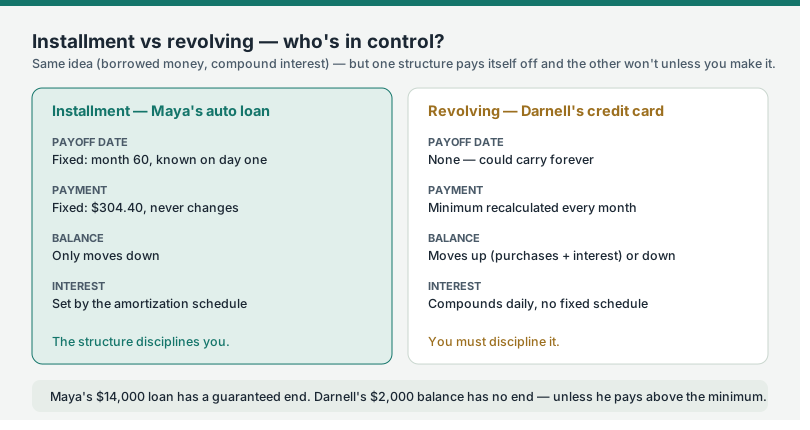
- Distinguish simple from compound interest — and understand why a fixed installment payment keeps a loan from compounding while a carried card balance compounds daily.
- Follow amortization through Maya's $14,000 loan: why each $304.40 payment shifts from mostly interest to mostly principal, and why paying extra early is disproportionately powerful.
- Read an amortization schedule field by field — Loan Summary, Payment Schedule, and Totals — and verify it cross-checks the TILA box.
- Use the APR, not the rate, to compare any two loan offers — and explain why a lower rate with a higher APR is the more expensive loan.
- Apply the term lever: pick the shortest term whose payment you can comfortably afford, and recognize when a salesperson is using the lever to hide a rising total.
- Recognize capitalization (Tomás's student loan) and the minimum-payment trap (Darnell's card), and know the specific defense for each.
- Read a credit card statement top to bottom — reconciliation, payment warning box, YTD totals, and the interest-charge calculation that shows the daily-compounding math.
- Apply the four-question cost-of-money mindset to any loan, and identify the 'low monthly payment' trap before it catches you.
What Borrowing Actually Costs
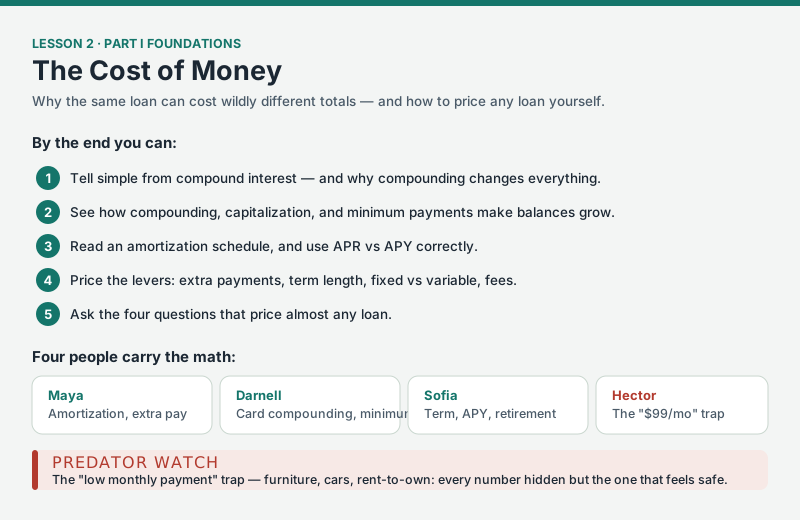
Lesson 1 gave Maya the vocabulary of a loan and taught her to read the documents one rides on. Each of those documents kept pointing at a question it couldn't answer on its own: what does this borrowing actually cost? That's this lesson.
It matters because cost is where borrowers get hurt — not through some exotic scheme, but through ordinary math they were never shown how to read. A car loan stretched an extra two years. A credit-card balance carried "just for a while." A store offer of "only $99 a month." Every one of these works the same way: it puts a small, comfortable monthly number in front of you and keeps the total out of view. The whole job of this lesson is to make that total visible — to take any monthly payment apart into its pieces, so that no pitch, no contract, and no salesperson can ever again hide the real price behind a number that merely sounds affordable.
We'll build it from the ground up, one idea at a time, each carried by someone real. The foundation is a single concept that everything else stands on, and it's worth slowing down for — so it gets the next section to itself.
What Interest Actually Is
Interest is the price of borrowing money — rent on money. When Maya borrows $14,000 from the credit union, she's using funds that belong to someone else, and she pays for that use exactly the way a tenant pays a landlord for an apartment they don't own: a fee, charged for as long as she holds it. That fee is quoted as a percentage per year — the interest rate — so an 11% rate means that, over a year, she's charged 11% of what she owes for the privilege of owing it.
It helps to know why the fee exists, because the reasons explain something that otherwise feels arbitrary: why two people borrowing the identical amount get charged different rates. There are two reasons, and every rate you'll ever see is a blend of them. The first is compensation for waiting. When the lender hands Maya $14,000, they give up the use of that money for five years — they can't spend it, lend it to someone else, or invest it during that time. Money in hand today is genuinely worth more than the same money returned years later, because of everything you could do with it in between (an idea §12 will make precise as the time value of money). The interest rate is, in part, simply the lender's price for that delay — the rent for the time, independent of any worry about Maya specifically.
The second is a risk premium. The lender cannot be certain Maya will repay — life happens, jobs end, people fall behind — so the rate carries a built-in cushion for the chance that she doesn't. This is the part that varies from borrower to borrower, and it's the entire reason Lesson 1's keystone was true: a borrower with a damaged credit file (Darnell, at 580) pays a higher rate than one with a strong file (Sofia, at 785) for the exact same loan, because the lender prices a bigger risk cushion into Darnell's rate. The "waiting" portion is roughly the same for both; the "risk" portion is what their credit history moves.
There's one distinction worth nailing down before we go further, because conflating it is where a lot of confusion starts: the rate is a percentage, but the interest is a number of dollars, and they are not the same thing. At 11% on $14,000, Maya's interest in the first year comes to roughly $1,540 — that's the rate applied to the balance she starts with. But here's the subtle part that previews the next sections: the rate stays 11% for the whole loan, yet the dollars of interest shrink every year, because each payment lowers the balance the rate is applied to. The rate is fixed; the dollar cost is not. People who think "11%" means a flat $1,540 every year are misreading the rate as if it were a fee — it isn't; it's a rate applied to a moving balance.
With interest defined as rent on money — priced by a fixed waiting component and a personal risk component, and quoted as a rate that produces shrinking dollar amounts rather than a flat fee — Maya now has the one concept everything else in the lesson stands on. The very next question is the one that decides whether a debt stays manageable or quietly runs away from a borrower: it's not how much the rate is, but how the rent is calculated. That's simple versus compound interest, and it gets its own turn.
Simple vs Compound Interest — the Difference That Decides Everything
The single most consequential idea in personal finance isn't how high a rate is — it's how the rent is calculated. There are two ways, and the gap between them is the line between a debt that stays manageable and one that quietly runs away from the person who owes it.
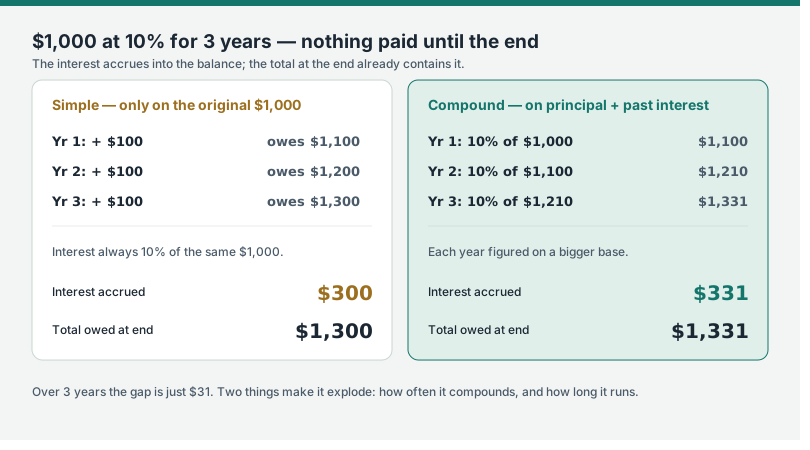
Simple interest is charged only on the original amount borrowed — the principal — and never on the interest itself. Picture $1,000 at 10% simple interest: it costs $100 the first year, $100 the second, $100 the third, forever, because it's always 10% of the original $1,000. The base never moves, so the charge never changes.
Compound interest is charged on the principal plus every dollar of interest that has already piled up — interest earning interest on itself. The same $1,000 at 10% compound costs $100 the first year, just like before. But in the second year the rate is applied to $1,100 (the original $1,000 plus last year's $100), so the charge is $110. In the third year it's applied to $1,210, so the charge is $121. Each year the base grows by the interest just added, so each year's charge is a little larger than the last — not because the rate changed, but because the thing the rate is multiplying keeps getting bigger. That's the whole mechanism: compound interest feeds on its own output.
The reason this matters so much is the shape of how the gap grows. In the early going, simple and compound look almost identical — a few dollars apart. Then the difference widens, slowly at first and then with surprising speed, because a bigger base produces bigger interest, which produces a bigger base still. Compounding is patient and then sudden. Over one year it's nearly invisible; over many years it can dwarf the original amount. Drag the time out and watch the two paths separate:
Now the part that turns this from arithmetic into a survival skill: where each kind shows up in real borrowing. Most installment loans — Maya's car loan, a mortgage, a personal loan — are structured so that a scheduled payment lands every month and pays that month's interest off before it can join the principal. As long as she pays on schedule, the interest never gets the chance to compound against her; in effect she's living in the gentle, simple-interest world, and the loan can only shrink. Revolving credit — a credit card — is the opposite. It compounds, usually daily, on whatever balance she carries, so if she leaves $2,000 sitting on a card, yesterday's interest becomes part of today's balance and earns its own interest tomorrow. That's the engine that takes Darnell's $2,000 and turns it into years of payments and thousands in interest (the story of §9–§10). The same dollar amount is dangerous on a card and tame on a car loan, purely because of how the rent is calculated.
One reframe worth carrying out of this section, because it's the same force pointed the other way: compounding is a curse when you borrow and a blessing when you save. The exact mechanism that makes a carried card balance balloon is what makes a retirement account or a high-yield savings balance grow when you're the one earning the interest — your interest earns interest, and the patient-then-sudden curve works in your favor. Borrowing and saving are two ends of one lever. The discipline this lesson is building — clear the compounding debt, then let compounding work for you — is the whole game.
How a scheduled fixed payment actually performs that knock-the-interest-down-every-month trick is the next thing to see, and it has a name: amortization. It gets its own turn.
How Often It Compounds — and Why Your Card's Stated Rate Understates the Bite
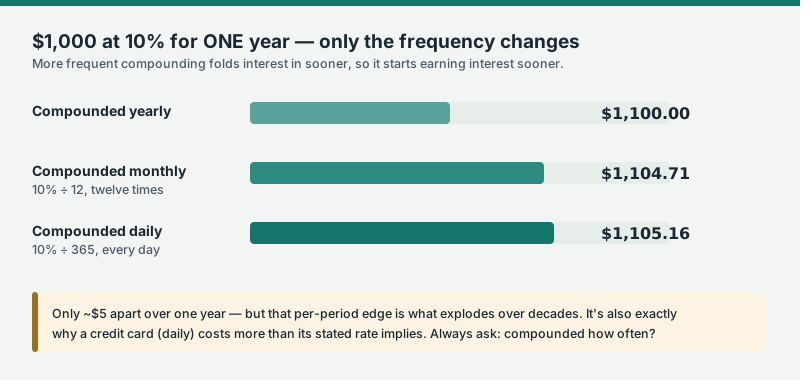
§2 settled that compounding matters. This section settles how often it happens — because the frequency is a second dial, and on a credit card it's turned all the way up. The same stated rate costs you more the more often it compounds, and a card compounds daily: the most aggressive setting in common consumer borrowing.
Here's the mechanism, in slow motion. The card takes its stated annual rate — its APR — and divides it by 365 to get a daily periodic rate. Every single day, it multiplies that tiny rate by the balance Darnell currently owes, and adds the result to the balance. The next day, it does the same thing to the new, slightly larger balance — so the interest charged on day two is figured on day one's interest too. Over a roughly 30-day billing cycle, these daily charges accumulate and compound on each other, and the total lands on his statement as that month's interest. For Darnell's card at 22.99%, the daily periodic rate is about 0.063%, which on his $2,000 balance is roughly $1.26 a day — about $38 a month, every month he carries it.
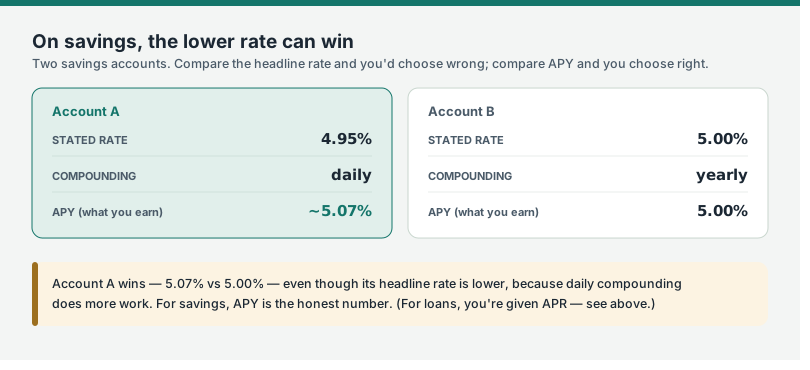
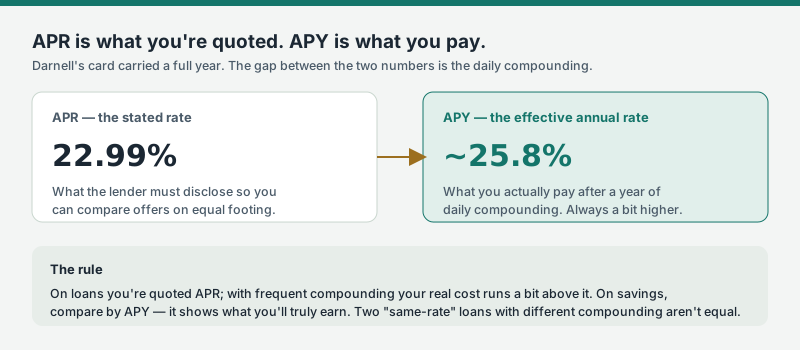
The consequence is a number the card never prints in big type: because the interest compounds daily rather than once a year, the effective annual cost is higher than the stated APR. The figure that captures this is the APY — the annual percentage yield, sometimes called the effective annual rate — and it's found by compounding the rate over all its periods: a 22.99% APR compounded daily works out to an effective ~25.8% a year. So the very same "22.99%" actually extracts closer to 25.8% from a carried balance, purely because of how often it compounds.
The two terms are worth keeping crisply apart, because the gap between them is the whole point of this section. The APR is the label — the standardized number the law makes every card print in the Schumer box (Lesson 1) so you can compare one card against another on equal footing. The APY is the bite — the effective rate that daily compounding actually extracts once you carry a balance. There's a real tension built into this: the system standardizes on APR for comparison, but a daily-compounding card means you pay closer to the APY. The wider a debt's compounding frequency, the wider that gap — and a credit card, compounding every day, sits at the harsh end of the scale.
Which points to the one clean defense, and it's the most important practical takeaway in this section: the daily engine only switches on when a balance is carried. If Darnell pays his statement balance in full by the due date, the grace period from his Schumer box makes the interest on purchases zero — the compounding never starts, and the 25.8% becomes irrelevant. The instant he carries even a small balance, though, the daily clock begins running on the whole thing. That's why "pay in full" isn't a nicety; it's the switch that keeps the most aggressive math in consumer lending turned off.
Everything so far has been about interest that shouldn't be allowed to pile up. The next section shows the reassuring opposite — how a fixed scheduled payment actively dismantles a loan, knocking the interest down before it can compound. That's amortization, and it gets its own turn.
Amortization — How a Fixed Payment Quietly Dismantles a Loan
After three sections on interest that shouldn't be allowed to pile up, here's the reassuring opposite. The word amortization comes from a root meaning "to bring to death" — and that's exactly what a properly structured loan does to itself: a fixed payment, made on schedule, kills the debt off a little at a time until nothing is left. Understanding how is what makes an installment loan feel safe instead of mysterious.
Every month, Maya's single fixed payment — $304.40 — does two jobs, in a strict order. First, it pays that month's interest, calculated as the rate applied to the balance she still owes. Second, whatever's left over pays down principal, shrinking the balance. That's the entire mechanism: interest first, principal with the remainder. In her very first month, the interest on $14,000 at 11% comes to $128.33, so $128.33 of her payment covers the rent and the other $176.07 reduces what she owes, dropping her balance to $13,823.93.
The interesting part is what happens next month, and why the loan accelerates toward payoff on its own. Because interest is charged on the remaining balance, and that balance just got smaller, next month's interest is a little less than $128.33 — which means a little more of the same $304.40 is left over for principal. That extra principal shrinks the balance a bit faster, which shrinks the following month's interest, which frees up still more for principal. The process feeds on itself in the helpful direction: the payment never changes, but the split inside it shifts steadily from interest toward principal, slowly at first and then faster, until the final payment is almost entirely principal and the balance lands on exactly zero. Drag through Maya's loan and watch the composition move:
Two things in that interactive are worth drawing out, because they teach the concept beyond the numbers themselves.
The first is where the split starts. For Maya, principal ($176.07) already beats interest ($128.33) in the very first month — the larger share of her payment is killing the debt from day one. That's because her rate is moderate (11%) and her term is short (five years), so the interest charge is small relative to the payment. This is not universal, and the contrast is the lesson: on a 30-year mortgage at a higher rate, the interest portion dominates for the first several years, and the "crossover" where principal finally exceeds interest can be a decade in. The shape of amortization is the same everywhere — interest shrinking, principal growing — but how front-loaded the interest is depends on the rate and the length, which is exactly why §7's term lever and a future mortgage lesson matter so much.
The second is the reassurance this whole section is built to deliver, and it ties straight back to §2 and §3. Because the payment clears that month's interest in full every single month, the interest never gets the chance to compound against her — there's no unpaid interest left over to fold into the balance, the way a carried card balance compounds daily. As long as Maya pays on schedule, her loan lives entirely in the gentle simple-interest world from §2, and it can only ever shrink. That's the structural difference between a loan that helps and a debt that runs away: not the rate, but whether a scheduled payment is knocking the interest down before it can pile up.
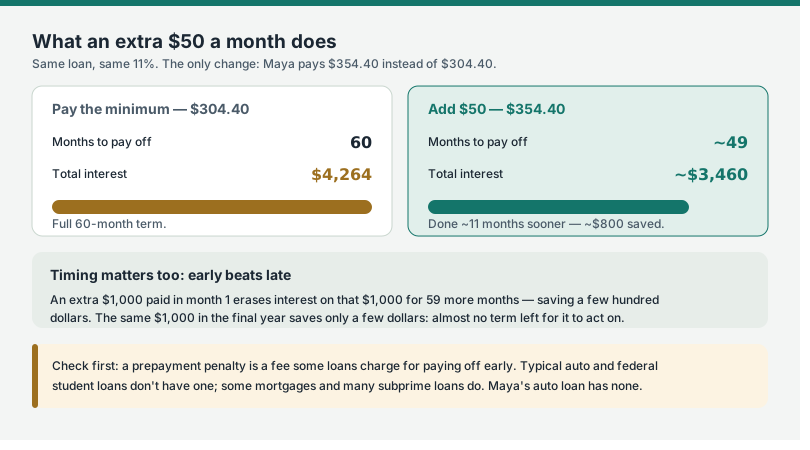
One practical consequence falls out of the "interest first" rule, and it's a quiet superpower: if Maya ever sends extra money, that month's interest is already covered by her regular $304.40, so the entire extra amount goes straight to principal. It skips the loan ahead on the balance and erases all the future interest that balance would have generated — which is why paying even a little extra is so disproportionately powerful. (The schedule rebuilds itself around the smaller balance; that re-amortization is something the next document shows directly.)
All of this — the split, the shift, the payoff at zero — is laid out for Maya row by row in a document the lender hands her: the amortization schedule, which is the lesson's first Document Walkthrough and gets its own turn next.
The Amortization Schedule — Your First Document Walkthrough
What it is, where Maya meets it, and how she encounters it. Everything §4 just described — the split, the shift, the payoff at zero — a lender will hand to Maya as an actual document called an amortization schedule: a table that takes the four terms of her loan (principal, rate, term, payment) and lays out, for every single payment from the first to the sixtieth, how much goes to interest, how much to principal, and what balance is left afterward.
She doesn't fill it out — this is a document she receives and reads. Heartland includes it in the closing packet she signs her loan on, and posts a live version inside her online account where the rows update as she pays. On a mortgage, the same kind of schedule is part of the closing documents. And because the math is standard, she can generate one herself for any loan she's considering — before she ever signs — by typing those four numbers into a free amortization calculator. The mode is plain: a reference table, on paper or on screen, with nothing to sign and nothing to authorize.
It's worth reading closely because it is, quite simply, the most transparent document a lender gives her. Every dollar she will ever pay over five years is printed in advance, with no fine print and nothing held back — which means she can use it two ways: to verify the loan is behaving exactly as her TILA box promised, and to plan (to see what an extra payment would do, when she'd be halfway, or what she'd still owe if she sold the car in year three). Here is hers, for the $14,000 auto loan at 11% over 60 months:
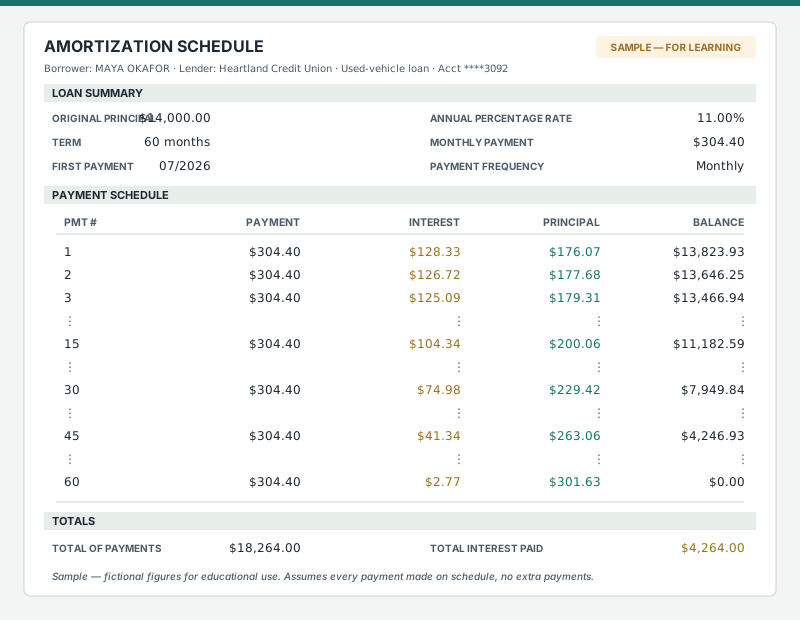
The document has three parts, and we'll read it in its own top-to-bottom order, giving each part the full three-part teach rather than rushing them together. At the top sits the Loan Summary — the five terms the whole table is built from (principal, APR, term, payment, first-payment date). In the middle, tinted as the section we're reading most closely, is the Payment Schedule itself — the row-by-row split of every payment into interest, principal, and remaining balance. At the bottom are the Totals — the all-in figures the sixty rows add up to, which cross-check directly against her TILA box.
We read the document top to bottom. The Loan Summary is the header block — the five terms the whole table is generated from. Each one earns the full three-part teach.
Original principal — $14,000. What it is: the amount Maya actually borrowed — the size of the debt before a single payment is made. It's the "amount financed" from her loan, the $14,000 left after her $2,000 down payment came off the $16,000 car price. What it does: every number further down the schedule is generated from this one. The lender applies the monthly rate to this $14,000 to produce the very first interest figure; the payment then chips principal off it, producing a new balance, and the entire table cascades down from there. Change this number and every row beneath it changes. Why it matters: it's her first and most important cross-check. This figure must match the "amount financed" on her TILA box and the loan amount on her application, to the dollar. If the schedule's principal were higher than what she agreed to borrow — padded with an add-on or a rolled-in fee she didn't expect — every interest figure below it would be inflated too, on all sixty payments. Confirming this one number is correct validates the whole document under it. ↳ commonly confused with the car's price — it isn't $16,000; the down payment already came off, so the loan is built on $14,000.
APR — 11.00%. What it is: the annual rate the lender charges on the balance still owed — the same rate disclosed in the four-box TILA disclosure from Lesson 1. Because this particular loan carries no fees, the APR here equals the plain interest rate. What it does: it's the engine of the entire interest column. Each month the lender converts it to a monthly rate (11% ÷ 12 ≈ 0.9167%) and multiplies that by the outstanding balance to get that month's interest. The steadily shrinking interest figures down the table are simply this rate applied to an ever-smaller balance. Why it matters: this is the rate she shopped for and agreed to, and the schedule is where she confirms the lender actually used it. If the APR printed here didn't match her TILA box — even by a fraction of a point — that's a discrepancy to raise before she pays, because the wrong rate quietly overcharges her on every one of the sixty payments. It's also the benchmark she'll measure any future refinance against: a later loan only saves her money if its APR beats this 11%.
Term — 60 months. What it is: the number of scheduled monthly payments — the agreed length of the loan, five years. What it does: it determines how the $14,000 and the 11% get spread out. The lender solved for the exact payment ($304.40) that drives the loan to zero over precisely these sixty months; a different term would produce a different payment and a different total interest. Why it matters: the term was a choice she made, not a fixed fact of the loan, and the schedule lets her see the consequence of that choice play all the way out to the final row. Sixty months keeps her payment affordable at $304.40; a shorter term (say 48 months) would have raised the payment but cut her total interest below $4,264, while a longer one would have lowered the payment and pushed the total interest higher (the lever §7 makes explicit). Reading the term here, against the totals at the bottom of the page, is how she checks whether the length she picked was worth what it cost her.
Monthly payment — $304.40. What it is: the single fixed amount due every month — identical on all sixty rows, the figure she'll actually send the credit union. What it does: it's the constant the whole schedule is built around. Each month it's split between interest (paid first) and principal (the remainder); the split shifts month to month, but the total she pays never does. It's also the number the lender derived first — the interest and principal columns are just this single payment being divided up sixty different ways. Why it matters: this is the number that has to fit her budget for five years, and the schedule's most reassuring feature is that it proves the payment never changes — no escalating step-up, no balloon at the end, no surprise jump in year three lurking in rows she didn't read. Seeing the same $304.40 on row 1 and row 60 is the guarantee in writing. ↳ commonly misread as a one-time total — it's a per-month figure, due sixty times; the all-in number lives in the totals section, not here.
First payment — 10/2026. What it is: the date the first of the sixty payments is due — the start of the repayment timeline. What it does: it anchors every subsequent due date. The lender counts forward from here, one payment a month, to schedule all sixty and fix the payoff date five years out. Why it matters: it's the first of sixty deadlines, and the stakes attach to the date as much as to the dollars. A payment that lands late triggers the late charge from her TILA box and — far costlier over time — a late mark on her payment history, the single heaviest factor in her credit score from Lesson 1. Knowing precisely when the clock starts is what lets her set up autopay or a reminder before the first payment is even due, so a missed date never costs her the very thing she spent Lesson 1 learning to protect.
Read this way, the Loan Summary isn't a header to skim — it's five separate cross-checks and decisions, each tied to something she already learned. With the top of the document fully taught, the middle and bottom — the Payment Schedule columns, the Totals, and the document's behaviors — come next.
Continuing down the document from the Loan Summary into the tinted focus — the Payment Schedule itself. Each of its five columns gets the full teach, since this is the section we're reading most closely.
PMT # (1–60). What it is: which payment each row represents, numbered 1 through 60 in order. What it does: it indexes the table — every row is one month, in sequence — so the schedule becomes navigable rather than a wall of numbers. Why it matters: it lets Maya find exactly where she'll stand at any point in five years. Row 30 is her halfway mark in time, and it's the row that tells her she'd still owe $7,951.67 if she wanted to sell or refinance the car midway. Every "what if I…" question she'll ever have about this loan is answered by going to the right numbered row.
PAYMENT ($304.40, every row). What it is: the fixed amount due that month — identical on all sixty rows. What it does: it's the constant the lender splits into interest and principal; the same figure repeats straight down the column. Why it matters: seeing it unchanged from row 1 to row 60 is the visual proof of the Loan Summary's promise — the payment genuinely never moves. ↳ commonly misread as a total — this column is the per-month amount sixty times over, not the cost of the loan; that cost lives in the Totals below.
INTEREST (gold, shrinking). What it is: the portion of each payment that covers that month's rent on the balance still owed — the rate applied to the current balance. What it does: it's deducted first from the $304.40, and it shrinks every row because the balance it's charged on shrinks every row. Why it matters: this column is where she watches her actual cost get paid down in real time, and it carries the document's most important confusion-flag. ↳ the interest being largest at the top looks like the lender front-loaded their profit on purpose — but it's simply the rate applied to the balance, which is at its biggest at the start; it's the math behaving honestly, not a trick. By the final rows it's just a few dollars, because there's almost nothing left to charge rent on.
PRINCIPAL (teal, growing). What it is: the portion of each payment that actually reduces what she owes — the remainder after interest is covered. What it does: it grows every row, as interest shrinks, and it's the part that drives the balance down toward zero. Why it matters: it's the exact mirror of the interest column — interest + principal always equals $304.40 on every single row — so watching principal climb is watching the loan dismantle faster and faster. It also answers the practical question "how much of my payment is doing real work?": $176 of $304 in month one, nearly the whole payment by the end.
BALANCE. What it is: what she still owes after that month's payment posts — the running total, falling row by row. What it does: it starts at $14,000, drops by each month's principal, and lands on exactly $0.00 at row 60. Why it matters: ↳ this is the single number she actually owes at any moment — her payoff figure, the amount to quote if she's selling the car or refinancing. And the fact that it lands precisely on $0.00 at the final row is the proof the loan is structured honestly: no balloon, no residual lump, no surprise at the end. A schedule that didn't reach zero would be the warning sign.
Now the bottom of the document — the Totals, which is where the sixty rows reconcile and cross-check against Lesson 1's TILA box.
Total of payments — $18,264.00. What it is: all sixty payments added together — what she'll have handed the credit union when the loan is done. What it does: it states the all-in dollar cost of the loan itself. Why it matters: it must equal the "total of payments" on her TILA box — the schedule and the federal disclosure agreeing is the cross-check that confirms both describe the same loan. It's also the honest accounting of her choice: the $14,000 she financed will cost $18,264 to repay, and combined with her $2,000 down, the $16,000 car runs her $20,264 all-in over five years — with $4,264 of that being the price of financing rather than the car.
Total interest — $4,264.00. What it is: the interest column summed — the total rent she pays over five years. What it does: it isolates the price of borrowing the $14,000, separated from the principal. Why it matters: ↳ this isn't an extra charge bolted on at the end — it's just the interest column added up, money already contained inside the sixty $304.40 payments, and it equals the "finance charge" on her TILA box. Seeing it as one clean number is what lets her judge the financing decision honestly: was having the car now worth $4,264? That's a question she can only answer once the cost is visible, which is exactly what this line does.
Total principal — $14,000.00. What it is: the principal column summed — confirming she repaid exactly what she borrowed, no more. What it does: it closes the loop — principal returned equals principal borrowed. Why it matters: it's the reconciliation that lets her trust the entire document. Total principal ($14,000) + total interest ($4,264) = total of payments ($18,264); the columns sum to $304.40 on every row; the balance lands at zero. A document that ties out in every direction is one she can rely on without second-guessing.
Two behaviors worth naming before she leaves the document. Re-amortization (extra payments): ↳ there's no column for an extra payment, which can make the table look fixed. It isn't. If Maya sends extra money, that month's interest is already covered by her regular payment, so the entire extra amount lands on principal — the balance drops below what the schedule shows, and the loan re-amortizes, rebuilding itself around the smaller balance, ending sooner and erasing the future interest that balance would have generated. She can do this freely here only because her TILA box showed no prepayment penalty — always the line to check first, because a loan that penalizes prepayment changes this math entirely. Escrow (the mortgage difference): ↳ on a mortgage, the real monthly payment is usually bigger than the interest + principal this schedule tracks, because it also includes escrow — money the servicer collects each month and holds to pay property taxes and homeowner's insurance when they come due. The amortization schedule shows only the principal-and-interest portion; escrow rides on top. It's not on her auto loan, but naming it now means she won't be alarmed later when a mortgage payment exceeds what its own amortization schedule shows.
The reassurance to carry into every loan she'll ever take: a schedule that front-loads interest honestly (because of the balance, not by design), holds the payment flat, grows the principal, reconciles in every direction, and lands exactly on $0.00 is behaving perfectly — the most transparent document a lender hands over, with every dollar shown before she pays the first one.
APR vs the Interest Rate — the Number That Catches Hidden Fees
The interest rate tells Maya the cost of borrowing the principal — but it deliberately leaves something out, and that something is where borrowers get quietly overcharged: fees. Most loans carry charges just for originating them — an origination fee, "points," certain processing costs — and the interest rate ignores all of it. The APR (Annual Percentage Rate) is the fix. It takes those mandatory loan fees, folds them into the cost, spreads the whole thing across the life of the loan, and re-expresses it as a single yearly percentage. So the APR answers a more honest question than the rate does: not "what's the rate on the money?" but "what does this loan actually cost me per year, fees and all?"
Because the APR adds the fees on top of the rate, it is always greater than or equal to the interest rate — and the two are equal only when a loan has no fees whatsoever. That's exactly why Maya's fee-free car loan showed an APR of 11.00% identical to its rate, both on her TILA box and her amortization schedule. The instant a loan carries a fee, its APR rises above its rate, and the gap between the two numbers is, in effect, the fees — which makes the APR a built-in fee detector: if a lender quotes a low rate but the APR sits well above it, that spread is telling you there are charges baked in that the rate was hiding.
It's worth knowing precisely what the APR does and doesn't capture, so Maya doesn't over-trust it. It folds in the lender's finance charges — origination fees, discount points, and the like. It generally does not fold in every third-party cost (some closing items, optional add-ons), so even the APR isn't a perfect total — but it is the best standardized comparison the law provides, which is why TILA (from Lesson 1) requires it on every loan: it lets her line up two offers on equal footing. The payoff of doing that is genuinely counterintuitive, and it's the whole reason this section exists — a loan with a lower rate but a fee can cost more than one with a higher rate and no fee:
The flip is the entire lesson of this section: Loan A's 9.0% rate looks like the better deal, but its $400 fee — invisible in the rate — lifts its true yearly cost to roughly 11%, while Loan B's fee-free 9.9% rate is its APR. Lined up by APR, B wins by about 1.1 points a year, and anyone who shopped on the rate alone would have walked straight into the costlier loan. The rate flattered the worse option; the APR exposed it.
Two refinements make Maya genuinely good at this rather than just aware of it. The first is why fees bite unevenly: a flat fee does more damage to the APR of a smaller or shorter loan than a large or long one, because the same $400 is being spread across fewer dollars and fewer months. That same $400 fee that pushed a $10,000 four-year loan's APR up by two full points would barely move the APR of a $300,000 thirty-year mortgage. So the smaller the loan, the more the fees matter — and the more important it is to compare by APR rather than rate. The second is a limit worth respecting: the APR assumes she holds the loan for its full term. If she pays off an upfront-fee loan early, that fee is being spread over fewer months than the APR assumed, so the loan's effective cost is actually higher than its stated APR — meaning a fee-heavy loan punishes early payoff in a way the APR alone won't show.
The discipline, then, is simple to state and rarely followed: compare loans by APR, never by rate — then open the itemization of the amount financed (from Lesson 1's TILA box) to see exactly which fees created the gap. The rate is one lever on cost, and the APR catches a second — the fees. There's a third lever, one borrowers pull constantly without ever seeing its price tag: the length of the loan. That gets its own turn next.
The Term Lever — the Lower Payment That Quietly Costs More
Rate and fees are two levers on the cost of a loan, and the APR catches both. There's a third lever, and it's the one borrowers pull most often without ever seeing its price tag: the term — how many months the loan runs. It's irresistible because pulling it has an immediate, satisfying effect. Stretch the loan over more months and each monthly payment gets smaller. That feels unambiguously like a better deal, and it's exactly why a salesperson's first move, when a payment looks too high, is to offer to "get it down" by lengthening the term.
The catch is that lengthening the term does two things from one change, and only the first one is visible. Yes, the same principal spread across more months means a smaller payment. But the balance also stays outstanding longer — Sofia is renting that money for more years — so more total interest accrues. The lever trades a lower monthly number for a higher lifetime cost, and the second effect is the one the showroom conversation never mentions.
Sofia, with her super-prime credit, is borrowing $20,000 at a clean 6% and choosing among terms. At 36 months her payment is a hefty $608 — but she pays only about $1,903 in total interest. Stretch the same loan to 72 months and her payment drops to a comfortable $331 — but the total interest nearly doubles, to about $3,864. Identical loan, identical rate; the only thing she changed was the length, and it cost her nearly two thousand extra dollars. Drag the term and watch the two numbers move in opposite directions:
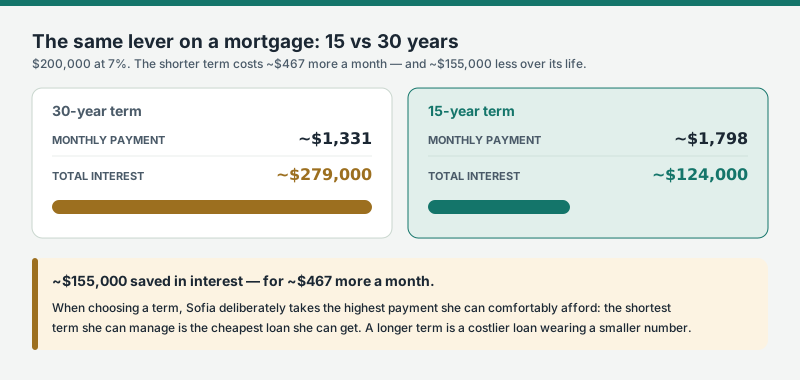
There's an asymmetry in the slider worth noticing, because it sharpens the discipline. The payment relief from each extra year shrinks as the term grows — going from 36 to 48 months saves Sofia a big chunk of monthly payment, but going from 72 to 84 saves only a little — while the interest climbs steadily the whole way. So the longest terms give the least payment relief for the most added cost: they're the worst trade on the slider, and they're exactly the ones a "we can get your payment even lower" pitch pushes toward. This is the precise seam the §13 predator pries open — a sales conversation built entirely around the monthly number, using the term lever to keep a rising total out of view.
The discipline that falls out is simple to state: pick the shortest term whose monthly payment you can comfortably afford. Affordability is the real constraint, and within it, shorter is always cheaper. But two honest nuances keep this from being a blunt "always go shortest" rule. First, a lower payment is sometimes genuinely the safer choice: if the shortest term would leave Sofia one bad month away from missing a payment, the slightly costlier longer term that gives her breathing room is the right call — paying a bit more interest beats risking a default, which would cost her far more than interest ever could. The word that matters is comfortably. Second, on a car loan specifically, a long term has an extra hidden cost beyond interest: it keeps her underwater — owing more than the car is worth — for years, because the loan pays down slower than the car loses value. That's a problem we'll meet head-on in the auto-loan lesson, but it's one more reason the marginal extra years rarely pay off.
So far every section has been about interest behaving in ways a borrower can manage. The next shows the one form that does the opposite — where unpaid interest gets folded into the principal and starts earning interest of its own. That's capitalization, and it gets its own turn.
Capitalization — the Worst Way Interest Piles Up
§2 and §3 showed compound interest as a danger; this section shows its most permanent form on a real loan. Capitalization is the moment when unpaid interest gets converted into principal — added onto the balance — after which the rate is charged on that new, larger balance, so the interest that was just folded in starts earning interest of its own. It's the compound-interest engine from §2, but with a one-way ratchet: once interest capitalizes, it's no longer a side charge you can catch up on — it's part of the debt itself, generating new interest forever after.
Capitalization needs a specific setup: a stretch of time where interest accrues but isn't being paid. That's exactly the situation a student borrower is in. Tomás (Maya's cousin) carries $20,000 in unsubsidized federal student loans at 6.39% — the current undergraduate rate, verified this session. The word unsubsidized is the whole story: interest accrues from the day the money is disbursed, while he's still in school, and he is not required to pay it during those years. (A subsidized loan would be different — the government covers the interest while he's enrolled — but his is unsubsidized, so the accrual is his.) At 6.39%, that's roughly $1,278 a year quietly building up in the background, on a loan he isn't yet making payments on.
If he leaves that interest unpaid — which most students do, because they're not required to and often can't — it accumulates. Say about $4,000 has piled up by the time he finishes school and his six-month grace period ends. At that point comes the capitalization event: that $4,000 is added to his principal, which jumps from $20,000 to $24,000. From then on, his 6.39% is charged on $24,000 — which means he is now paying interest on $4,000 of old interest. Over a standard ten-year repayment, that capitalized chunk generates roughly $1,440 in additional interest he would never have owed if it hadn't been folded in.
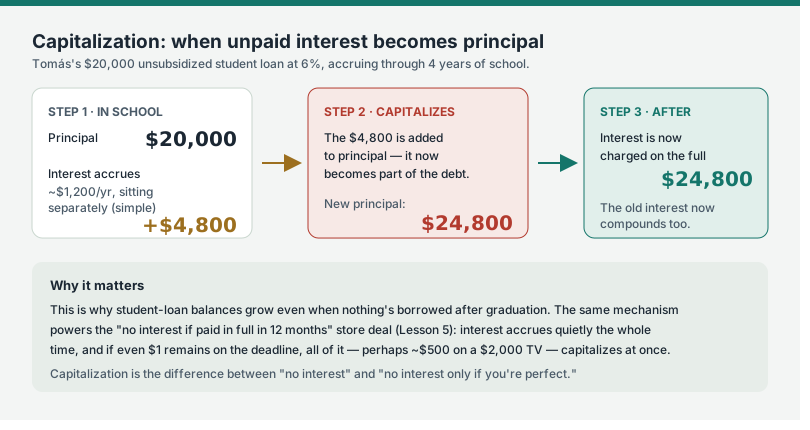
What makes capitalization genuinely worse than ordinary interest is its permanence. A normal month's interest is a one-time charge; if Tomás pays it, it's gone. But capitalized interest is converted into principal, so it doesn't just cost him once — it permanently enlarges the base that all his future interest is calculated on, for the entire remaining life of the loan. The $4,000 didn't merely get added; it got promoted from a charge into debt that breeds more debt. That one-way ratchet is why this single mechanism deserves its own section.
The defense is correspondingly simple and high-leverage: pay the interest as it accrues, before it can capitalize. Even modest payments while he's in school — on the order of $100 a month — keep the accrued interest from ever being folded in, so his principal stays $20,000 and he never pays interest on interest at all. For a student borrower, this is very likely the highest-return financial move available, because it costs little now and prevents a permanently larger debt later. (Two honest footnotes: a subsidized loan wouldn't have this problem in school, since the government pays that interest; and recent federal rule changes have reduced the number of events that trigger capitalization on Direct Loans — the precise triggers are federal specifics that Lesson 11 covers in full. But the concept and the defense hold regardless of the fine print.)
It's worth seeing how this connects to where we've been and where we're going. Capitalization is the §2 compounding danger and the §3 frequency danger made concrete on a real loan — but with a cruel twist: unlike a credit card, where the clean defense is to pay the balance in full, an in-school student loan can't simply be paid off, so the only defense is to keep paying down the interest so it never compounds. The credit-card version of this same trap — where the defense is available but the design makes it easy to skip — is the minimum-payment trap, and it gets its own turn next.
The Minimum-Payment Trap — Designed to Feel Manageable
Capitalization (§8) was a trap where the defense — paying interest before it compounds — isn't always available. The minimum-payment trap is its credit-card cousin, with a twist: here the defense is fully available, and the card's design simply makes it easy to skip.
Every month, a credit card asks for a minimum payment — the least Darnell can pay to keep the account current and in good standing. It's usually the greater of a small floor (around $35–40) or a small percentage of the balance, and since the CARD Act it has to at least cover that month's interest plus a sliver of principal — so the balance always declines, but only barely. Paying just the minimum feels responsible, because it does keep him current and protects his credit. That feeling is exactly what the trap runs on.
Here's the arithmetic that makes it a trap. On Darnell's $2,000 balance at 22.99%, the interest alone for one month is about $38 (the daily-compounded charge from §3). So a roughly $40 minimum payment leaves only a couple of dollars to actually reduce the $2,000 — almost the entire payment is just treading water against the interest. And because the card compounds daily, the balance crawls down so slowly that the result is brutal: paying about $40 a month, it takes Darnell roughly 14 years to clear $2,000, and he pays about $6,700 in total — of which ~$4,700 is interest, more than double what he originally borrowed. Drag the payment up and watch the trap snap shut:
The trap has a second, crueler feature that the headline number hides. The minimum isn't fixed at $40 — it's recomputed each month as a percentage of the balance, so as the balance slowly falls, the minimum falls too. The payments get smaller over time, which means less and less goes to principal, which drags the payoff out even longer than a flat $40 would. A borrower who faithfully "pays the minimum every month" is actually paying a shrinking amount on a barely-shrinking balance — the two declining together in a way engineered to feel manageable while quietly maximizing the interest collected. It's worth being clear-eyed about why the minimum is set so low: a carried balance is how the issuer earns, so the low minimum is the mechanism that keeps people carrying. The trap isn't an accident; it's the business model.
The escape is the mirror image, and it's the most important practical move in this lesson: pay a fixed amount above the minimum. The leverage comes from the same arithmetic that created the trap — since the first ~$38 covers the interest, almost every dollar above that goes straight to principal. So it doesn't take a huge payment to change everything. A fixed $77 a month clears the same $2,000 in about three years for roughly $2,790 total — saving Darnell close to $3,900 and eleven years versus the minimum. The slider makes the shape of it visible: the timeline doesn't ease down gently as you pay more, it collapses, because you're refusing to let the balance — and its daily-compounding interest — linger.
This connects the whole back half of the lesson. The daily-compounding engine from §3 is what makes carrying a balance so costly; capitalization in §8 was that engine ratcheting permanently into a student loan; and the minimum-payment trap is that same engine running on a card, with the defense sitting right there unused. The cleanest version of the defense, from Lesson 1's grace period, is to pay the statement balance in full so the interest is zero from the start — and short of that, a fixed payment well above the minimum. All of this, remarkably, is printed on Darnell's own statement every month, in a federally mandated box built to show him exactly this — which is the lesson's second document, and it gets the next several turns.
The Credit Card Statement — Your Second Document Walkthrough
What it is, where Darnell meets it, and how he encounters it. Where the amortization schedule was a document Maya fetched, this one arrives at Darnell — every month, automatically, whether he opens it or not. A credit card statement is the full monthly accounting of his card: what he owed, what he paid, what he charged, what it cost him in interest and fees, and what he owes now. It comes as a paper statement in the mail and an identical PDF in his card's app, and there's nothing to sign — it's a record to read.
It matters because almost everything this lesson taught lands somewhere on this one page. The daily-compounded interest from §3 shows up as a real dollar figure with the calculation behind it. The minimum-payment trap from §9 is printed in a federally mandated warning box. And the whole thing reconciles — last month's balance, plus charges, minus payments, equals this month's balance — so a borrower who can read it can verify the card is treating him correctly and see exactly where his money is going. The reason the earlier version of this walkthrough was wrong to show only the payment block is that a real statement is a multi-section document, and recognizing the whole of it — not just one corner — is the skill. Here is Darnell's, in full:
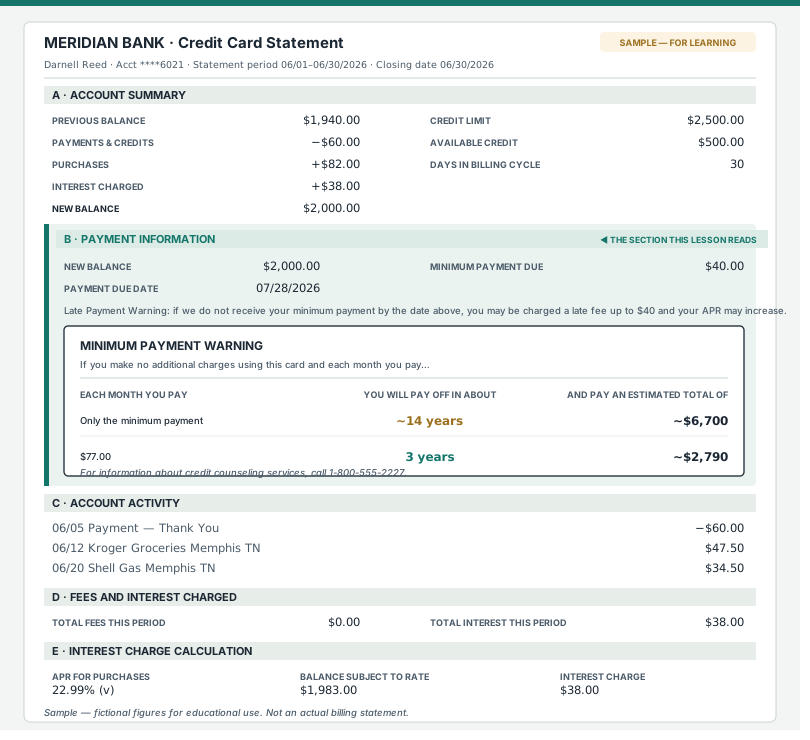
That is the whole document — six sections plus the masthead, not a single strip — and we'll read it in its own top-to-bottom order, each section getting the full three-part teach rather than being crammed together. The shape of what's there: the Account Summary reconciles last month to this month ($1,985 − $40 + $17 + $38 = $2,000); the Payment Information block states what's due and when; the Minimum Payment Warning — tinted, because it's the section that carries this lesson's hardest truth — projects the §9 trap in his own numbers; the Transactions list itemizes what moved; the Fees Charged and Interest Charged sections give both this period and the year-to-date totals the CARD Act requires; and the Interest Charge Calculation shows the §3 daily-compounding math producing that $38, line by line.
The masthead identifies the document and frames everything below it.
Issuer, account holder, masked account number — Summit Bank Visa · Darnell Reed · ····4417. What it is: whose card this is, which issuer and network (Visa), and which account — shown by its last four digits, with the rest hidden. What it does: it confirms the statement belongs to him and to this specific card. Why it matters: the masking is a deliberate security feature — a legitimate statement never prints his full card number. ↳ if a "statement" ever shows the full number or asks him to confirm it, that's a phishing red flag, not a real statement; the last four digits are all that's needed to match it to his card.
Statement closing date + billing cycle — 09/22/2026 · 08/23–09/22 (30 days). What it is: the closing date is when this billing cycle ended and the statement was generated; the cycle is the ~30-day window the statement covers. What it does: every figure below reflects activity within this window, and the closing date starts the clock on both his grace period and his due date. Why it matters: the cycle length is the multiplier behind his interest — the daily charge from §3 is applied across these 30 days — and the closing date controls timing: a purchase made the day after closing lands on next month's statement, buying him a longer interest-free runway. Knowing his closing date lets him deliberately time a large purchase for the longest grace.
The Account Summary is the heart of the masthead's promise: it's the monthly reconciliation, showing in one place how last month's balance became this month's. Read top to bottom, it's the story of the cycle.
Previous Balance — $1,985.00. What it is: what Darnell owed at the end of last cycle — the starting point for this one. What it does: it's the opening figure every line below adjusts. Why it matters: it must exactly match the "New Balance" on last month's statement; a mismatch means something's wrong (a missing payment, an error) and is worth investigating. It's also the balance the interest ran on — because he carried it, the §3 daily-compounding engine churned against this $1,985 all month.
Payments / Credits — −$40.00. What it is: money that came off the balance this cycle — his payment, plus any refunds or credits. What it does: it's the only line that reduces what he owes. Why it matters: this is where he confirms his payment was received and applied — $40 paid showing as −$40 means the card credited him correctly. A payment that posted late, or not at all, would be missing here, and this is the first place to catch that before it becomes a late fee and a mark on his credit report.
Purchases — +$17.00. What it is: the total of new spending charged this cycle. What it does: it's added to the balance. Why it matters: it's the figure he checks against his own memory, with the line-item detail sitting in the Transactions section below. ↳ a purchase total larger than he expects is the cue to scan the transactions for a charge he doesn't recognize — the everyday way fraud or a forgotten subscription first surfaces.
Cash Advances — +$0.00. What it is: cash pulled against the card — an ATM withdrawal or cash-like transaction. What it does: added to the balance, but treated differently from a purchase. Why it matters: ↳ a cash advance is the most expensive way to use a card — from his Schumer box in Lesson 1, it carries a higher APR (31.99% here versus 22.99% on purchases) and, crucially, no grace period, so interest starts the moment he takes the cash. Seeing $0 is good news; any figure here would be a flag, because that money is accruing immediately at the higher rate.
Fees Charged — +$0.00. What it is: fees added this cycle — late, cash-advance, over-limit, and the like. What it does: added to the balance. Why it matters: $0 means he dodged all fees this cycle. The year-to-date tally lower on the statement ($29) is the running total worth glancing at to catch fees accumulating quietly. ↳ a fee he didn't expect is worth a phone call — many fees, especially a first late fee, can be waived on request.
Interest Charged — +$38.00. What it is: the interest added this cycle for carrying a balance. What it does: it's a real charge, added to the balance — the cost of not paying in full. Why it matters: this is the §9 trap made visible as a single number — the $38 is what carrying the $1,985 cost him this month alone, and it's exactly the figure the Interest Charge Calculation at the bottom shows the math behind. ↳ had he paid the previous balance in full, this line would read $0 — the grace period from Lesson 1 — so this number is the live, monthly price of carrying the balance.
New Balance — $2,000.00. What it is: what he owes now — the reconciled total after every line above. What it does: it's the sum of them all: previous balance, minus payments, plus purchases, cash advances, fees, and interest. Why it matters: ↳ the reconciliation is his proof the statement is honest — $1,985 − $40 + $17 + $0 + $0 + $38 = $2,000; if that arithmetic didn't tie out, the statement has an error. It's also the number he'd pay to clear the card entirely and stop all interest — set against the much smaller minimum the next block will ask for, which is the whole tension this statement is about.
Credit Limit + Available Credit — $2,500.00 / $500.00. What it is: the limit is the ceiling the issuer set; available credit is what's left after the new balance. What it does: the limit caps his spending; available credit is what he can still charge. Why it matters: ↳ these two drive his utilization — the ratio from Lesson 1 that's a heavy credit-score factor. A $2,000 balance against a $2,500 limit is 80% utilization, high enough to weigh on his score even though he's perfectly current. This is where he sees, in real numbers, that paying the balance down isn't only about interest — it also restores available credit and lowers the utilization that's quietly pressing on his score.
Days in billing cycle — 30. What it is: the number of days this statement covers. What it does: it's the period the daily interest was applied across. Why it matters: it's the multiplier behind the $38 — roughly $1.26 a day × 30 days, straight from §3 — which is why the interest charge isn't identical every month even on a steady balance: a 28-day cycle charges less than a 31-day one.
Read this way, the Account Summary stops being a box of numbers and becomes a reconciliation he can audit — every line a checkpoint, the whole thing tying out to a New Balance he can trust, with his utilization and his carried-balance cost both sitting in plain sight.
Continuing down the statement from the Account Summary, the Payment Information block is where the document poses its central question: clear the balance, or feed the trap?
New Balance — $2,000.00 (repeated here). What it is: the full amount owed, repeated from the summary into the payment block so it sits directly beside the minimum. What it does: it's the amount that, if paid by the due date, clears the card and stops all interest. Why it matters: ↳ the statement deliberately places the New Balance next to the Minimum Due so Darnell sees both choices at once — pay $2,000 and owe nothing more, or pay $40 and keep the daily-compounding engine from §3 running. Thanks to the grace period from Lesson 1, paying this full balance by the due date means $0 interest next cycle. It's the single most consequential number-pair on the whole page.
Minimum Payment Due — $40.00. What it is: the least he can pay to keep the account current. What it does: paying it keeps him in good standing and avoids a late fee and a late mark. Why it matters: ↳ this is the §9 trap's hook — paying it is "responsible" only in the narrowest sense (it protects his credit), but it barely dents the debt, since roughly $38 of the $40 just covers this month's interest. The warning box directly below exists precisely to show what happens if $40 is all he ever pays. The discipline: treat $40 as the floor he must clear, never the target he aims for.
Payment Due Date — 10/17/2026. What it is: the date the minimum (at least) must post by. What it does: it's the deadline separating "current" from "late." Why it matters: ↳ missing it is a double hit — a late fee of up to $40 (his Schumer box) and, if he falls 30+ days behind, a late mark on his payment history, the single heaviest factor in his credit score from Lesson 1. The fee is the small harm; the credit-report mark is the lasting one. By law the due date falls on the same day each month and at least 21 days after the statement closes, so it's predictable — which means he can set autopay for at least the minimum and guarantee a late payment never happens by accident.
Late Payment Warning line. What it is: the federally required notice of what a late payment costs. What it does: it states the late fee (up to $40) and warns that the APR could rise. Why it matters: ↳ the "may increase your APR" clause is the bigger threat than the fee — if his card carries a penalty APR, a single late payment can jump his rate toward ~29.99% and keep it there for months. The CARD Act puts this warning here to make the consequence explicit before it happens, which is his cue to never let a payment slip, because the downstream cost dwarfs the $40.
The Transactions section is the itemized detail behind those summary totals — and it's the borrower's primary tool for catching fraud and errors.
The section itself. What it is: the dated, line-by-line list of every charge and credit this cycle — date, description, amount. What it does: it breaks the summary's totals into their individual pieces (the "+$17 purchases" and "−$40 payments" shown as the actual transactions that produced them). Why it matters: it's his audit trail — every total in the Account Summary should trace back to lines here, and a charge he doesn't recognize is how unauthorized use first surfaces. This is the section to scan every month, even briefly.
08/28 · Payment — Thank You · −$40.00. What it is: his payment, posted on 08/28 and credited to the account. What it does: it's the −$40 from the summary, shown as a dated line. Why it matters: ↳ this confirms his payment was received and exactly when — and the date matters as much as the amount, because a payment must post on or before the due date; one that posts after is late even if he "sent" it earlier. Seeing it dated 08/28, well ahead of the 10/17 due date, confirms he's current. If a payment he'd made were missing from this list, this is where he'd catch it and call before a late fee ever hit.
09/05 · Corner Market · $17.00. What it is: a $17 purchase at Corner Market on 09/05. What it does: it's the +$17 from the summary, itemized. Why it matters: this is the line he checks against his own memory — did he spend $17 there on the 5th? If a charge here is genuinely unauthorized, the Fair Credit Billing Act gives him the right to dispute it, and this transaction line — date, merchant, amount — is exactly the evidence he'd cite. ↳ one caution before assuming fraud: the merchant name on a statement is a billing descriptor that sometimes doesn't match the store's sign out front (a parent company, a payment processor, a different city), so an unfamiliar name isn't automatically fraud — he should check the date and amount first. But a small charge he truly can't place is worth taking seriously, because fraudsters often test a stolen card with a tiny purchase before attempting a large one.
Read together, these two sections turn the statement from a bill into a control panel: the Payment Information block frames the one decision that matters (clear it or carry it), and the Transactions list is the monthly check that nothing unauthorized slipped through.
The Fees Charged section is small but does a specific job: it surfaces fees both for this cycle and cumulatively.
Total fees charged this period — $0.00. What it is: the fees added during this billing cycle. What it does: it rolls into the "Fees Charged +$0.00" line in the Account Summary. Why it matters: $0 means he avoided every fee this month — no late fee, no cash-advance fee, no over-limit fee. It's the line that confirms a clean cycle on the fee front.
Total fees charged in 2026, year-to-date — $29.00. What it is: every fee charged to the account so far this calendar year, added up. What it does: it keeps a running tally that resets each January. Why it matters: ↳ this YTD total is a deliberate CARD Act transparency feature — fees are designed to feel small and forgettable one at a time, so the law forces the issuer to print the cumulative number where Darnell can't miss it. The $29 here (likely a single late fee earlier in the year) is the kind of quiet drain that this line exists to make visible — and seeing it is often the nudge to set up autopay so it never grows.
The Interest Charged section does the same thing for interest, and its year-to-date figure is the one that should genuinely sting.
Total interest charged this period — $38.00. What it is: the interest added this cycle for carrying a balance. What it does: it's the "Interest Charged +$38.00" line from the summary, restated here. Why it matters: this is the live monthly price of not paying in full — and from the grace period in Lesson 1, it would read $0 if he'd cleared the previous balance by its due date. Every month it's nonzero, the §9 trap is actively running.
Total interest charged in 2026, year-to-date — $402.00. What it is: all the interest charged to the account this calendar year, summed. What it does: the running annual total, resetting each January. Why it matters: ↳ this is the number the CARD Act put here to make the cost impossible to rationalize away — $402 in interest so far this year, on a balance that's hovered around $2,000, is money that bought Darnell nothing — no goods, no service, just the cost of carrying. Set beside the warning box's projection, this single figure is often what finally tips a borrower from "I'll pay it down eventually" to actually doing it. It's the year's receipt for the trap.
The Interest Charge Calculation is the most quietly important section on the statement, because it's where the abstract daily-compounding idea from §3 becomes a concrete, auditable number. It shows the math behind the $38.
The section itself (the four columns: balance type · balance subject to rate · APR · interest charge). What it is: the worked calculation of how each interest charge was produced. What it does: it breaks the interest down by balance type, showing the rate applied to each and the resulting charge. Why it matters: ↳ this is the one place Darnell can verify the interest is correct rather than just trusting it — every other section reports a number; this one shows its work, which is exactly the transparency a borrower should use.
Purchases — balance subject to rate $1,985.00. What it is: the balance the purchase APR was applied to. What it does: it's the base of the interest calculation. Why it matters: ↳ commonly misread as his current balance — it isn't the $2,000 closing balance; it's the average daily balance, the average of what he owed across all 30 days of the cycle. This is why the interest isn't simply "current balance × monthly rate": the method accounts for the balance changing during the month (his payment and purchase shifted it), so it averages the daily balances. Understanding this stops the calculation from looking like an error when it doesn't match a back-of-envelope guess.
Purchases — APR 22.99% (v). What it is: the annual rate charged on the purchase balance. What it does: it's the rate the average daily balance is run through. Why it matters: ↳ the "(v)" means variable — from his Schumer box in Lesson 1, this rate equals the prime rate plus a fixed margin, so it moves when prime moves; it's not the issuer acting arbitrarily. And this is the very 22.99% that, compounded daily across the cycle, produces the ~25.8% effective APY from §3 — the label here, the bite in the interest column.
Purchases — interest charge $38.00. What it is: the interest produced for the purchase balance this cycle. What it does: it's the result of the calculation — and it's the same $38 that appears in the Account Summary and the Interest Charged section. Why it matters: ↳ this is §3 made fully concrete and checkable — roughly $1,985 × (22.99% ÷ 365) × 30 days ≈ $38; Darnell can run that arithmetic himself and confirm it. And because this $38 appears identically in three places on the statement — the summary, the interest-charged section, and here — the document is internally consistent, which is one more way he can trust it.
Cash Advances — $0.00 · 31.99% (v) · $0.00. What it is: the cash-advance balance, its rate, and its interest — all zero this cycle. What it does: it shows the separate calculation cash advances would receive. Why it matters: ↳ the row teaches even at zero — it makes plain that cash advances carry a 31.99% rate, nine points higher than purchases, and (from Lesson 1) accrue from day one with no grace period. The fact that the statement computes them on a separate line is the visual proof that the two balance types are charged differently — a useful thing to have seen before he's ever tempted to pull cash from the card.
The method footnote — "(v) = variable; balance subject to rate is the average daily balance." What it is: the definition of the terms used above. What it does: it tells him precisely how the "balance subject to rate" was derived. Why it matters: it's the key that unlocks the whole section — once he knows the base is the average daily balance and the rate is variable, the calculation stops being a black box and becomes something he can reproduce and verify.
Read together, these three sections are the statement's honesty layer: the fees and interest YTD totals make the cumulative cost impossible to ignore, and the Interest Charge Calculation shows its work so the cost can be verified, not just believed. Everything here has been building toward the one section that turns all of it into a decision — the Minimum Payment Warning box.
This is the section the whole statement was building toward: it's the one place the §9 trap is printed for Darnell, in his own numbers, by federal mandate. The CARD Act requires it on every statement precisely because issuers profit when borrowers pay the minimum, so the law forces the true cost into view whether the issuer wants it there or not. Every element gets the full teach.
The preamble — "If you make no additional charges and each month pay only the minimum payment…" What it is: the assumption the entire projection rests on — no new spending, minimum payment only. What it does: it sets the scenario the numbers below are computed under. Why it matters: ↳ commonly misread as a worst case — it's actually the optimistic one. The ~14-year projection assumes Darnell stops charging the card entirely; real life, where he keeps using it, is worse, not better. So the scary number isn't the ceiling of the damage — it's the floor. Reading the preamble correctly reframes the whole box: this is the best the minimum-only path gets.
The table's column structure — "if you pay…" / "you'll pay it off in about…" / "estimated total." What it is: the three-column frame that organizes the comparison. What it does: it lines up each payment strategy against its time-to-payoff and its all-in cost, side by side. Why it matters: the side-by-side is the point — the box isn't just warning him, it's giving him a direct, apples-to-apples comparison of two paths so the choice is concrete rather than abstract. The law mandates this exact structure so the alternative is never hidden.
Row 1 — "Only the minimum payment → ~14 years → ~$6,700." What it is: the projection if he pays only the minimum each month. What it does: it states the time and the total cost of the minimum-only path. Why it matters: this is the §9 trap in black and white, on his own balance. ↳ the ~$6,700 isn't $6,700 on top of the $2,000 — it's the all-in total: his $2,000 principal plus roughly $4,700 of interest, more than double what he owes. And ↳ the "~14 years" is itself optimistic, because, as §9 showed, the minimum falls as the balance falls, dragging real-world payoff even longer than a flat payment would. Seeing his specific debt cost him $4,700 in interest over 14 years is the number meant to stop him.
Row 2 — "$77 → 3 years → ~$2,790." What it is: the comparison path the CARD Act requires the issuer to compute — the fixed payment that clears the balance in three years. What it does: it shows a concrete alternative payment and its dramatically better outcome. Why it matters: ↳ the $77 isn't a charge, a penalty, or a new minimum — it's a target the law makes the issuer calculate and display for him. It's the §9 escape hatch, printed right on his bill: a fixed $77 a month (only ~$37 above the minimum) clears the same $2,000 in three years for ~$2,790 total — about $790 in interest instead of $4,700. The box hands him the exact number that defuses the trap.
The savings line — "Paying $77 instead saves about $3,900 and clears it 11 years sooner." What it is: the difference between the two rows, stated plainly. What it does: it converts the comparison into a single, motivating figure. Why it matters: ↳ this is the box doing the arithmetic the borrower usually never does — $6,700 minus $2,790 is ~$3,900 saved, and 14 years minus 3 is 11 years of his life freed. Putting the savings in one sentence is what turns a warning into a decision; it's the most actionable line on the entire statement.
The credit-counseling referral — "Nonprofit credit counseling: 1-800-388-2227." What it is: a required pointer to nonprofit credit counseling. What it does: it gives him a number for free, legitimate help if the balance feels unmanageable. Why it matters: ↳ this is a real resource, not a sales line — it routes to nonprofit counselors (the kind affiliated with the NFCC) who can help set up a manageable repayment plan, and the law puts it here on purpose. ↳ and it's the safe alternative to the predators a struggling borrower might otherwise find — the for-profit "debt relief" and "credit repair" outfits that charge fees for what nonprofits do for free or low cost. When money is tight, this number is where to start.
The whole box, as one tool. What it is: taken together, a federally mandated cost-and-alternatives disclosure. What it does: it shows Darnell the true price of the easy path, the concrete cost of a better one, the savings between them, and where to get help. Why it matters: it's the single most valuable thing on the statement, and it's free, automatic, and on every bill — the law's attempt to put the §9 math in front of the exact person it's designed to trap. Read once with understanding, it makes the minimum-payment trap nearly impossible to fall into unknowingly.
The reassurance to carry out of this entire document: a credit card statement isn't a bill to glance at and pay the minimum on — it's a control panel. The Account Summary lets him verify the card is honest, the Transactions list lets him catch fraud, the YTD totals show the real running cost, the calculation shows its work, and this warning box hands him the one move — pay a fixed amount above the minimum, or better, pay in full — that defuses everything else in the lesson. He doesn't need to fear the statement; he needs to read it, and now he can.
Points & Fees — Naming the Charges the Rate Hides
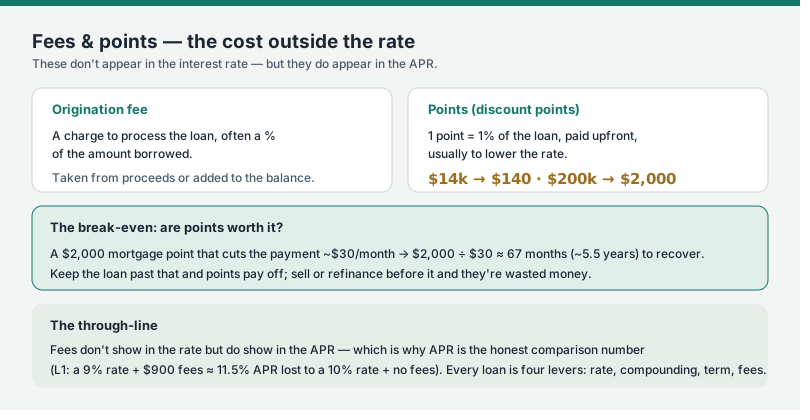
§6 established that fees exist and that the APR catches their combined effect. This section names what they actually are, because a borrower who can identify each fee can question it, compare it, or refuse it — and these charges are precisely what live in the gap between a loan's rate and its APR. There are four kinds worth knowing.
Each fee rewards a closer look, because the move differs for each.
The origination fee is the most common and the biggest driver of the rate-APR gap. It's a mandatory charge just for making the loan, usually a percentage of the amount borrowed — about 1% on a mortgage or a federal student loan, but as much as 1–8% on personal loans. Tomás's federal student loan carries one of roughly 1%, which is why he actually receives slightly less than he borrows: the fee comes off the top. Because it's mandatory, the only defense is comparison — some lenders charge none, and since §6 showed a flat fee hits smaller loans hardest, this is exactly where shopping by APR pays off.
Discount points are different in kind, because they're optional — and confusing them with origination fees is a common mistake. A point is an upfront payment that buys down the interest rate: one point equals 1% of the loan amount and typically lowers the rate by about a quarter of a percentage point. You pay more now to pay less every month, which makes it a pure break-even calculation, and it's worth walking through because the logic generalizes. Suppose Sofia, looking ahead to a $200,000 mortgage (the territory of Lesson 13), can pay one point — $2,000 — to drop her rate from 6.5% to 6.25%, saving roughly $32 a month. Her break-even is simply the cost divided by the monthly saving: $2,000 ÷ $32 ≈ 62 months, about five years. If she'll keep the mortgage longer than five years, the points pay off; if she'll sell or refinance sooner, she loses money on them. Points are only ever as good as how long you hold the loan — the same "assumes you hold to term" logic from §6, turned into a decision.
The prepayment penalty is the fee that can quietly undo the §5 superpower of paying ahead: a charge for paying the loan off early, designed to compensate the lender for the interest they expected to earn but now won't. Maya's TILA box showed none, which is exactly why she can throw extra money at her loan freely and let it re-amortize. But some loans — certain subprime auto loans, some personal loans, older mortgages — do carry one, and it can erase the benefit of early payoff entirely. The move is non-negotiable: always read the prepayment line on the TILA box before assuming you can pay early without cost. (Federal rules now sharply limit prepayment penalties on most "qualified" mortgages, but they aren't banned across all loan types, so the check still matters.)
Finally, the other and "junk" fees — application, processing, underwriting, documentation, administrative charges. Some are legitimate costs of doing the work; others are padding with an official-sounding name and no real service behind them. They all surface in the itemization of the amount financed from Lesson 1's TILA box, which is exactly why reading that itemization matters: a fee with a vague label and a real dollar figure is something to ask about, and regulators including the CFPB have specifically targeted these "junk fees" as a category. The move is to ask what each one is for — some are negotiable, some can be removed, and a lender who can't explain a fee is a lender quoting you a worse deal than they're admitting.
The synthesis ties the whole back half of the lesson together: the rate prices the money, the fees pad the cost, and the term stretches it — three separate levers. The APR catches the fees in aggregate (compare APRs, never rates); the itemization shows them one by one (read it, question the junk); the prepayment line protects your right to pay ahead (check it); and for points, the break-even tells you whether buying down the rate is worth it. With all of that in hand, the lesson can finally hand Maya a single habit that captures it all — four questions to ask of any loan — which gets the next turn.
The Cost-of-Money Mindset
Back in §1, I said the "compensation for waiting" built into every interest rate would get a name later. Here it is: the time value of money. A dollar in your hand today is worth more than that same dollar a year from now — and not only because of inflation. It's worth more because today's dollar can be used, spent, or invested immediately, while next year's can't do anything for you until it arrives. Time itself has value, and that is the bedrock fact underneath this entire lesson.
Interest is simply the price that bridges that gap. When Maya borrows $14,000, she's choosing to have the car now and pay for the time-shift — the $4,264 of interest is what she pays for not waiting five years to save up. The trade makes sense to her because she values having the car today more than she values that $4,264 spread thin over five years. When Sofia saves instead, she's on the other side of the same trade: she gives up money now and is paid (in the interest her savings earn) for the wait. It's the §2 reframe, now with its proper name — the same force, pointed in two directions. Borrowing has a real cost because time has value; the whole lesson has been about measuring that cost precisely, so a friendly monthly number can never again hide it from her.
So how do you measure it on the spot, in a dealership or staring at a loan offer, without redoing the whole lesson each time? You ask four questions. Each one maps to a lever we've taken apart, and together they convert any monthly payment back into its true cost:
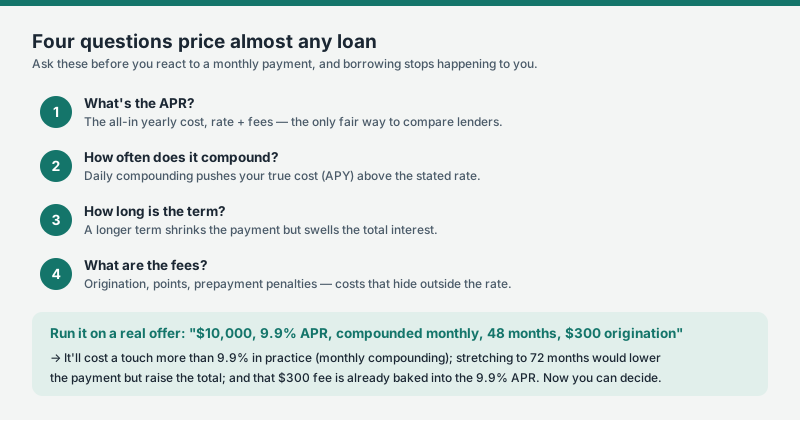
These four questions are the whole lesson folded into something Maya can carry into any showroom, bank, or app. What's the APR collapses the rate and every fee into one comparable number (§6). Does it compound, and how often tells her whether the debt will fight back — and if it will, how to stop it: pay a card in full so the grace period zeroes the interest, or pay a student loan's interest before it capitalizes (§2, §3, §8). What's the total, and what's the term doing to it drags her eyes off the seductive monthly figure and onto the all-in cost, with the discipline to choose the shortest term she can comfortably carry (§4, §5, §7). And what are the fees, can I pay it off free sends her to the itemization and the prepayment line before she signs (§5, §11).
The reason this is the lesson's keystone is that every borrowing trap she'll meet for the rest of the course is, underneath, an attempt to keep her from asking one of these four questions — usually the third, by burying a high total inside a low monthly payment. A person who reflexively asks all four can't be sold a cost they can't see. And the deepest layer, the one holding all four up, is the time value of money: borrowing costs because time has value, which is exactly why measuring that cost honestly — rather than letting a friendly number stand in for it — is the entire point.
That brings us to the trap these four questions are built to defeat, in the form it takes in the real world — the pitch built entirely around a low monthly payment. That's the Predator Watch, and it gets the next turn.
Predator Watch — the "Low Monthly Payment" Trap
This is the trap the whole lesson was built to defeat, because it's the real-world embodiment of every warning in it: a sales pitch engineered to stop you from asking the four questions from §12 — above all the third one, the total — by putting a single small monthly number in front of you and keeping everything else out of view. Hector has met it in three different costumes, and the trick underneath is identical every time.
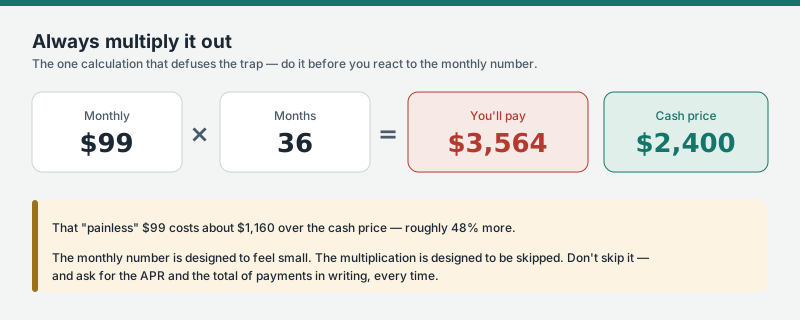
The three costumes look like three different products — a couch, a car, a TV — but they're one trick wearing different clothes. In each, the seller leads with the monthly number and lets Hector fill in the rest with hope: $99 a month feels like the couch costs roughly a hundred dollars, when multiplying it out reveals $3,564 for $2,400 of furniture at an APR north of 27% nobody said aloud. The 84-month car loan feels affordable at the monthly figure, but it keeps him underwater — owing more than the car is worth — for years, so if it's totaled or he needs to sell, he owes the gap out of pocket (the negative-equity problem the auto lesson covers in full). And rent-to-own feels like small manageable payments, right up until the $500 TV has cost him $1,500. The trap is the same in all three: a small monthly number, deployed to keep the total invisible.
The defense is the §12 mindset, and it's almost mechanical: before reacting to any monthly figure, multiply it by the number of months and read the APR. That single habit — converting the monthly number back into the total it's hiding — disarms every costume the trap can wear. And if a seller won't put the APR and the total of payments in writing, that refusal is itself the answer: those are Hector's disclosure rights under the Truth in Lending Act, and a deal that hides them is a deal to walk away from.
Where to report: file with the FTC at reportfraud.ftc.gov (the federal agency for deceptive practices), your state attorney general's consumer-protection office (search "[your state] attorney general consumer complaint"), and the state financial regulator for licensed sellers. The CFPB at consumerfinance.gov/complaint is a third channel — file there too, with the caveat that its enforcement capacity has been reduced through 2025–26, so use it alongside the others. What to have ready: the contract, the advertised offer, the APR and total that were withheld or disclosed, names, dates, and any screenshots. Reports with specifics get acted on. Why it matters: the pitch was built to hide the math, so your complaint is how regulators catch a store running the trick systematically — and that protects whoever comes next. Reporting isn't about shame; it's a civic act.
That's the trap and how to fight it. But warnings land differently on someone it already caught — so the next beat is for them.
A warning is useful to someone deciding whether to sign. But plenty of people reading this have already signed — the $99-a-month plan, the seven-year car loan, the rent-to-own TV — and only later did the total swim into focus. For them, another warning is just salt in the wound. So this beat is for them, and it's deliberately calm:
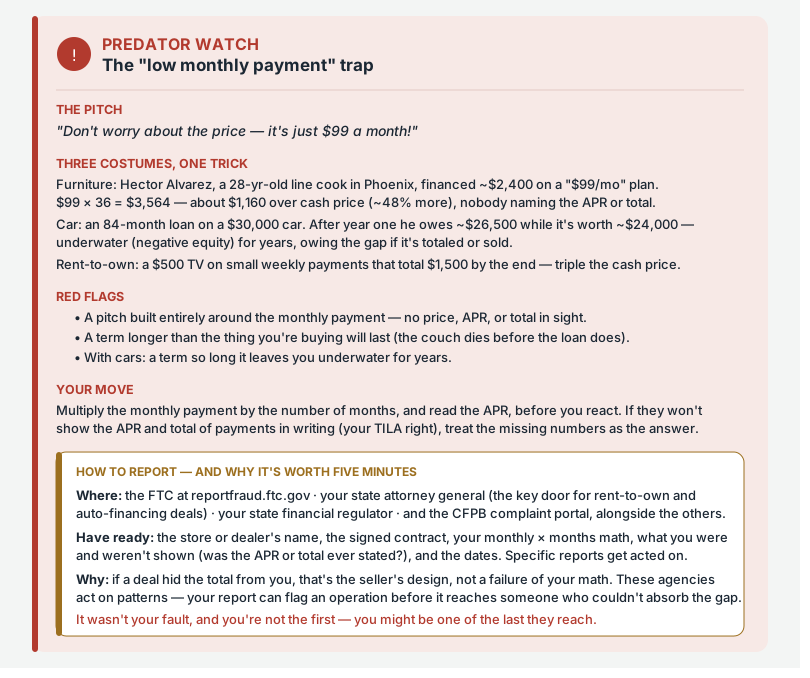
The beat does four things on purpose, in order: it names the stumble as something ordinary and engineered rather than a personal failing; it sets the self-blame down explicitly, because "you should have known" is exactly the wrong lesson and the wrong feeling; it points to what's still actionable from right where the person is — reading the contract with new eyes, exploiting the absence of a prepayment penalty, paying above the minimum, refinancing, holding an underwater car; and it offers reporting not as penance but as a quiet civic act that protects whoever's next. The skill this lesson taught isn't only protection going forward — it's also a way out of a deal already signed, and naming that is the kindest and most useful thing the section can do.
With the trap understood and a path back for anyone it caught, the lesson's last structural piece is the question of recourse — who you actually turn to when a lender or seller does you wrong — which gets the next turn.
The Recourse Stack — Who to Turn to When Something Goes Wrong
Every How-to-report block in this course points at the same underlying structure, so it's worth learning once as a reusable ladder. When a lender, card issuer, or seller does you wrong — an error you can't get fixed, an unfair fee, a deceptive deal, a billing dispute — there's an ordered set of places to turn. You climb it only as far as you need to, and you keep a written record at every step, because the record is what makes each higher rung take you seriously.
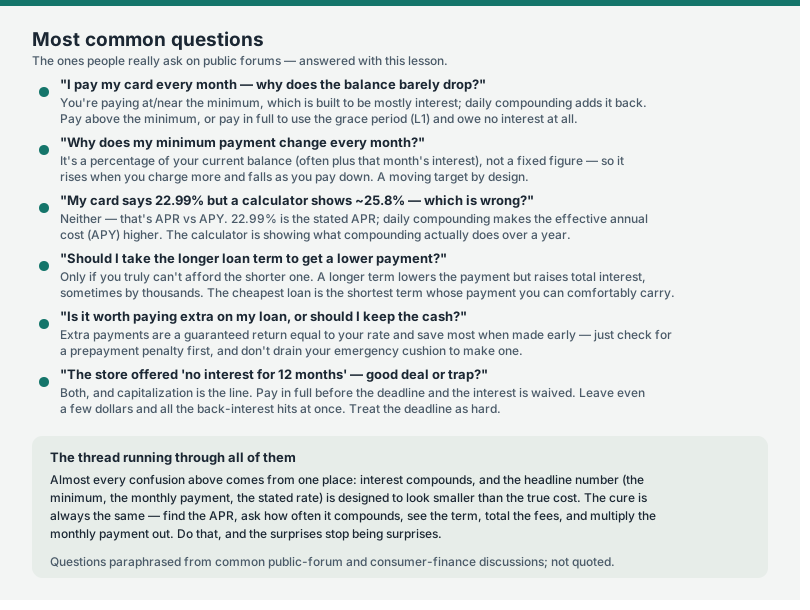
Each rung does a specific job, and knowing which is which saves time.
The company first — always. The great majority of problems are fixed right here, and even the ones that aren't start here, because every rung above asks "did you contact the company?" first. The key move is to put the dispute in writing — email or a letter, not just a phone call — because that creates the paper trail everything else depends on. For credit-card billing errors specifically, the Fair Credit Billing Act gives Darnell formal rights: dispute in writing within 60 days of the statement, and the issuer must investigate and can't demand payment on the disputed amount while it does. The written dispute isn't just polite; it's the legal trigger.
The state Attorney General — increasingly the front line. Every state's AG has a consumer-protection division that takes individual complaints, often mediates directly with the company, and investigates patterns across many complaints. As of 2026, with federal enforcement pulled back, state AGs have become the more active enforcers in consumer finance — so for many problems this is now the rung that actually moves things. It's reachable by searching "[your state] attorney general consumer complaint."
The state financial regulator — for licensed lenders. Lenders that operate in a state are usually licensed by it — payday lenders, auto-finance companies, mortgage servicers, money transmitters — and the agency that licenses them (often a "Department of Financial Institutions" or "Department of Banking") can investigate and discipline them, up to pulling a license. This is the right venue when the wrongdoer is a licensed lender rather than a one-off seller, because the regulator holds something the lender genuinely fears.
The FTC — for deceptive practices and scams. Reported at reportfraud.ftc.gov, the FTC handles unfair or deceptive practices, scams, and false advertising. It generally won't resolve an individual case — that's not its role — but it aggregates reports to spot bad actors and build enforcement actions, which is exactly the civic logic from the Predator Watch: your report is how a pattern becomes visible.
The CFPB — operational but diminished, so use it alongside. The Consumer Financial Protection Bureau runs the federal complaint portal at consumerfinance.gov/complaint, and filing there still does two useful things: it creates an official federal record, and it obliges the company to respond, typically within about 15 days. But it's important to be accurate and current about its state — since 2025 the bureau's enforcement activity and the monetary relief consumers receive have been sharply reduced, staffing has been cut, and its future is the subject of ongoing litigation. That doesn't make it useless — the record and the required response still have value — but it does mean Darnell should file there alongside his state AG, as a backstop and a record, rather than treating it as the agency that will single-handedly fix his problem the way it might have a few years ago.
The principle holds across the whole course, which is why this is a cross-cutting fixture you'll see again in Phase 7's trouble lessons: climb in order, keep every letter and confirmation number, and don't rely on a single rung. The written record is your leverage at each step, and filing with more than one venue is your insurance against any one of them being slow or diminished. You don't need to memorize which agency does what — you need to know the ladder exists, start at the bottom, and keep climbing with your paper trail in hand.
Most Common Questions
These are the questions real people ask after wrestling with the cost of borrowing — paraphrased from the kinds of things that fill personal-finance forums.
Two legitimate methods. Mathematically, attack the highest-APR debt first (the "avalanche") — it minimizes total interest, because you're killing the most expensive money first. Psychologically, some people do better clearing the smallest balance first (the "snowball") for the quick win and the momentum it builds. The avalanche saves the most dollars; the snowball can keep you going. If the rates are close, pick the one you'll actually stick with — and either way, pay the minimums on everything else while you throw extra at your one target.
The two levers from this lesson: rate and term. If your APR is higher — weaker credit, or a dealer rate markup — your payment is higher for the identical loan. And if her term is longer (say 72 months versus your 60), her payment is lower, but she'll pay more total interest over the life of it. The same $20,000 can produce very different payments. Compare the APR and the total of payments, never the monthly figure alone.
Usually no, and this catches people off guard. Extra payments go straight to principal, so they shorten the loan and cut total interest — but your required monthly payment stays the same; you just finish early. To actually lower the monthly amount on the same loan, the lender would have to recast (re-amortize) it, which some mortgages allow for a fee but most auto and personal loans don't. So paying extra makes you debt-free sooner and cheaper, but it doesn't reduce the bill you owe each month.
Two common causes. First, most card APRs are variable — tied to the prime rate plus a margin (your Schumer box) — so when the Fed moves and prime rises, your rate rises automatically, with no action from you. Second, if you started carrying a balance, you lost the grace period, so interest now applies where paying in full used to make it $0 — which feels like a rate hike but is really the daily-compounding engine switching on.
Run both — don't assume "0%" wins. With 0% financing you pay no interest but the full price; with the rebate you pay $2,000 less but finance the rest at a normal rate. Compare the full price at 0% against (price − $2,000) financed at the rate you'd actually get. A strong-credit buyer who can get a cheap loan elsewhere often comes out ahead taking the rebate plus a low-rate loan; someone facing a high rate usually does better with 0%. The trap is treating 0% as automatically best when the rebate can be worth more than the interest it saves.
APR is the stated yearly rate — the comparison number on your loan or card (fees included, for loans). APY is the effective yearly rate after compounding is counted. On a card compounding daily, the APY runs a bit above the APR (22.99% → ~25.8%). The rule of thumb: when you borrow, you're shown the APR (and pay closer to the APY if you carry a balance); when you save, banks advertise the APY (your effective return). Same idea — it just depends which side of the money you're on.
Yes — when the lower payment is genuinely necessary for breathing room. A loan you can comfortably pay beats a shorter one that leaves you one bad month from default. The move is to take the longer term for safety if you must, but then treat its payment as a floor and pay extra whenever you can (assuming no prepayment penalty) — so you get the cash-flow cushion without paying all the extra interest. That's exactly what "the shortest term you can comfortably afford" already builds in.
Check Yourself
Six questions across the whole lesson — tap an answer to see how you did:
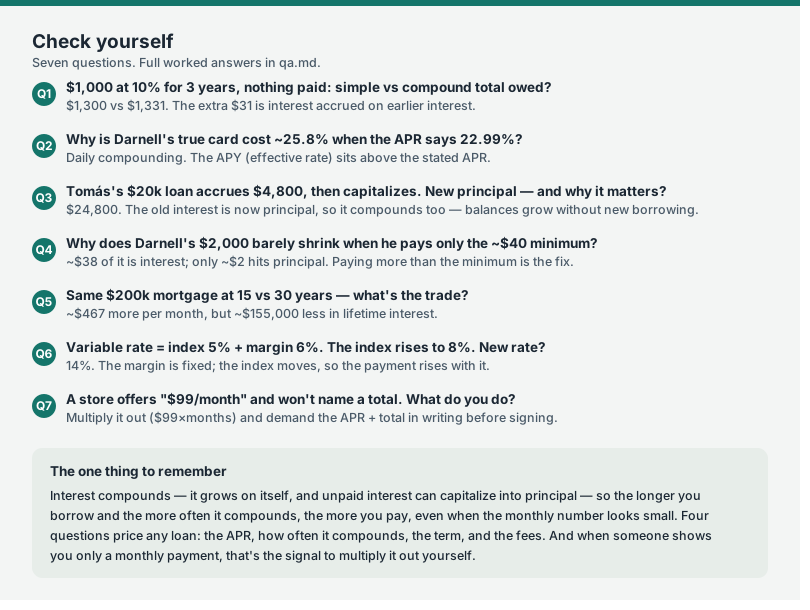
Key Takeaways
- Interest is rent on money — charged on the remaining balance, not the original, which is why it shrinks with every payment and why paying extra early saves the most.
- Compound interest feeds on its own output. A fixed installment payment kills that month's interest before it can compound; a carried card balance compounds daily at closer to 25.8% effective than the 22.99% the label shows.
- The APR is the only honest comparison number — it folds fees into the rate. A lower rate with a higher APR is the more expensive loan. Always compare APRs, never rates.
- Extending the term lowers your monthly payment but raises your total interest. The longest terms give the least payment relief for the most added cost. Pick the shortest term you can comfortably afford.
- Capitalization converts unpaid interest into principal — it then earns interest of its own forever. The defense: pay Tomás-style interest as it accrues, before the capitalization event.
- Paying $40 minimum on Darnell's $2,000 card takes 14 years and costs $4,700 in interest. A fixed $77 instead clears it in 3 years for $790 in interest — saving $3,900 and 11 years.
- Any pitch that leads with a monthly number and keeps the total out of view is the low-monthly-payment trap. Multiply monthly × months before reacting to any offer.
Quiz — 6 Questions
Answer one at a timeWhen comparing two loan offers, which number should Maya always use?