Buy Now, Pay Later
BNPL mechanics, the deferred-interest trap vs true zero-percent, the pay-in-4 agreement decoded, and the consumer protections that do and don't apply.
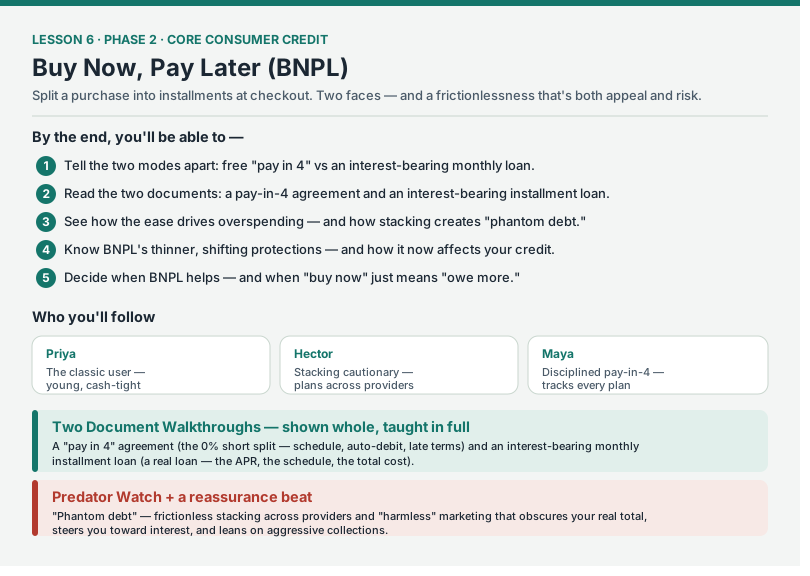
- Define BNPL as point-of-sale installment credit, and explain how pay-in-4 and interest-bearing monthly plans are both closed-end loans — different in duration and cost, not in kind.
- Trace the pay-in-4 mechanics — 25% down, three biweekly auto-debits, 0% if on time — and identify the fee cascade that fires when a debit fails on a short account.
- Read an interest-bearing BNPL loan's TILA disclosure cell by cell (APR, finance charge, amount financed, total of payments) and compare it directly to a pay-in-4 agreement that has no APR box.
- Evaluate the linked-account choice and explain why a carried credit card converts a 0% plan into an interest-bearing one.
- Identify loan stacking and phantom debt, build the one-list aggregate view that defeats it, and apply the five-question checkout checklist.
- Recognize the phantom-debt predator — the "this isn't really borrowing" frame — and know the CFPB/state-AG/FTC reporting path when marketing is deceptive.
- Navigate BNPL's 2026 credit-reporting landscape (FICO Score 10 BNPL, provider-by-provider reporting, the collection path) and the consumer-protection patchwork (federal floor: TILA/FDCPA/FCRA; state law led by New York).
Opening
The honest framing, as always, is non-moralizing. BNPL isn't good or bad. A pay-in-4 plan for something Priya would buy anyway and can comfortably clear in six weeks is a legitimately useful, free tool. But the ease nudges overspending, the longer plans are real interest-bearing loans, the protections are currently weaker than a credit card's, and stacking multiple plans creates phantom debt — obligations scattered across providers that no single statement adds up for you. The sobering companion to the adoption number: 41% of BNPL users paid late on at least one loan, and the practice of juggling several at once has been flagged as a systemic risk. So the lesson's job is to make BNPL legible — to teach Priya to use the free version deliberately, to recognize when "buy now, pay later" has quietly become "spend more, owe more," and to treat every plan as a real debt she tracks.
It starts with the basic question underneath the marketing: what is BNPL, really — what kind of credit is it, and how does it differ from the credit card, the old layaway counter, and a personal loan? That's the next turn.
1. What BNPL actually is — a small loan attached to a purchase
Strip away the checkout button and BNPL is a specific thing: point-of-sale installment credit — credit offered at the moment of purchase, online or in-store, to split that one purchase into installments. It shows up as a payment option right next to "credit card" and "debit," which is exactly why it doesn't feel like taking out a loan. But structurally, each BNPL plan is a closed-end installment loan: a fixed amount (the purchase), a fixed number of payments, and then it's done — the same family as Maya's car loan (Lesson 1) or Priya's credit-builder loan (Lesson 4), and the opposite of a credit card's revolving line. The cleanest way to see it: a credit card is one reusable account; BNPL is many small separate loans, one per purchase. Defining it against its three closest neighbors makes the distinction concrete:
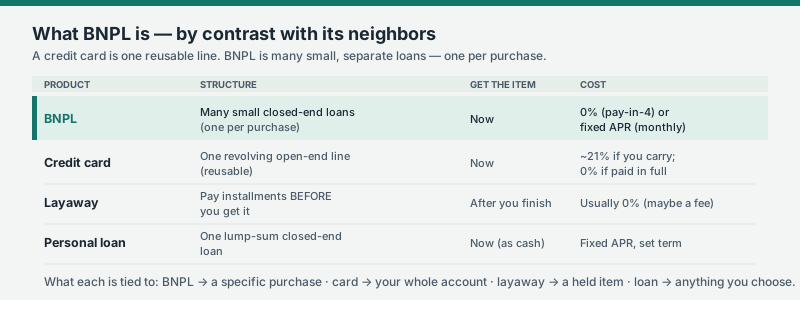
The contrasts pin down what BNPL is by showing what it isn't. Against a credit card, the structural gap is the one to hold onto: a card is a single revolving line Priya reuses indefinitely, with a grace period, strong dispute protections, and credit-building built in (Lesson 5); BNPL is a pile of separate small loans, each tied to one purchase, with — for now — thinner protections and credit-reporting only just emerging (the §opening shifts). Against layaway — BNPL's direct ancestor — the difference is timing flipped on its head: with layaway, you paid the installments first and the store handed you the item only when you finished; with BNPL, you get the item now and pay after. Same installments, opposite order, and that reversal is the entire psychological shift — possession precedes payment, so the purchase feels done while the debt is just beginning. And against a personal loan (Lesson 7), BNPL is essentially a micro version: a personal loan is a lump sum you apply for and can spend on anything, while BNPL is a tiny, frictionless loan welded to a single checkout — you don't "apply," you just tap.
Within that structure, the two faces from the opening are simply two lengths of closed-end loan. Pay-in-4 is a short one — four payments over about six weeks at 0% — and the monthly plan is a longer one — three to sixty months at a real APR. Both are closed-end loans tied to a purchase; they differ in duration and cost, not in kind. The provider landscape is a mix worth knowing: the main fintech providers are Klarna, Affirm, Afterpay (owned by Block), PayPal, Sezzle, and Zip — several of them partnered with a bank behind the scenes (Klarna with WebBank, Affirm with Cross River) — and increasingly banks and others including Citibank, Synchrony, and Amazon offer BNPL-like options too. When Priya picks "pay in 4" with one of these at an online checkout, she is, in plain terms, taking out a small closed-end installment loan from a lender she may never have heard of — in one tap, with no application-shaped friction.
And that frictionlessness, combined with the per-purchase structure, plants the seed of the lesson's central danger. Because each BNPL plan is offered as "just another way to pay" and each one is small and separate, borrowing feels trivial and the individual loan feels like nothing. But there's no single account that adds them up: Priya's four-payment boot plan, a Klarna plan for a coat, an Afterpay plan for a gift, an Affirm plan for a laptop — to her they feel like four little conveniences, when structurally they're four real loans with four schedules across four providers. The per-purchase design that makes BNPL easy is exactly what makes stacking easy and phantom debt invisible (the subject of §15). Each plan is a genuine closed-end loan, owed on a schedule, with consequences for missing — even when it doesn't feel like one.
With what BNPL is established, the next turn opens up how the free version actually works, payment by payment — the "pay in 4" mechanics. That's §2.
2. How "pay in 4" works — the free six-week split
The pay-in-4 plan is the face of BNPL most people picture, and its mechanics are simple by design. A purchase is split into four equal installments: the first 25% is charged at checkout, and the remaining three are auto-debited every two weeks, so the whole thing is paid off in about six weeks. Approval is usually instant with a soft check or none (the §4 subject), and — the headline — it's 0% interest if every payment lands on time. Here's Priya's $200 boots on a pay-in-4 plan:
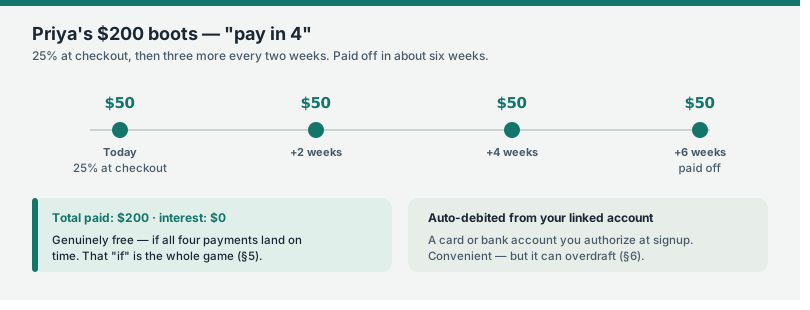
The schedule is the whole product: Priya pays $50 at checkout, then $50 every two weeks for three more cycles, and at the six-week mark she's paid exactly $200 with zero interest. Used this way, pay-in-4 is genuinely free — there's no finance charge, no fee, no catch, provided all four payments land on time. That last clause is doing enormous work, and it's the difference between the tool and the trap (the fees and what-happens-if-you-miss are §5).
A few mechanics underneath the simple picture matter more than they look.
The biweekly cadence is fast, and it's deliberate. Four payments over six weeks aligns loosely with biweekly paychecks — a selling point — but it also means Priya is committing the next three of her pay periods to this purchase. On a tight student budget of ~$1,300 a month, four $50 hits in six weeks isn't nothing, and it overlaps with whatever else she might split the same way. The short, fast schedule feels manageable per-payment precisely because each slice is small — which is the point.
Auto-debit is the engine, and it cuts both ways. Priya authorizes the provider to pull each installment automatically from a linked card or bank account at signup. That's convenient — she won't forget a payment — but it also means money leaves her account on the provider's schedule whether or not she's tracking it, and if the linked account is short when a debit hits, it can trigger an overdraft or a failed payment (the §6 linked-account risks). The automation that protects her from forgetting is the same automation that can quietly overdraw her.
The "feels small" psychology is the hook. "$50 today" lands very differently than "$200 today," even though Priya is committing to the full $200 the moment she taps. Splitting the price reframes the purchase as cheap and the decision as trivial — which is exactly why BNPL drives more spending (the §opening business model, and the §14 overspend mechanics). The number on the button is a quarter of the real obligation.
So the honest read of pay-in-4: against simply paying outright with cash or debit, it offers nothing but a cash-flow spread — if Priya already has $200, paying it now is simplest and carries no obligation or miss-risk. Where pay-in-4 genuinely helps is smoothing a purchase she can comfortably afford across a few paychecks without paying interest — a real, if narrow, benefit. The discipline it requires is small but non-negotiable: make all four payments on time, and keep the linked account funded when each debit hits. Do that, and it's free. Miss the "if," and §5 begins.
That's the free, short version. The other face — the longer monthly plan that carries a real interest rate — works quite differently, and that's the next turn.
3. The other face — the interest-bearing monthly loan
The pay-in-4 plan is free; the other BNPL product is not, and the danger is that they wear the same checkout button. For larger purchases, providers — Affirm most prominently — offer longer monthly installment plans, running anywhere from a few months to several years, and these carry a real APR. This face isn't a clever payment split; it's an ordinary installment loan — fixed amount, fixed monthly payment, fixed term, fixed interest rate — the same structure as Maya's car loan (Lessons 1–2), complete with a TILA disclosure showing the APR, the finance charge, and the total of payments (that's DW#2). Putting the two faces side by side is the heart of this section:
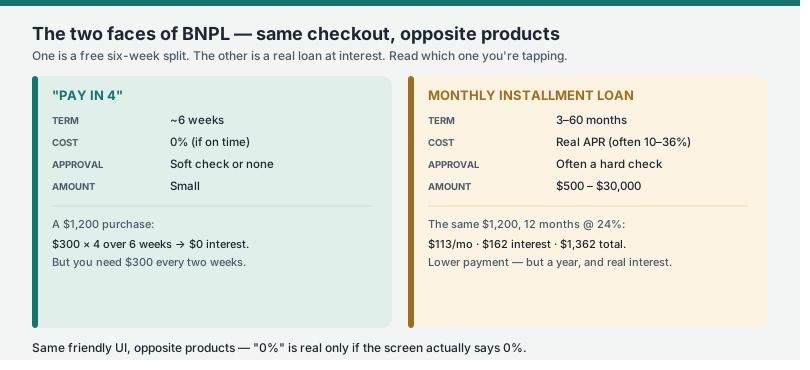
The contrast is the whole lesson of this section. On the same $1,200 purchase, pay-in-4 means $300 every two weeks for six weeks at zero interest — free, but it demands $300 a paycheck. The monthly plan means a much gentler $113 a month, but stretched over a year and carrying $162 in interest, for a total of $1,362. That trade — a smaller payment in exchange for real interest and a long commitment — is the principle exactly: a longer term lowers the monthly payment but raises the total cost. And Affirm's terms run as long as 60 months on big-ticket items (Lesson 6 §opening), so on a large purchase the interest can stack up substantially.
This is where the danger lives, and it's specific to BNPL's branding. The two faces are offered under the same provider name, in the same checkout flow, with the same friendly interface. A person — Hector, say — who used pay-in-4 a few times and internalized "BNPL = no interest" can tap into a longer plan for a $1,200 laptop he needs for a side gig and find himself in a real interest-bearing loan at 24%, possibly after a hard credit inquiry (unlike pay-in-4's soft check, the §4 subject), without registering that the product changed underneath him. The word "BNPL" spanning both a free six-week split and a 24% multi-year loan is precisely the confusion this lesson exists to clear up.
Two refinements complete the picture. First, some longer plans genuinely are 0% — a provider may offer true 0% promotional financing on, say, a mattress for 12 months, which (like a real balance-transfer 0%, Lesson 5) costs nothing if paid in the window. But Hector must read which one he's getting, because the same screen also offers interest-bearing plans, and — the Lesson 5 §22 warning carried forward — he should check whether a "no interest" offer is a true 0% or a deferred-interest trap that bills retroactively. The protective habit is identical: the word "if" and the phrase "no interest if paid in full" are the tell. Second, because the interest-bearing plan is a real loan, it comes with the TILA disclosure that DW#2 will read in full — the APR, the finance charge, the total of payments — which means the cost is there to check, printed, before he commits. The failure isn't that the cost is hidden; it's that the friendly UI invites him not to look.
So the key teaching of §3 is a single instruction: always read the APR. "0%" is real only if the screen actually says 0%. Maya, disciplined, checks the rate before tapping and treats a monthly BNPL plan exactly as she'd treat any other loan — a decision, not a payment method. Hector, assuming "BNPL = free," is the one this face catches. The same friendly button leads to two opposite products, and the entire skill is knowing which one you're standing in front of.
That difference in approval — soft check for the free split, often a hard inquiry for the real loan — is worth its own look, because it affects Hector's credit before he's borrowed a dollar. How BNPL approval works is the next turn.
4. Getting approved — easy by design, and what that hides
The speed of BNPL approval is a feature people love and rarely examine. For pay-in-4, approval is typically instant, based on a soft credit check or none at all — which means tapping "pay in 4" at checkout does not trigger a hard inquiry and doesn't ding Priya's score to apply. The provider decides in seconds using its own model: the purchase amount, any history she has with them, sometimes a soft pull or a peek at her bank/debit data. Compared with getting a credit card, it's a different universe:
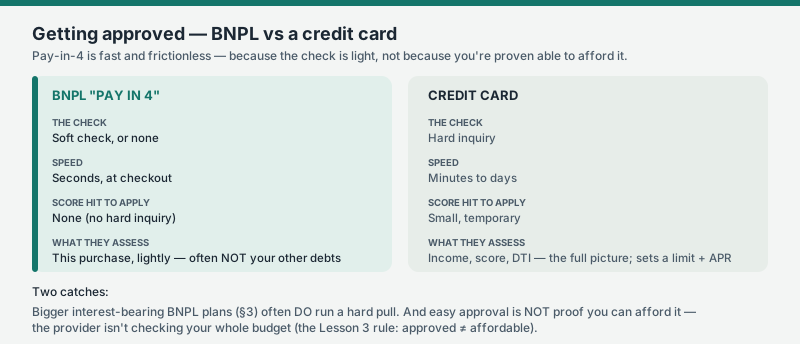
Why is pay-in-4 approval so easy? The amounts are small, the term is short, the provider earns from the merchant fee rather than from underwriting Priya carefully (the §opening business model), and BNPL has — for now — escaped much of the underwriting regulation that governs cards and mortgages. Low friction is the product. For a credit card, by contrast, the issuer runs a hard inquiry, evaluates her income, score, and debt-to-income, and sets a limit and APR — a real assessment of her ability to repay (Lesson 5 §2). Pay-in-4 skips almost all of that.
That gap has a genuine upside worth stating plainly: easy approval makes BNPL accessible to exactly the people cards turn away. Priya — thin-file, maybe no card yet — can get a pay-in-4 plan in seconds, with no hard inquiry and no score damage for trying. For someone building credit or short on options, that accessibility is real and valuable, and it's a large part of why BNPL caught on with younger and cash-tight users.
But the same lightness creates the lesson's recurring risk, and it has two parts. First, the "what they assess" row: because the check is light and per-purchase, the provider often doesn't see — or doesn't count — Priya's other BNPL plans or debts. Each provider underwrites its own little loan in isolation, so she (or Hector) can be approved for a fifth plan that, added to the other four, she can't actually afford, because no one is looking at the total. This is the seed of stacking and phantom debt (§15), and it's the specific concern regulators have raised: the CFPB flagged accumulating debt and "regulatory arbitrage" as central risks of BNPL — the product sidestepping the ability-to-repay scrutiny that cards and mortgages face (the Lesson 3 ATR idea). Second, and following directly: easy approval is not proof you can afford it. The provider clicking "approved" is the Lesson 3 approved-isn't-affordable point in its purest form — the lender isn't checking Priya's whole budget, so the approval carries no signal about whether the payments fit her life. She has to be her own affordability check, because the system isn't doing it for her.
Two clarifications round out the picture. The frictionless soft-check story is the pay-in-4 story; the bigger interest-bearing plans from §3 often do run a hard inquiry and fuller underwriting (which is why your APR there depends on your credit) — so "BNPL doesn't affect my credit to apply" is true for the free split and not reliably true for the real loan. And the soft check at approval shouldn't be confused with the plan being invisible forever: even a plan approved with no hard pull can later report to the bureaus and hurt her if she misses (the §12 credit shift). The check to get in is light; the consequences of getting it wrong are increasingly real.
So the honest read of BNPL approval: it's a real benefit for access — fast, soft, no score hit to use the free version — and a real trap for discipline, because the ease removes the natural friction (and the lender's affordability check) that would otherwise make Priya pause. Approval means the provider will lend; it never means she should borrow.
The next turn turns to what happens when the easy approval meets a missed payment — the fees, and the consequences of falling behind. That's §5.
5. When you miss — the small fee, and the cascade behind it
Pay-in-4 is free if every payment lands on time — and §opening's sobering statistic is that 41% of BNPL users paid late on at least one loan, so missing is common, not rare. What happens when Priya misses isn't one fee; it's a small fee with a potentially large cascade behind it. Here's what one missed $50 payment can actually set off:
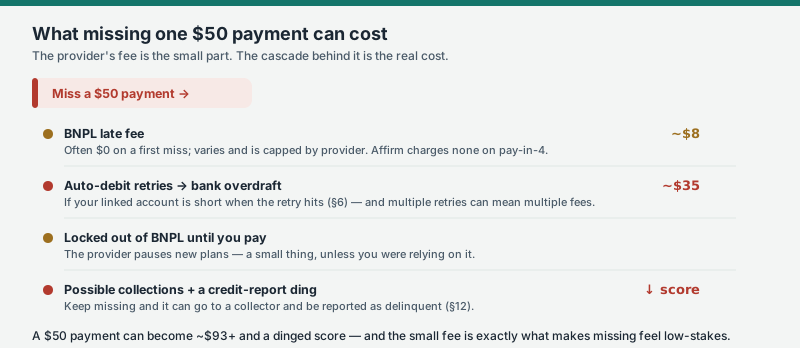
The breakdown is deliberately ordered from the cost people expect to the cost that actually hurts. The late fee is the part everyone anticipates, and it's genuinely small: the providers that charge one — Afterpay, Klarna, Sezzle, Zip — typically assess around $7–$8 per missed payment, frequently waive it on a first miss, and cap the total (often at a fraction of the order value), while Affirm charges no late fee at all on pay-in-4 (the §opening grounding). If the late fee were the whole story, missing a payment would be a minor annoyance. It isn't the whole story.
The cost that matters most isn't the provider's — it's your own bank's. Because pay-in-4 is auto-debited (§2), a missed payment usually means the debit failed — and when it fails, the provider commonly retries it. If Priya's linked debit account is short when that retry hits, her bank charges an overdraft or returned-payment fee of around $35 — and because providers may retry more than once, a single missed installment can spawn multiple overdrafts. So the $8 late fee sits on top of a $35-and-up bank cascade that has nothing to do with BNPL's posted terms and everything to do with the auto-debit mechanics (the full §6 subject). The small, visible fee is dwarfed by the larger, invisible one.
If the missing continues, the consequences widen. The provider locks Priya out of new BNPL plans until she's current — minor unless she'd come to rely on it. More seriously, a persistently unpaid plan can be sent to a collections agency — a third-party collector, with all the stress and contact that entails — and, now that BNPL is starting to report, reported to the bureaus as a delinquency, dinging her score much like a missed card payment would (the §12 credit shift). The "credit-lite" reputation that made missing feel consequence-free is precisely the assumption that's no longer safe.
And on an interest-bearing monthly plan (§3), missing is worse still: late fees and continued interest accrual, with default carrying the same weight as defaulting on any installment loan — collections, credit damage, potentially the whole balance coming due.
Put together for Priya: she misses a single $50 installment because her debit account ran low, picks up an $8 late fee, the retry overdrafts her account for $35, and she's locked out until she clears it — so a $50 payment has effectively cost her ~$93 plus a hit to her account and, if it lingers, her credit. That disproportion — a small obligation generating a fee several times its own size — is the trap, and the reason it's a trap is exactly that the headline fee is small. "$8" reads as low-stakes, so people don't fund the linked account or track the date as carefully as the real downside warrants. And the danger multiplies across stacked plans: Hector, juggling five BNPL plans across three providers, doesn't risk one cascade — he risks several at once, on a pay schedule no single statement reconciles for him (the §15 phantom-debt problem). With 41% of users missing at least one payment, this isn't an edge case; it's the modal BNPL experience for a large share of borrowers.
The defense is unglamorous and effective, and it's Maya's habit: keep a small buffer in the linked account so a retry can never overdraft, and track every due date so nothing slips. The entire cascade is avoidable — it only fires when a debit hits an empty account or a date goes unwatched. Treated as the real obligations they are, with a funded account behind them, the four payments stay free; treated as frictionless taps against whatever happens to be in checking, they're a $50 commitment that can detonate into $93 and a collections call.
The mechanism doing the most damage here — the auto-debit pulling against a linked account that may be short — deserves its own close look, because which account Priya links changes the risk entirely. That's §6.
6. Auto-debit and the account you link — where the quiet damage happens
Every BNPL plan runs on auto-debit: at signup, Priya authorizes the provider to pull each installment automatically from a linked payment method. That method can be a debit card or bank account, or it can be a credit card — and which one she links changes the entire risk profile of the "free" plan. This is the single most consequential setup choice in BNPL, and almost no one thinks about it at checkout:
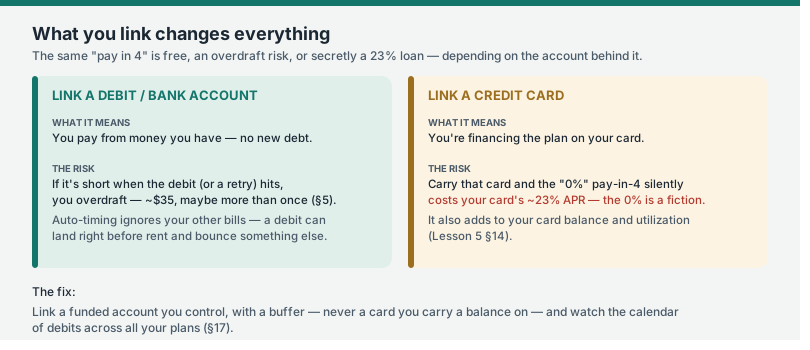
The two columns are two different ways the same "free" plan can go wrong, and they're worth taking one at a time.
Linking a debit or bank account is the better default, because Priya pays from money she actually has — no new debt is created, which is the whole point of staying on the free side of BNPL. But it carries the §5 cascade's trigger: if the account is short when the auto-debit (or a retry) lands, her bank charges an overdraft of about $35, possibly several times. The subtler problem is the auto-timing: the debit fires on the provider's schedule, not Priya's, and it has no awareness of her other bills. A $50 BNPL pull that hits the morning before her rent clears can overdraw the account and bounce the rent payment — so a small BNPL installment can knock over a much larger, much more important obligation. For cash-tight users — the exact population BNPL attracts — a thin balance plus an indifferent auto-debit calendar is the recipe for exactly this.
Linking a credit card is the more insidious mistake, because it quietly negates the free premise. When Hector links a credit card and then carries a balance on that card, his "0% pay-in-4" isn't 0% at all — the money that pays each installment is itself borrowed at his card's ~23% APR. He's added a layer: the BNPL plan is paid by the card, and the card charges interest, so the "free" split is silently costing him 23% (plus, the §22 trap in disguise — it feels free while it isn't). A pay-in-4 is only truly 0% if the account behind it doesn't itself charge interest; financing it on a carried card turns the headline 0% into a fiction. And it compounds the Lesson 5 §14 problem — the BNPL purchase now sits on his card balance, raising his utilization and his carried debt at the same time.
Underneath both columns is the set-and-forget dynamic that makes auto-debit double-edged. The convenience is real — Priya won't forget a payment — but the cost is loss of active control: money moves without her watching, and BNPL obligations slip out of sight, which is precisely what makes overspending feel consequence-free until the debits start piling up. Across stacked plans (§15), this gets genuinely hard to manage: multiple auto-debits hitting on different dates from different providers make her account balance unpredictable, so the overdraft risk doesn't just exist once — it compounds across every plan she's running. And when a debit does fail, providers typically retry — sometimes a few days later, sometimes splitting the charge — so a single shortfall can generate repeated overdraft attempts rather than one clean failure.
The defenses follow directly from the diagnosis, and they're the difference between Maya's experience and Hector's. Link a funded account you control and keep a buffer in it, so a retry can never overdraft. Never link a credit card you carry a balance on, because that alone converts the free product into a 23% one. Watch the calendar of debits across all your plans (the aggregate view of §15 and §17), so no date surprises you. And use the lever most people don't know exists: many providers let Priya reschedule or pause an upcoming payment in the app — but only before it fails, so if money's tight this week, the move is to reschedule ahead of the date, not to let the debit bounce and eat the cascade. Turning on alerts for upcoming debits makes all of this visible.
The honest framing is that auto-debit is both the convenience that makes BNPL frictionless and the mechanism that does most of its quiet harm — and the fix is not to avoid it (manual payments invite the forgotten-payment miss) but to choose the right linked account and keep it funded. Get that one setup choice right, and the most common BNPL injury simply never happens.
That covers how pay-in-4 and its interest-bearing sibling work, get approved, and go wrong. Next we put a real one under the magnifying glass — the first Document Walkthrough: an actual pay-in-4 agreement, shown whole. That's §7.
7. Document Walkthrough #1 — the "Pay in 4" agreement
WHERE & WHAT. This is the contract Priya meets at the exact moment she selects "Pay in 4" at an online checkout — it appears on screen before she confirms the order, and a copy lands in her email as confirmation. It's the actual agreement governing her four payments on the $200 boots: the payment schedule, the auto-pay authorization, the fees, and the miss/return/dispute terms. The provider here is a representative one — call it Paylin — standing in for the Afterpay/Klarna/Sezzle-style pay-in-4 product.
MODE. Fully digital. There's no paper and no signature in the old sense — Priya agrees by tapping a checkbox at checkout. That low-friction "agreement" is easy to tap straight past, which is exactly why it's worth slowing down on.
One thing to notice before we even read it: unlike a credit card's agreement or the interest-bearing loan in DW#2, a pay-in-4 agreement has no TILA "APR box." Because it's 0% and four payments or fewer, pay-in-4 has historically fallen outside Truth-in-Lending, so it carries fewer of the standardized, legally-mandated disclosures you'd see on other credit. That absence is itself part of the lesson — the thinner-disclosure, thinner-protection theme made literal. Here's the whole document:
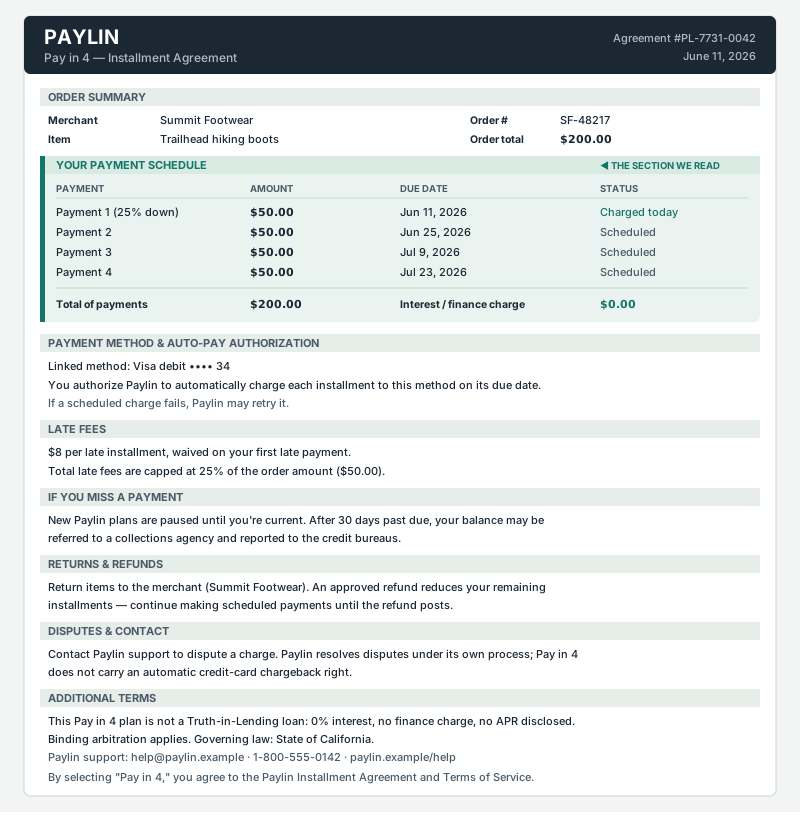
That's the entire agreement Priya taps "agree" on — not a fragment, but the whole artifact: the order summary, the four-payment schedule (the section we'll read closely), the auto-pay authorization, the late-fee terms, the miss/default consequences, the returns and dispute rules, and the additional legal terms. A few things are worth flagging even before the detailed read.
Notice what anchors the document — the payment schedule — and notice what's conspicuously missing: there's a "Total of payments: $200.00" and an "Interest/finance charge: $0.00," but no APR box, no finance-charge disclosure table, none of the TILA furniture a credit card or the DW#2 loan would carry. That's the pay-in-4 disclosure gap made concrete. Notice too the quiet but consequential lines that a person tapping through would never register: the auto-pay authorization (Paylin may charge — and retry — automatically, the §6 risk in writing), the 30-days-to-collections-and-credit-reporting clause (the §5/§12 consequence, stated plainly), and the disputes line admitting that pay-in-4 carries no automatic chargeback right like a credit card (the §opening protection gap, in the contract itself). The document is short and friendly-looking, and that's precisely why the breakdown matters — the most important terms are the easiest ones to skim past.
The next turn reads it section by section at full depth — every field, focus and boilerplate alike, getting the what-it-IS / what-it-DOES-for-Priya / why-it-MATTERS treatment. That's §8.
8. DW#1 Breakdown — the "Pay in 4" agreement, field by field
Masthead — "PAYLIN · Pay in 4 — Installment Agreement." What it is: the lender's name, the product, and the document type. What it does for Priya: it tells her who she's actually borrowing from — not Summit Footwear, the shoe store, but Paylin, a separate financing company. The store sold her the boots; Paylin lent her the money to split them. Why it matters: her counterparty for anything about the financing — a payment, a fee, the schedule — is Paylin, with its own support line and rules, while anything about the boots goes to the store. That single distinction orients every later question in the document. ↳ The word "Installment Agreement" is the quiet tell that this is a loan — a contract to repay in installments — even at 0% and even though it felt like picking a payment method, not signing for credit.
Agreement #PL-7731-0042 and the date. What it is: the unique ID for this specific plan and the day she agreed. What it does: lets both Priya and Paylin point to this plan among any others. Why it matters: once she's running several plans (the stacking problem, §15), the agreement number is how she tells which plan a charge, fee, or dispute belongs to — the first practical handle on phantom debt.
Order Summary — Merchant: Summit Footwear. What it is: the store where the purchase happened. What it does: names who to contact about the product — a return, a defect, an order that never arrives. Why it matters: this is the §13 split made concrete — product problems go to the merchant, payment problems go to Paylin — and confusing the two is the single most common reason BNPL disputes get stuck.
Order #SF-48217. What it is: the merchant's order number, separate from Paylin's agreement number. What it does: ties the financing to the specific purchase in the store's system. Why it matters: a return needs this number for the merchant; a payment problem needs the agreement number for Paylin. ↳ Two different reference numbers for two different parties — it's easy to hand the wrong one to the wrong company and get bounced.
Item: Trailhead hiking boots, and Order total: $200.00. What it is: what she financed, and the purchase price — which equals the amount financed. What it does: the $200 is the basis for everything downstream — the four $50 payments ($200 ÷ 4), and the late-fee cap (25% of $200 = $50). Why it matters: this is the entire obligation, and every other number in the agreement scales off it. There's no markup hidden between "order total" and "amount financed" — on pay-in-4, they're the same figure.
Your Payment Schedule — the four installments. This is the heart of the document, so it gets the closest read. What it is: the exact dates and amounts Priya owes — $50 charged today (June 11), then $50 on June 25, $50 on July 9, and $50 on July 23. What it does: each of those is an auto-debit date — money leaves her linked account on each one automatically. Why it matters: these four dates are the ones she must keep her linked account funded for, because missing any single one triggers the §5 cascade — and Paylin will not check this schedule against her rent due date or her other BNPL plans. This schedule is the one thing she should copy straight into her own calendar; it's the only place all four dates live in her control. ↳ The cadence is every two weeks, not monthly — four payments inside six weeks, faster than most people expect when they tap.
"Payment 1 (25% down) — Charged today." What it is: the down payment, taken immediately at checkout. What it does: means Priya has already paid $50 before she even leaves the confirmation page. Why it matters: "pay later" is only three-quarters true — a full quarter is "pay now." The product's name slightly oversells how much of the cost is actually deferred.
The Status column (Charged today / Scheduled). What it is: the state of each payment. What it does: shows what's completed versus pending. Why it matters: it lets her verify that payment 1 actually went through and the other three are correctly queued — a quick check that catches a setup error before it becomes a missed payment.
Total of payments: $200.00. What it is: the sum of the four installments. What it does: confirms the total equals the purchase price. Why it matters: this line is the proof that pay-in-4 is free — total of payments equals order total, so she pays exactly what the boots cost and not a cent more. (Hold this number; in DW#2's interest-bearing loan, the total of payments will be larger than the price, and the gap is the interest.)
Interest / finance charge: $0.00. What it is: the cost of financing — zero. What it does: confirms the 0%. Why it matters: this single line is the entire value proposition of pay-in-4, and it's exactly the line that quietly stops being true if she's late or if she'd chosen an interest-bearing plan (§3). ↳ A $0 finance charge is not a promise the plan stays free — a late fee isn't classified as "interest," so it won't appear on this line, but it's still very much a cost if she misses.
Payment Method — Linked: Visa debit •••• 34. What it is: the account Paylin will auto-charge. What it does: every installment pulls from her debit account ending 34. Why it matters: this is the §6 choice made literal — she linked a debit account, which is the safer pick (no financing-at-23%, unlike a carried credit card) but carries the overdraft risk if it's short. The four dates above are precisely the dates this account must hold at least $50.
"You authorize Paylin to automatically charge each installment on its due date." What it is: the auto-debit authorization — her standing permission for Paylin to pull money. What it does: means she never manually pays; it happens on its own. Why it matters: this is the convenience (she won't forget) and the loss of active control (§6) — money moves on Paylin's schedule, not hers — and this one sentence is the legal basis for all of it. Agreeing to "Pay in 4" is agreeing to this.
"If a scheduled charge fails, Paylin may retry it." What it is: the retry term. What it does: if her debit account is short on a due date, Paylin tries the charge again. Why it matters: this is the overdraft-cascade trigger from §5 and §6 — a retry against a short account can generate repeated overdraft fees from her bank, which is the part that turns an $8 problem into a $90 one. It may be the most expensive sentence in the whole document, and it's tucked quietly into the auto-pay section. ↳ "May retry" means each retry is another chance to overdraft your bank account — those overdraft fees are yours, not Paylin's, and Paylin's retry doesn't know or care what else is in your account.
That's the first half — the identity of the lender, the purchase, the schedule that runs the whole plan, and the auto-pay machinery behind it. The next turn finishes the document: the late-fee terms, the miss-and-default consequences, returns and refunds, the dispute rights (and their limits), and the additional legal terms — including the line admitting this isn't a Truth-in-Lending loan. That's §8 part 2.
Late Fees — "$8 per late installment, waived on your first late payment." What it is: the charge for a missed installment. What it does for Priya: costs her $8 each time a payment is late, with the first miss forgiven. Why it matters: in isolation it's small — and that smallness is exactly the §5 trap, because the $8 on this line is not where the real damage is. The first-miss waiver is a genuine, if one-time, grace. ↳ $8 looks trivial — but it's the auto-debit retry overdrafting your bank (§6), not this $8, that turns a missed payment into ~$90. Don't let the small number on this line set your guard.
"Total late fees are capped at 25% of the order amount ($50.00)." What it is: the ceiling on Paylin's late fees for this plan. What it does: no matter how many installments Priya misses, Paylin's late fees on the $200 order can't exceed $50. Why it matters: it's a real consumer protection — her fees can't spiral on Paylin's side. But the cap covers the wrong number from a damage standpoint. ↳ The 25% cap limits Paylin's fees only — it does nothing to cap your bank's overdraft fees, which are separate and uncapped. The reassuring ceiling sits over the smaller of the two costs.
If You Miss a Payment — "New Paylin plans are paused until you're current." What it is: the lockout. What it does: blocks Priya from opening new BNPL plans until she catches up. Why it matters: mostly a nudge to pay, minor unless she'd come to lean on BNPL — and, mildly helpful, it stops her stacking more while she's already behind.
"After 30 days past due, your balance may be referred to a collections agency and reported to the credit bureaus." What it is: the escalation timeline and its two serious consequences. What it does: at 30 days late, a $50 boots installment can be handed to a collector and land on Priya's credit report. Why it matters: this is the single line that makes BNPL "real" — the §12 credit shift written into the contract. The whole "credit-lite, it doesn't show up" reputation dies right here. ↳ "May be reported to the credit bureaus" is the sentence that ends the "BNPL doesn't affect my credit" assumption — an unpaid $50 here can ding your score and put a collector on the phone, exactly like a missed card payment.
Returns & Refunds — "Return items to the merchant (Summit Footwear)." What it is: where returns go. What it does: sends product problems to the store, not Paylin. Why it matters: the §13 split again — Paylin financed the boots but can't take them back; only Summit can authorize the refund. Contact the wrong party and Priya gets bounced between them.
"An approved refund reduces your remaining installments — continue making scheduled payments until the refund posts." What it is: how a refund interacts with the auto-debit schedule. What it does: a refund shrinks or cancels what's left to pay — but the auto-debits keep running until that refund actually posts. Why it matters: this is the BNPL refund trap. Priya can return the boots, then watch another $50 get pulled from her account before the refund lands, leaving her temporarily out of pocket on an item she no longer has. Money goes out before money comes back. ↳ Don't stop the auto-debits because you returned something — the refund isn't instant, and skipping a scheduled payment mid-return triggers a late fee on an item you're sending back. Keep paying until the credit actually appears.
Disputes & Contact — "Contact Paylin support to dispute a charge." What it is: the dispute channel. What it does: routes disputes to Paylin. Why it matters: her recourse runs entirely through Paylin's own process — there's no card issuer standing behind her here.
"Paylin resolves disputes under its own process; Pay in 4 does not carry an automatic credit-card chargeback right." What it is: the limit of her dispute power. What it does: tells Priya plainly that she does not have the automatic chargeback right a credit card would give her (Lesson 5 §24). Why it matters: this is the §opening protection gap, in writing. Because the CFPB rule that would have granted pay-in-4 card-like dispute rights was rescinded in 2025 and not reissued, she's relying on Paylin's goodwill and internal process rather than a federal right to force a reversal. A merchant who won't make it right leaves her with far less leverage than a card would. ↳ This is the protection gap made explicit. On a credit card you can compel a reversal; on pay-in-4 you're depending on the provider choosing to side with you. Same purchase, weaker recourse.
Additional Terms — "This Pay in 4 plan is not a Truth-in-Lending loan: 0% interest, no finance charge, no APR disclosed." What it is: the document's disclosure status. What it does: explains why there's no APR box anywhere on the page — pay-in-4 sits outside Truth-in-Lending. Why it matters: the absence of the standardized TILA disclosures isn't an oversight; it's the regulatory gap, and it's the reason this agreement can be so short and friendly compared with a card's dense booklet. ↳ "Not a Truth-in-Lending loan" is the reason this document has no APR box and fewer mandated disclosures than a credit card — or than the DW#2 loan we'll read next. The gap is the point, not an accident.
"Binding arbitration applies." What it is: the dispute-resolution clause. What it does: sends most legal disputes to private arbitration rather than court. Why it matters: it limits Priya's legal recourse — typically waiving her right to sue or join a class action. ↳ Standard across most consumer finance, but real: with a tap, you're giving up the right to take Paylin to court or join a class action.
"Governing law: State of California," and the contact/agreement lines. What it is: which state's law governs, plus support contacts and the agree-by-tapping mechanism. What it does: sets the legal framework (and state BNPL rules vary, the §opening patchwork), and confirms that selecting "Pay in 4" is the signature. Why it matters: there's no wet signature and no separate signing step — agreeing is a checkbox at checkout, which is precisely why a document this consequential is so easy to accept unread. That ease is the whole reason this walkthrough exists.
What the whole document taught. Read end to end, the pay-in-4 agreement is short, plain, and friendly — and its most important lines are the easiest to skim: the retry clause (the overdraft trigger), the 30-day collections-and-reporting clause (the credit consequence), the keep-paying-during-a-return clause (the refund trap), the no-automatic-chargeback line (the protection gap), and the not-a-TILA-loan line (the disclosure gap). None of those is hidden or deceptive — they're stated openly. The skill isn't decoding fine print; it's slowing down enough to read terms a friendly one-tap checkout invites you to ignore. Priya now knows which five sentences to find before she agrees.
That's the free product, fully documented. The next turn shows the other BNPL document — DW#2, an interest-bearing monthly installment agreement, which does carry a full TILA disclosure — so the contrast between the two faces becomes a contrast between two real contracts. That's §9.
9. Document Walkthrough #2 — the interest-bearing installment loan
WHERE & WHAT. This is the agreement Hector meets when, at the same kind of checkout, he chooses a longer monthly plan — "12 monthly payments" — for a $1,200 laptop, the interest-bearing path from §3. It's the same provider Priya used for her boots (Paylin), now showing its monthly installment-loan product instead of pay-in-4. Two differences from DW#1 are baked in before he even reads it: this plan required a hard credit check (§4), and the APR he's shown — 24% — was set by his credit. A copy is emailed.
WHAT, precisely. An Installment Loan Agreement — a genuine closed-end loan — whose signature feature is a Truth in Lending Disclosure, the federal "box" (APR / Finance Charge / Amount Financed / Total of Payments) you saw on Maya's car loan in Lesson 2. This is the standardized disclosure that pay-in-4 lacked entirely.
MODE. Digital, agreed at checkout, emailed — but underwritten with a hard pull and priced to his credit.
The contrast to hold in mind while reading: DW#1's schedule said "Interest / finance charge: $0.00" and the document had no APR box at all. This one has a $161.76 finance charge and a 24% APR sitting in a federal box near the top. Same provider, same friendly flow — opposite cost. Reading that box is how Hector knows which of the two BNPL products he's actually standing in. Here's the whole agreement:
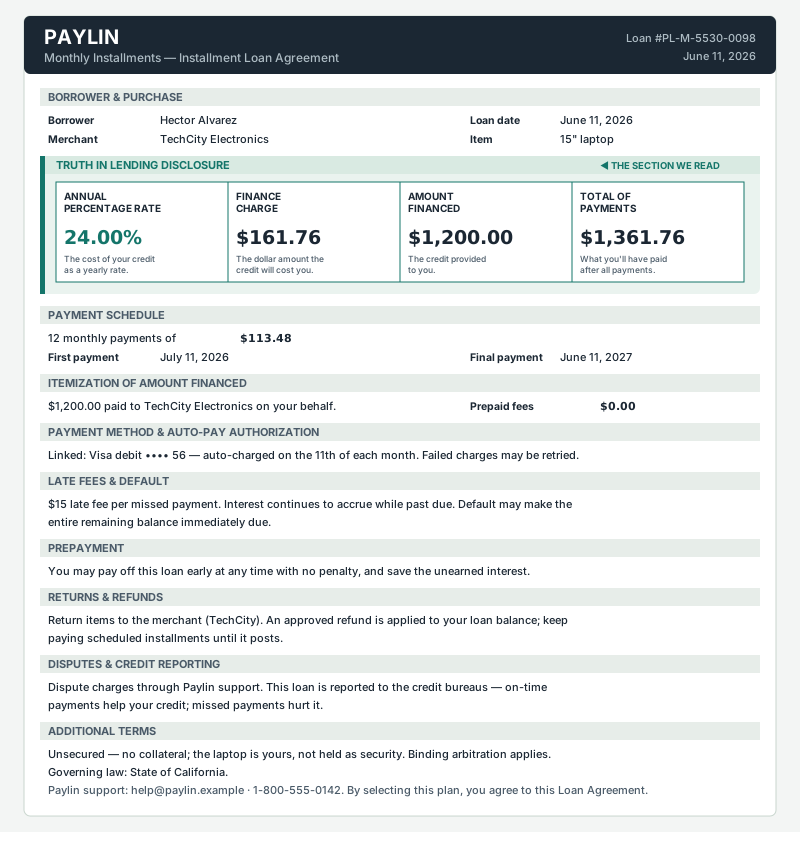
That's the whole loan agreement Hector taps "agree" on — and side by side with DW#1, the difference between BNPL's two faces stops being a slogan and becomes two visibly different contracts. A few things jump out even before the detailed read.
The document is anchored by the federal Truth in Lending box — the same four-cell disclosure (APR, Finance Charge, Amount Financed, Total of Payments) that governs a car loan or a mortgage — and that box exists here precisely because this is a real loan and pay-in-4 wasn't. The single most important contrast in the whole lesson is sitting in two numbers: DW#1 said Finance Charge $0.00; DW#2 says Finance Charge $161.76. The $1,200 laptop will cost Hector $1,361.76 by the time he's done — the "Total of Payments" line — and that $161.76 gap is the interest, the price of stretching the purchase over a year instead of six weeks.
Notice, too, the things this document has that the pay-in-4 agreement didn't: a prepayment clause (he can pay early and save the unearned interest — a real lever), an itemization showing the $1,200 went straight to the merchant with no padded fees, and an explicit credit-reporting line stating this loan is reported to the bureaus, so on-time payments help and missed ones hurt. That last point flips the script from DW#1: the free plan only reported when something went wrong; this loan reports either way, which means it can actually build Hector's credit if he pays it well. The same friendly checkout produced a fundamentally different financial instrument — and the federal box near the top is the tell that lets him know it.
The next turn reads this agreement section by section at full depth — the TILA box cell by cell, the schedule, the itemization, prepayment, the fees, and the credit-reporting and legal terms — and draws the explicit DW#1-vs-DW#2 contrast. That's §10.
10. DW#2 Breakdown — the installment loan, field by field
Masthead — "PAYLIN · Monthly Installments — Installment Loan Agreement." What it is: the same lender as Priya's boots, but its monthly product, and the document is titled a Loan Agreement. What it does for Hector: tells him he's dealing with the company he may already associate with "free" BNPL — except this is a different product from the same shop. Why it matters: the word "Loan" (not just "Installment Agreement") is the unambiguous signal that this is borrowing with interest, and the federal box below will prove it. ↳ Identical Paylin branding to the free pay-in-4 plan — but "Loan Agreement" plus the APR box are the tells that this is a real interest-bearing loan, not a free split. The logo is the same; the product is not.
Loan #PL-M-5530-0098 and the loan date. What it is: the unique identifier and origination date. What it does: names this specific debt and starts its clock. Why it matters: it's Hector's handle for this loan among his obligations, and the date sets the schedule (first payment a month out). Distinct from pay-in-4's agreement number — a different product gets a different kind of ID.
Borrower — Hector Alvarez. What it is: the named obligor. What it does: puts Hector personally on the hook for the loan. Why it matters: unlike pay-in-4's lighter, almost-not-a-loan feel, he is named as the borrower on a loan that reports to the credit bureaus — his credit is now tied to how he pays this. Being "the borrower" here carries weight pay-in-4 didn't.
Merchant — TechCity Electronics, and Item — 15″ laptop. What it is: where he bought it and what he financed. What it does: product problems route to TechCity; the laptop is the thing the $1,200 bought. Why it matters: the same merchant-vs-lender split as DW#1 — returns and defects go to TechCity, payments and loan questions go to Paylin. And note what the laptop is not: it isn't collateral (the loan is unsecured, per the additional terms), so Paylin can't repossess it — this is a personal loan against the purchase, not a secured one.
The Truth in Lending Disclosure — the federal box. This is the heart of the document and the thing pay-in-4 entirely lacked, so it gets the closest read. It's the same four-cell federal disclosure that governed Maya's car loan in Lesson 2, and the four numbers together tell Hector everything about the cost of borrowing.
Cell 1 — ANNUAL PERCENTAGE RATE: 24.00%. What it is: the cost of his credit as a yearly rate — the all-in price of borrowing, annualized and standardized. What it does: tells Hector he's borrowing at 24%, a rate set by his credit when Paylin ran the hard pull (§4). Why it matters: this is the number to read before tapping, because it's the entire difference between this product and the free pay-in-4 — and 24% is a real, card-level rate. If Hector walked in assuming "BNPL means no interest," this single cell corrects him. ↳ The APR is the standardized, comparable cost — hold it against the alternatives. At 24%, this "BNPL" monthly plan is no cheaper than carrying a balance on a credit card; it is not a discount, it's a loan.
Cell 2 — FINANCE CHARGE: $161.76. What it is: the APR expressed in actual dollars — the real money the credit will cost him. What it does: turns "24%" into "$161.76 of interest on top of the $1,200." Why it matters: the APR is the rate; this is the bill. It's the concrete price of stretching the laptop over a year instead of paying cash or using pay-in-4. ↳ This is the exact line that read "$0.00" on Priya's pay-in-4 agreement. The same federal box would say $0 there and $161.76 here — so finding this one cell instantly tells you which of BNPL's two faces you're looking at.
Cell 3 — AMOUNT FINANCED: $1,200.00. What it is: the credit actually provided — here, exactly the laptop's price. What it does: names the principal he's borrowing. Why it matters: because it equals the purchase price (the itemization confirms $0 in rolled-in fees), there's no padding — Hector is financing the laptop and nothing else. That clean match is worth confirming, because some loans quietly bundle fees into the amount financed; this one doesn't.
Cell 4 — TOTAL OF PAYMENTS: $1,361.76. What it is: what he'll have paid after all twelve installments — the amount financed plus the finance charge. What it does: states the true total cost of buying the laptop this way. Why it matters: this is the honest sticker price of the decision — a $1,200 laptop costs $1,361.76 on this plan — and holding that figure against the $1,200 cash price is the Lesson 3 affordability check made concrete. ↳ Total of Payments minus Amount Financed equals the Finance Charge ($1,361.76 − $1,200.00 = $161.76). The box cross-checks itself — if those three numbers don't reconcile, something's wrong, and that's worth a call before you agree.
Payment Schedule — "12 monthly payments of $113.48." What it is: the fixed monthly payment. What it does: $113.48 auto-debits every month for a year. Why it matters: this is the number that has to fit Hector's budget every month for twelve months (Lesson 3) — a year-long commitment versus pay-in-4's six weeks. The low monthly figure is the appeal and the reason it costs $162: spreading a fixed amount over a longer term lowers each payment but raises the total interest (the Lesson 1–2 principle). The gentler $113/month is exactly what the $161.76 buys. ↳ $113/month feels easy next to pay-in-4's $300 every two weeks — but "easier monthly payment" is the trade you make for "more total interest and a year on the hook," not a free lunch.
First payment July 11, 2026 · Final payment June 11, 2027. What it is: the start and end of the loan. What it does: the loan runs a full year, with the first bill a month after signing. Why it matters: those are twelve specific dates Hector's linked account must hold $113.48 — and the obligation will outlast the novelty of the laptop. ↳ The first payment is a month out, not "25% today" like pay-in-4 — that gap before the first bill can make the loan feel free at the start. It isn't; the meter started the day he signed.
That's the loan's identity, its full federal cost disclosure, and the schedule that runs it — with the $0.00-vs-$161.76 contrast that defines BNPL's two faces sitting right in the box. The next turn finishes the document: the itemization, the auto-pay authorization, the late-and-default terms, the prepayment lever, returns, the credit-reporting line (the one that can build his credit), and the legal terms. That's §10 part 2.
Itemization of Amount Financed — "$1,200.00 paid to TechCity Electronics on your behalf · Prepaid fees: $0.00." What it is: a breakdown of where the financed money actually went. What it does for Hector: confirms the full $1,200 went to the store for the laptop, with no fees rolled into the loan. Why it matters: it's the proof behind the federal box — the "Amount Financed" equals the purchase price because nothing was padded in. This is the cell that catches a common loan trick, where a lender quietly bundles an origination fee into the amount financed so you pay interest on the fee too. Here, $0.00 prepaid fees means the loan is clean. ↳ Always read the itemization against the "Amount Financed" cell — if they match the purchase price with $0 in fees, nothing's hidden; if the amount financed is bigger than what you bought, a fee got rolled in and you're paying interest on it.
Payment Method & Auto-Pay — "Visa debit ••56, auto-charged on the 11th of each month. Failed charges may be retried." What it is: the linked account and the monthly auto-debit authorization. What it does: pulls $113.48 from Hector's debit account on the 11th, every month, automatically. Why it matters: same §6 mechanics as pay-in-4, with a longer fuse — it's twelve monthly auto-debits instead of four biweekly ones, so the linked account must hold $113.48 on twelve specific dates across a full year, and the retry clause carries the same overdraft-cascade risk. The longer the loan, the more chances for a short account to trigger a bank fee. ↳ "May be retried" is the same overdraft trigger as the pay-in-4 plan — and over twelve months, that's twelve separate dates your bank account can get caught short. Keep the buffer (§6).
Late Fees & Default — "$15 late fee per missed payment. Interest continues to accrue while past due. Default may make the entire remaining balance immediately due." What it is: the consequences of falling behind on a loan (heavier than pay-in-4's). What it does: a missed payment costs $15, interest keeps running on the unpaid balance, and serious default can trigger acceleration — the whole remaining balance becoming due at once. Why it matters: this is materially more dangerous than pay-in-4's $8-capped fees. Here the interest doesn't pause when he's late (so the cost grows), and acceleration means a single deep default could turn a manageable $113/month into a demand for the entire remaining balance. A real loan has real teeth. ↳ "Acceleration" is the scary one: default badly enough and you don't just owe the late payment — you can owe the whole remaining loan at once. This clause doesn't exist on a six-week pay-in-4 plan; it's the price of a real loan.
Prepayment — "You may pay off this loan early at any time with no penalty, and save the unearned interest." What it is: his right to pay ahead. What it does: lets Hector clear the loan early without a penalty and stop paying interest on the time he skips. Why it matters: this is a genuinely valuable lever and the opposite of a deferred-interest trap — if Hector comes into money in month four, paying it off then means he only owes interest for the four months he borrowed, saving a chunk of the $161.76. ↳ "No prepayment penalty" plus "save the unearned interest" means paying early genuinely costs less — the finance charge isn't fixed, it shrinks the sooner you finish. Always confirm a loan has this before signing; some don't.
Returns & Refunds — "Return to TechCity; an approved refund is applied to your loan balance; keep paying until it posts." What it is: the return mechanics. What it does: product returns go to the merchant; an approved refund pays down the loan (rather than coming back as cash), and the auto-debits keep running until it posts. Why it matters: the same refund-timing trap as DW#1 — Hector keeps owing payments during the gap before the refund lands — with the wrinkle that the refund reduces his balance rather than refunding him directly. Returning the laptop doesn't instantly end the loan; it credits the loan once processed. ↳ Don't stop the monthly auto-debits because you returned the item — a skipped payment mid-return still triggers the $15 late fee and keeps interest running, on a loan that's being refunded anyway.
Disputes & Credit Reporting — "Dispute through Paylin; this loan is reported to the credit bureaus — on-time payments help, missed payments hurt." What it is: the dispute channel and the credit-reporting status. What it does: routes disputes to Paylin, and tells Hector plainly that this loan reports to the bureaus both ways. Why it matters: this is the most important difference from pay-in-4's reporting. The free plan only surfaced on his credit when something went wrong (30 days late → collections); this loan reports every month, so paid well, it can build Hector's credit like any installment loan (Lesson 4) — and paid badly, it damages it just as reliably. The interest-bearing product is the one that actually helps his score if he handles it right. ↳ This loan reporting "both ways" is a double edge: it's the one BNPL product that can genuinely build your credit with on-time payments — and the one that will reliably hurt it if you miss. Pay-in-4 mostly only reports the bad.
Additional Terms — "Unsecured; binding arbitration; governing law: California; agree by selecting the plan." What it is: the legal frame. What it does: confirms the loan is unsecured (the laptop isn't collateral, so it can't be repossessed for nonpayment — though the debt still follows him), sends disputes to arbitration (waiving court and class actions, as in DW#1), sets California law (and state BNPL rules vary, the §opening patchwork), and confirms that selecting the plan is the signature. Why it matters: "unsecured" is genuinely reassuring on the asset side — he keeps the laptop — but it doesn't soften the credit and collections consequences of default. And, as with pay-in-4, a one-tap "agree" carries a full loan's worth of legal weight. ↳ "Unsecured" means they can't take the laptop — but they can still send the debt to collections, sue (subject to arbitration), and report it. No collateral isn't the same as no consequences.
Closing the two-document contrast. Reading DW#1 and DW#2 back to back is the whole point of the pair, because they're the same provider, same checkout, same one-tap agreement — and structurally opposite products. The pay-in-4 agreement: no APR box, $0.00 finance charge, four biweekly payments, six weeks, soft-check, mostly reports only when you fail, and no automatic chargeback right. The installment loan: a full TILA box at 24% APR, $161.76 finance charge, twelve monthly payments, a year, hard-pull underwriting, reports both ways (so it can build credit), and an acceleration clause if you default badly. The single fastest way to tell them apart is the one habit this lesson keeps returning to: find the finance charge. If it says $0.00, you're in the free six-week split; if it shows real dollars, you're in a real loan — and the friendly interface will not make that distinction for you. Hector now knows to look at that one line before he taps, every time.
That completes both Document Walkthroughs. The next turn steps back from the documents to compare BNPL against the credit card head-to-head — when each is the better tool, across cost, protections, credit-building, and the overspend pull. That's §11.
11. BNPL vs the credit card — when each is the better tool
BNPL and the credit card are the closest substitutes in the curriculum — both let you take the item now and pay over time — so the real question isn't which is "better" in the abstract, but which is the better tool for a given purchase and a given person. Laid out across the dimensions that matter:
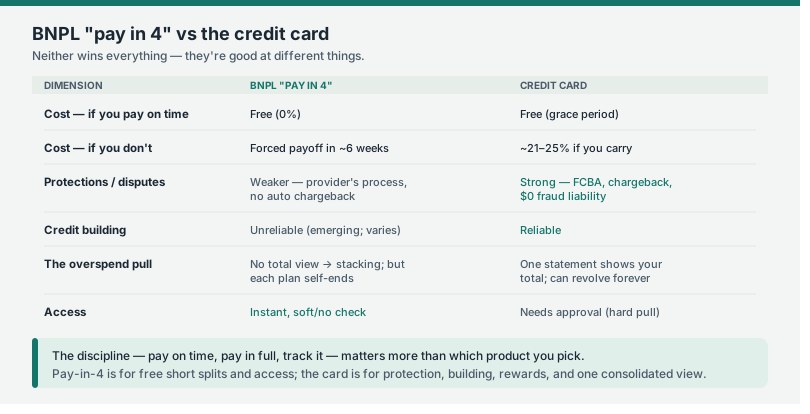
Walking the rows shows that the contest is closer than BNPL's reputation (or the card's) would suggest, and that each tool genuinely wins some dimensions.
On cost, they tie if you're disciplined: pay-in-4 paid on time is free, and a credit card paid in full within its grace period is also free (Lesson 5). They also tie if you're not: an interest-bearing BNPL loan runs a real APR, and a carried card balance runs ~21–25% — both expensive. The whole cost question collapses into the same one the card lesson asked: do you pay it off? The product barely matters; the discipline does. There's one subtle structural difference worth noting, though — a single pay-in-4 plan forces payoff in about six weeks, whereas a card balance can revolve indefinitely, so on the narrow question of "could this debt linger for years," the card is the one that lets it.
On protections, the card wins decisively. It carries the FCBA dispute rights, the automatic chargeback, $0 fraud liability, and claims-and-defenses (Lesson 5 §21/§24). BNPL, after the CFPB rule was rescinded (§opening), gives Priya only the provider's own dispute process and no automatic chargeback right — the gap that was written into DW#1's contract. For any purchase that's large, risky, or from an unfamiliar merchant, the card's chargeback shield is a real reason to prefer it.
On credit-building, the card also wins for now. A card reliably reports payment history and utilization and builds credit (Lessons 4–5); BNPL is uneven — pay-in-4 often reports only when something goes wrong, while interest-bearing loans increasingly report both ways (the §12 shift), so BNPL can't yet be counted on to build credit the way a card can.
On the overspend pull, it's genuinely mixed. The card hands Priya one statement that shows her whole balance and utilization — a consolidated view BNPL lacks — but it also lets that balance revolve forever. BNPL has no aggregate view (the stacking/phantom-debt problem, §15) and its splitting reframes cost as trivial, which pushes toward overspending — yet each individual pay-in-4 plan self-terminates in six weeks, which is a built-in brake a card balance doesn't have. Neither is clearly safer; they fail differently.
On access, BNPL wins cleanly: instant approval with a soft check or none makes pay-in-4 available to thin-file users like Priya whom a card would turn away (§4).
So when is each the better tool? Pay-in-4 is the better choice when Priya wants to split a specific, affordable purchase interest-free over six weeks, will pay on time, and tracks it — or when she simply can't get (or doesn't want) a card, where its access and forced payoff are real virtues. The credit card is the better choice when the purchase is big or risky enough that the chargeback protection matters, when she wants reliable credit-building or rewards, or when she values seeing all her spending in one place — provided she pays in full. For most purchases by someone who has a card and pays it off, the card is at least as good as pay-in-4 and better protected. And for the head-to-head that's really a wash — interest-bearing BNPL vs carrying a card balance — the move is to compare the actual APRs, weigh the card's stronger protections against the BNPL loan's fixed payoff date and possible credit-building, and recognize that either way you're borrowing at interest, which is the thing to avoid if you can.
The honest synthesis is the panel's line: the discipline matters more than the product. Used well, pay-in-4 is a fine, even good, narrow tool — free short splits and access. Used well, a card is more powerful and better protected. The worst outcomes don't come from picking the "wrong" product; they come from using BNPL's frictionless stacking to overspend, or from financing at interest on either one. Priya, thin-file, leans on pay-in-4 now and will add a card's protections as her credit grows (Lesson 4); Maya, who has a card and pays in full, routes most purchases through it for the protection and rewards and uses pay-in-4 only to smooth the occasional affordable purchase — tracked. Hector is the cautionary: handed both tools, he uses BNPL's ease to overspend rather than the card's protection to buy well. BNPL isn't a card-killer and isn't a card; it's a narrower instrument, best used for the specific thing it's genuinely good at.
The next turn digs into the dimension that's changing fastest — how BNPL now affects your credit, the reporting shift, and what it means for building or hurting your score. That's §12, with a live recency check.
12. BNPL & your credit — the reporting shift
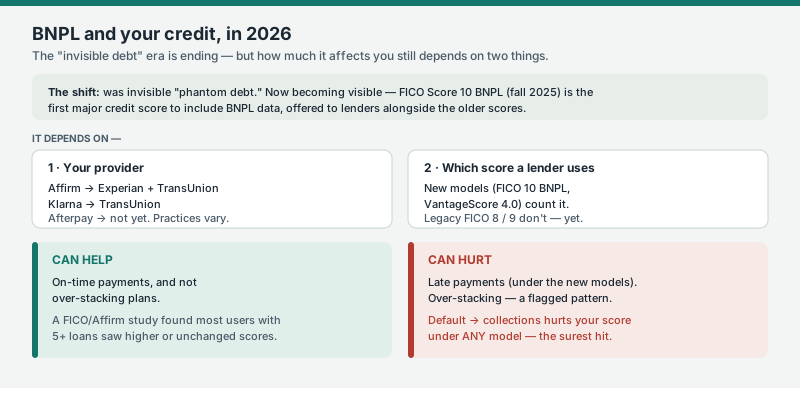
For most of BNPL's history, the answer to "does this affect my credit?" was simply no — the loans didn't report, so they were invisible to the bureaus, and a person could stack four or five plans across providers without a single one showing up. That invisibility is exactly what made BNPL feel low-stakes, and it's exactly what's ending. The pivotal change: in June 2025 FICO announced FICO Score 10 BNPL and FICO Score 10 T BNPL, available in fall 2025 — the first major credit scores to incorporate BNPL data — and several providers began furnishing that data to the bureaus.
But the honest 2026 answer is "increasingly yes — and it depends on two things," which the panel lays out, because overstating it would be as misleading as the old "it's invisible."
It depends, first, on the provider. Reporting is uneven: Affirm reports loans to Experian and TransUnion, Klarna reports to TransUnion, and Afterpay does not currently report at all — practices vary by company. So whether Priya's particular plan shows up at all hinges on which provider she used.
It depends, second, on which score a lender pulls. The new BNPL-aware models (FICO Score 10 BNPL, and VantageScore 4.0, which is built to use alternative data like BNPL) count the loans — but the legacy scores that still dominate most lending decisions, FICO 8 and 9, don't yet. BNPL tradelines currently sit tagged and largely excluded from those legacy scores. FICO is offering the BNPL versions side by side with the older ones, letting each lender choose. Because of that, and because it takes time for enough BNPL data to accumulate at the bureaus, industry voices caution that meaningful, widespread score impact may still take a while to fully arrive. The direction, however, is unambiguous and one-way: toward visible. The safe planning assumption for 2026 is "assume BNPL can affect my credit," because that's where it's heading and you can't control which score a future lender uses.
Within that, the effect cuts both ways. On the helping side, responsible use can genuinely add positive history: a FICO/Affirm study found that most consumers with five or more Affirm BNPL loans saw their scores rise or stay the same, and an interest-bearing BNPL loan like DW#2 that reports both ways can build credit the way any installment loan does (Lesson 4) — and FICO built in safeguards meant to avoid over-penalizing reasonable BNPL usage. On the hurting side, late payments can now ding a score under the new models (about one in four BNPL users paid late last year), and over-stacking many loans in a short window is a behavior the models specifically watch. And cutting through all the model-dependence is the one consequence that has always been true and stays true: a defaulted BNPL debt sent to collections (DW#1's 30-day clause) hurts your credit under any score model. Collections is the surest credit hit BNPL can deliver, regardless of which provider or which score.
For the three borrowers, the shift lands differently. Priya, who's actively building credit (Lesson 4), can treat a reporting provider's on-time plan as a modest bonus to her positive history — but she shouldn't rely on it, given how uneven reporting is; her credit-builder loan and secured card remain her dependable builders, and the rule is on-time-and-don't-over-stack. Hector, with five plans across three providers, is the one the shift turns into a warning: debt that used to be invisible can now surface to lenders using the new models, a missed payment can ding him, and a default drops him into collections — the phantom debt is materializing into his credit file. Maya, disciplined, is barely affected or even slightly helped — she pays on time and doesn't over-stack, so a reporting provider simply adds a clean tradeline.
The practical takeaways are short and robust to all the uncertainty: assume BNPL can affect your credit now (it's trending that way and you don't control the lender's score choice); pay on time (the one rule that protects you under every model); don't over-stack (it's both a debt problem and a flagged credit pattern); check whether your provider reports if you're specifically trying to build (Affirm and Klarna do, in part; Afterpay doesn't yet); and above all avoid the default-to-collections path, because that's the one credit hit that lands no matter what. The era when BNPL was a free pass on your credit report is closing — which makes the discipline this lesson keeps returning to matter more, not less.
The next turn takes the other thing that gets messy with BNPL — returns, refunds, and disputes — including the protection gap and its shifting legal status. That's §13, with a live recency check.
13. Returns, refunds & disputes
This is BNPL's weakest consumer-protection area, and it's worth understanding why it gets messy: a single BNPL purchase involves three parties — Priya, the merchant who sold the item, and the provider who financed it — with no single clean process binding them together. When everything goes smoothly, that's invisible. When it doesn't, the seams show.
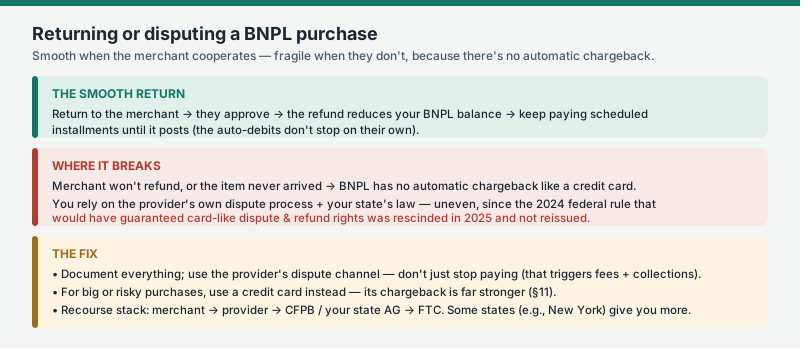
The smooth return is the common case, and it's the one DW#1 and DW#2 already described. Priya returns the boots to the merchant — Summit Footwear, not Paylin, because the provider only financed them and can't take them back — the merchant approves the refund, and the refund is applied to her BNPL balance, reducing or canceling the remaining installments. The catch, carried straight from the documents: the auto-debits don't stop on their own. She has to keep making scheduled payments until the refund actually posts, which means she can return an item and still watch another $50 get pulled before the credit lands — temporarily out of pocket on something she no longer owns. The defensive move is precise: return promptly, get written confirmation, and keep paying until the refund appears — because skipping a payment mid-return triggers a late fee on an item she's sending back, which is the worst of both worlds.
Where it breaks is the part that distinguishes BNPL from a credit card, and it's the §opening protection gap made operational. If the merchant won't refund, or the item never arrives, or it shows up defective and the seller stonewalls — Priya has no automatic chargeback right. With a credit card, she could invoke her FCBA dispute rights and have the issuer simply reverse the charge (Lesson 5 §24); the issuer would claw the money back from the merchant on her behalf. BNPL gives her no such guaranteed federal lever. The 2024 CFPB interpretive rule would have changed this — it was explicitly designed to give BNPL borrowers card-like rights to dispute charges, withhold payment during an investigation, and demand refunds for returned or undelivered goods — but it was rescinded in 2025 and not reissued. So federally, when a merchant refuses to cooperate, she's left relying on the provider's own dispute process and chasing the merchant herself — and consumer advocates have documented exactly the "runaround" this produces: weeks of hassle, sometimes still making payments on a product she never received, with no automatic reversal to fall back on.
That said, the picture isn't uniform, because the federal floor isn't the whole story. Her actual rights depend on two things beyond federal law. Some states have stepped in — New York's BNPL law, for instance, builds in many of the card-like dispute and refund protections the federal rule would have required — so depending on where Priya lives, she may have more. And some providers voluntarily follow those rescinded-rule protections as best practices, so depending on which provider she used, she may also have more. The result is a genuine patchwork: her dispute power is a function of her state and her provider, not a guaranteed national baseline.
The practical playbook follows directly, and it's the panel's third band. Don't just stop paying when something goes wrong — a missed payment triggers fees, collections, and a credit ding (§5, §12) on top of the dispute, which makes a bad situation worse; instead, document everything and use the provider's formal dispute channel. For big or risky purchases — an expensive item, an unfamiliar online seller — the smarter move is preventive: use a credit card instead of BNPL, precisely because the card's chargeback is far stronger than any BNPL dispute process (§11). And if the provider's process fails, the recourse stack is the system's standard one — merchant → provider → CFPB complaint → state attorney general → FTC — with the state AG carrying extra weight in states that have passed BNPL laws, and the CFPB used alongside the others given its reduced capacity (Lesson 2).
The three borrowers show the range. Priya's damaged boots are the smooth-but-annoying case: she returns them, gets confirmation, and keeps paying the $50s until the refund posts — out of pocket briefly, but fine. Hector's is the hard case: he buys something on BNPL that never arrives, the merchant goes quiet, and with no automatic chargeback he's stuck chasing both the merchant and the provider — the runaround — when a credit card would have reversed the charge in a few clicks. Maya avoids the whole problem by design: for a big purchase from an unknown online seller, she deliberately uses her credit card rather than BNPL, buying herself the chargeback shield for exactly the moment it might be needed.
The honest framing: BNPL's return-and-dispute process is workable when the merchant cooperates and fragile when they don't — and the gap, after the federal rule's reversal, is real and currently wider than it briefly looked like it would be. None of this makes BNPL unusable; it makes it the wrong tool for purchases where the dispute risk is high. Returns from a cooperative merchant are fine. A risky purchase you might need to fight over belongs on a card.
The next turn turns from the mechanics to the behavior BNPL encourages — why splitting a price into small payments makes people spend more. That's §14, the overspending mechanics.
14. Why BNPL makes you spend more — the mechanics
Recall the business model from §opening: merchants pay BNPL providers 3 to 6 percent of each sale because consumers buy more and spend more with BNPL. That single fact reframes this entire section — overspending isn't an accidental side effect of BNPL; it's the function the merchant is paying for. Understanding how it works is the only real defense, because you can't resist a nudge you can't see. Here's the core of it:
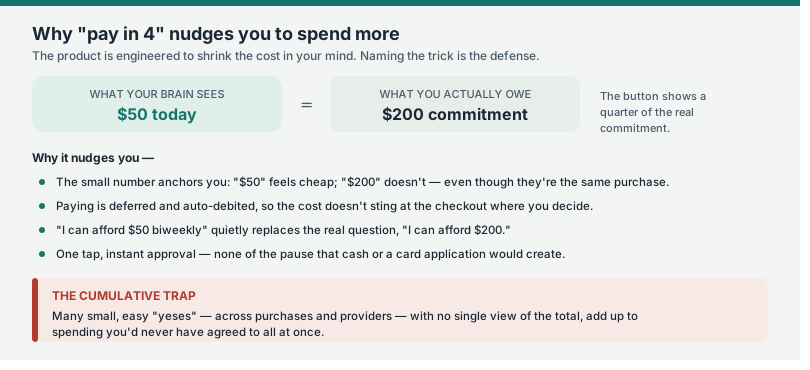
The mechanisms break into two groups — the psychological reframing of a single purchase, and the structural features that let many purchases accumulate unseen.
The per-purchase psychology starts with what the panel calls the reframe. When Priya sees "$50 today" on the button, her mind anchors on that number, not on the $200 she's actually committing to — and $50 feels cheap while $200 doesn't, even though they're the identical purchase. Splitting the price shrinks it in her perception. On top of that, BNPL reduces the pain of paying: behavioral research is consistent that paying hurts, and that hurt is part of what restrains spending — but BNPL gets Priya the pleasure of the item now while the pain of paying is deferred and auto-debited later, out of sight, so the friction that would normally make her hesitate is stripped out at the exact moment she decides. Then comes the affordability illusion: "I can afford $50 biweekly" feels true even when "I can afford $200" isn't, so the small-payment framing quietly swaps the budget question for an easier one — the same trap as Lesson 2's low-monthly-payment framing and Lesson 3's approved-isn't-affordable point, now applied to a $50 top instead of a car. And wrapping all of it is frictionlessness: one tap, instant approval, no application, which removes the natural pause that counting out cash — or even waiting on a card decision — would have created. Each of these makes a single purchase feel smaller and easier than it is, which is precisely why BNPL reliably raises average order value — people add an extra item or trade up to a pricier one because "a little more" reads as trivial when it's sliced into four. That lift is the entire reason merchants pay for it.
The structural amplifiers turn those individual nudges into a cumulative problem, and they're the panel's red band. There's no aggregate view — each plan lives in its own app, so Priya never sees her total BNPL commitment in one place (the §15 phantom-debt setup), which means the overspend is invisible in aggregate even when each plan looks fine alone. Auto-debit keeps the cost out of sight — payments leave automatically, so the ongoing drain never registers the way writing a check would. And because BNPL is per-purchase, a person makes many small, separate decisions rather than one big one — a series of easy "yeses" to a jacket, a gadget, takeout, each reframed as trivial, that sum to a total no one ever decided on. The danger of BNPL is rarely any single plan; it's the accumulated pattern of small, frictionless, reframed approvals.
The honest framing matters here, because it's tempting to read all this as "people are just bad with money," and that's both wrong and unhelpful. The mechanisms above are engineered — deliberate reductions of the friction and reframings of the cost that normally make anyone pause. Falling for them isn't a character flaw or a willpower failure; it's the predictable result of a product designed to produce exactly this behavior. Which is why naming the mechanism is the actual defense: once Priya can see "$50 today" as "a $200 decision," the spell weakens and she can choose deliberately instead of being nudged.
That gives the concrete defenses, which §16 and §17 develop but are worth stating now. Re-anchor on the full price, always — "this is a $200 commitment, not a $50 one." Ask the cash test: "would I buy this with cash, right now, at the full price?" — if the answer is no, the split is masking an affordability problem, not solving one. Keep the aggregate view by tracking every plan in one place (§17), so the cumulative total can't hide. And reserve BNPL for planned, affordable purchases rather than impulse add-ons, where the reframing does the most damage.
The three borrowers map onto the mechanism cleanly. Priya's boots were a planned, affordable buy — fine; the next time, though, when she's browsing and sees "$12.50 × 4" on a $50 top she hadn't planned to buy, the small number is the nudge, and only by naming it ("that's a $50 decision") does she keep the choice hers. Hector is the overspend pattern personified — a run of small, easy, reframed "yeses" across jackets and gadgets and takeout that add up to a total he never sat down and agreed to. Maya is immune to the nudge not because she has more willpower but because she has the habit: she re-anchors on the full price and asks whether she'd pay cash, so the reframing simply doesn't land.
The accumulation problem this section keeps gesturing at — many plans, no total view — is serious enough to get its own treatment. That's §15: loan stacking and phantom debt.
15. Loan stacking and phantom debt — the plans no one adds up
The single most BNPL-specific danger isn't any one plan; it's running several at once. Stacking is opening multiple BNPL plans simultaneously — often across different providers — so a person is juggling several installment obligations at the same time. Each was easy to get (§4), each felt trivial (§14), and crucially, no one sees the total. The result is phantom debt — real obligations that don't show up where debt normally shows up. Here's what Hector's looks like:
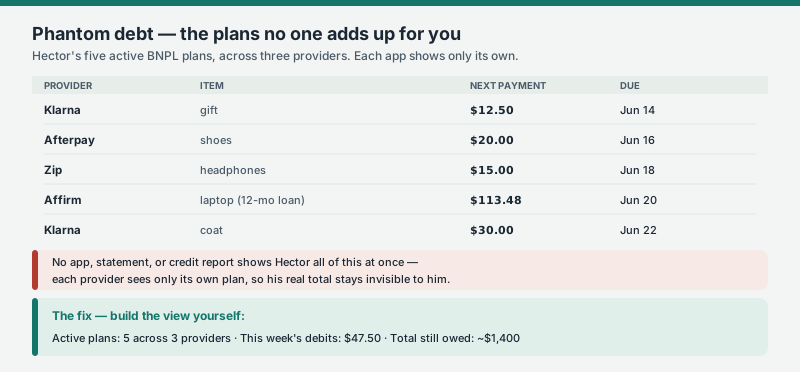
Hector's five plans tell the whole story. Looked at individually, each is unremarkable — $12.50 here, $20 there, a $30 coat — and even the Affirm laptop loan, at $113 a month, felt reasonable when he signed. But no single screen anywhere shows him the bottom row. Klarna's app shows his two Klarna plans; Afterpay shows the shoes; Affirm shows the laptop; Zip shows the headphones — and none of them shows the ~$1,400 he still owes in total or the $47.50 hitting his account just this week across three different providers on three different dates. That invisibility is what "phantom" means: the debt is entirely real, but it doesn't appear in the one place — a consolidated statement — where debt is supposed to appear.
Why stacking happens so easily is just the earlier sections compounding. The per-purchase structure and frictionless approval (§1, §4) mean each plan is a separate, instant decision with nothing tying it to the others. No provider sees Hector's other plans — each underwrites its own little loan in isolation (§4) — so he can be approved well past what he could afford if anyone looked at the sum. The reframing (§14) makes each one feel trivial in the moment. And because the plans live across different apps, with different amounts on different dates, there's simply no single statement to bring them together. The system has no aggregate view by design, and that absence is the entire problem.
What "phantom debt" costs is more than a tidy-bookkeeping annoyance. First, Hector loses track of his calendar of debits — five auto-debits across three providers make his account balance genuinely unpredictable, which multiplies the §6 overdraft risk: a tight week doesn't threaten one cascade, it threatens several at once. Second, he's over-extended without realizing it — the sum of "small" plans quietly exceeds what he can comfortably carry, precisely because he never sees the sum. Third, a cash crunch hits everything simultaneously — if money's short, he doesn't miss one $50 payment, he misses three, picking up multiple late fees, multiple overdrafts, and (now) multiple credit dings (§5, §12). Fourth, stacking is itself a flagged credit behavior under the new models (§12) — opening many loans in a short window is exactly the pattern they watch. And it's serious enough at scale that the Richmond Fed flagged BNPL stacking as a systemic risk and the CFPB has long worried about debt accumulation (§opening, §4). What feels like a handful of small conveniences is, in aggregate, a meaningful and fragile debt load.
The fix is structural, not moral, and that framing matters. Hector didn't stack because he's reckless; he stacked because the system gave him frictionless approval, reframed each cost as trivial, and showed him no total. So the defense is to build the aggregate view the system refuses to give you. Concretely: keep one list — every active plan, its provider, the amount remaining, and the next due date — which is exactly the "fix" row in the panel, and which instantly converts five invisible plans into one visible $1,400. Cap the number of active plans with a personal rule ("never more than two at once"), so the count can't creep. Before opening any new plan, check the list — what's the current total, and what's already debiting this week? Don't stack across providers to dodge a single provider's limit, which is the move that turns a manageable habit into phantom debt. And treat the calendar of debits as one thing (§6, §17), not five separate surprises. One list defeats phantom debt — it's the cheapest, most powerful BNPL habit there is.
The borrowers show the spectrum. Hector is phantom debt embodied — five plans, no view, a tight week away from a multi-plan cascade. Priya, young and cash-tight and therefore at risk, protects herself by capping (one or two plans at a time) and keeping a running list, so her total never goes invisible. Maya simply doesn't stack — one plan at a time, tracked on her calendar — which makes the whole failure mode a non-event for her.
This stacking dynamic — frictionless approval plus no aggregate view plus reframing — isn't only a self-management problem; it's also the soil the lesson's predator grows in. The next turn is §16 — when BNPL makes sense, and when it doesn't — the honest decision framework.
16. When BNPL makes sense — and when it doesn't
After all the mechanics, the practical question is simply: when should Priya actually use this, and when should she walk away? BNPL isn't good or bad — it's a narrow tool that's genuinely useful for one specific job and a trap for several others. Here's the framework, anchored by the single question that does most of the work:
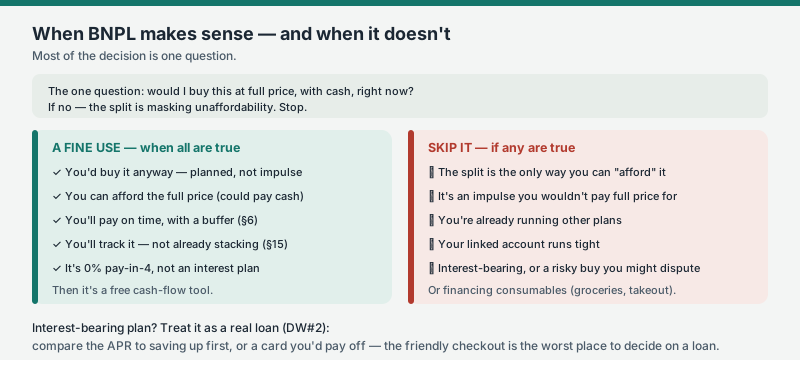
The framework rests on one question, and most of the decision collapses into it: would I buy this at full price, with cash, right now? If the answer is no, the split isn't helping Priya afford something — it's masking the fact that she can't, which is the Lesson 3 affordability principle and the Lesson 2 low-payment trap converging on a checkout button. A "yes" means the split is just smoothing cash flow on something she'd buy regardless; a "no" means BNPL is the only reason the purchase is happening, and that's exactly when it shouldn't.
The green-light conditions — the left column — are all true together when pay-in-4 is a genuinely fine, even smart, use. She'd buy the item anyway (it's planned, not an impulse the reframing conjured). She can afford the full price (the cash test passes). She'll pay on time, with a buffer in the linked account so no auto-debit overdrafts her (§6). She'll track it, and she isn't already stacking (§15). And it's a 0% pay-in-4, not an interest plan in disguise (§3). Under those conditions, pay-in-4 is precisely what it advertises — a free, short cash-flow tool — and using it is no more reckless than splitting a dinner check. This is Maya's selective use and Priya's planned boots: a wanted, affordable purchase, smoothed over six weeks at no cost, tracked.
The red flags — the right column — are each independently disqualifying; any one should stop the purchase. The split being the only way she can "afford" it (masked unaffordability). An impulse she wouldn't pay full price for (the §14 nudge driving the buy). Already running other plans (don't add to the stack, §15). A linked account that runs tight (the overdraft cascade waiting to happen, §5/§6). An interest-bearing plan for something she doesn't actually need to finance, or a big/risky purchase she might need to dispute — where a card's chargeback shield is far stronger (§11, §13). And a category-level red flag worth naming on its own: financing consumables — groceries, takeout, everyday essentials. Splitting a meal she'll have eaten before the fourth payment clears is financing consumption, and routinely doing it is one of the clearest signs BNPL has shifted from a convenience to a way of papering over a budget that doesn't balance — a debt-trap pattern, not a cash-flow tool.
The interest-bearing decision is its own, harder case, flagged at the bottom of the panel. A monthly BNPL loan (DW#2) is a real loan, so it deserves the full Lesson 3 affordability treatment and a genuine comparison: the move is to read the APR (§3) and weigh it against the alternatives — saving up first, a 0% card promo, or a lower-rate personal loan (Lesson 7) — because the friendly checkout is the single worst place to make a financing decision impulsively. An interest-bearing plan makes sense only when Priya genuinely needs the item, can't reasonably pay cash, the APR is competitive with her alternatives, and the payment fits her budget for the whole term — and even then she should watch for the deferred-interest tell (Lesson 5 §22). Most of the time, a moment's pause reveals a cheaper path than financing at the register.
Boiled down, the framework is a five-question checklist Priya can actually run at the checkout: (1) Would I buy this at full price with cash right now? (2) Can I cover every payment on time, with a buffer? (3) Am I already running other plans? (4) Is this 0% pay-in-4, or interest? (5) Might I need to dispute or return it? All green, it's a fine use; any red, she reconsiders. That's small enough to remember and robust enough to catch every trap the lesson has covered.
The honest synthesis is the one the whole lesson has been building toward: BNPL is a narrow tool that's good at exactly one thing — a free, short, tracked cash-flow smoothing of a planned, affordable purchase paid on time. It's the wrong tool for impulse buys, things you can't afford, stacking, risky purchases, and financing consumption. And the line between the two isn't the product — it's the discipline, the same one every lesson returns to: pay on time, pay the whole thing, track it, and don't let the reframing make the decision for you. Used that way, pay-in-4 is genuinely useful. Treated as "free money," it's a slow debt trap wearing a friendly interface.
The next turn makes the "use it well" half concrete — the habits that keep BNPL safe: tracking every plan, funding the buffer, capping the count, and managing the calendar. That's §17.
17. Managing BNPL — adding back the structure the system removes
Every danger in this lesson traces to two design choices: BNPL gives you frictionless approval and no aggregate view. So managing BNPL safely is, at heart, one idea — add back the friction and the view the product strips out. A handful of concrete habits do exactly that, and the centerpiece is so simple it's almost disappointing:
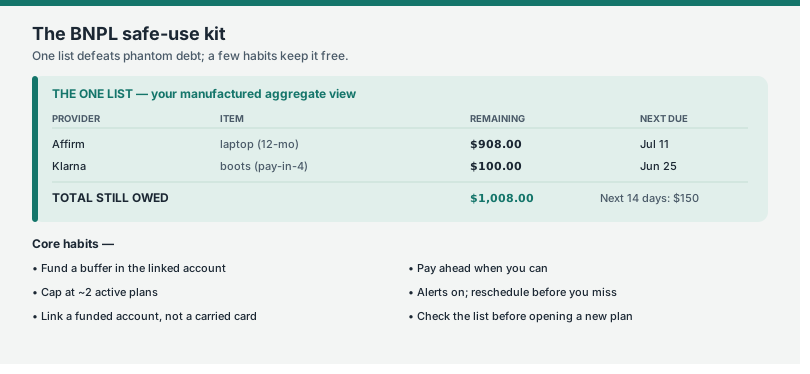
The one list is the whole game, and it's worth being concrete about why. BNPL's defining flaw is that no app, statement, or bureau shows a person their total (the §15 phantom-debt problem) — so the fix is to manufacture that view: a single running list with every active plan's provider, item, amount remaining, and next due date. It can be a note on a phone or a scrap of paper; the format doesn't matter, the existence does. The instant Maya writes her two plans down, "an Affirm thing and a Klarna thing" becomes a crisp $1,008 still owed, $150 due in the next two weeks — a number she can actually reason about against her budget. That list is the cheapest, highest-leverage BNPL habit there is, because it converts invisible obligations into a visible total, which is the one thing the product refuses to do for her.
The other habits cluster around that list and each closes a specific failure mode from earlier in the lesson:
The debit calendar (§6) puts every payment date in one place, so Maya can see the week and month ahead and make sure the linked account is funded before each pull. Across several plans, this single calendar is her overdraft defense — it's how a tight week stops being a surprise.
Fund the buffer (§6) — keep a cushion in the linked account so no auto-debit, and no retry, can ever overdraft. This is the cheapest possible defense against the §5 cascade, because the entire cascade only fires when a debit hits an empty account.
Cap the count (§15) — a personal rule like "never more than two active plans" — stops stacking creep before it starts, keeping the list short enough to actually manage and the total small enough to stay affordable.
Link the right account (§6) — a funded account she controls, not a credit card she carries (which would silently convert her 0% into 23%). The setup choice she makes once protects every payment afterward.
Pay ahead when you can — most providers let her clear remaining pay-in-4 installments early in the app, which removes the miss-risk entirely; and on an interest-bearing loan (DW#2), prepaying with no penalty actually saves her the unearned interest. Finishing early is almost always the right move when cash allows.
Alerts on, and reschedule before you miss (§5/§6) — turn on payment reminders, and if money's tight this week, use the in-app reschedule ahead of the due date rather than letting the debit bounce and eating the fee-plus-overdraft cascade. The lever only works before the miss, not after.
Check the list before opening a new plan (§15/§16) — the friction the system removed, added back by hand. Before tapping "pay in 4" again, Maya glances at the list: what's her current total, what's already debiting this week, and does this new purchase pass the §16 cash test? That five-second pause is the deliberate decision the frictionless checkout was designed to skip.
Two more habits keep the system honest over time. Know your provider's terms — late fee, whether it reports to credit (§12), its dispute process (§13), its reschedule options — because these vary provider to provider, and the differences matter when something goes wrong. And reconcile monthly — a quick check that the list matches reality, removing paid-off plans and catching anything unexpected, so the manufactured view stays accurate rather than drifting into its own kind of phantom.
And the habit for when things have already slipped: if you're behind or overextended, the moves are to stop opening new plans immediately, write everything down to see the true total, prioritize the plans that charge fees or report to credit, use the reschedule tools, and — if it's genuinely underwater — reach out to a nonprofit credit counselor (the legitimate help, never an upfront-fee "debt relief" shop), which the reassurance beat will return to. Getting the full picture on paper is the first step out, exactly as it was the first step to staying safe.
The three borrowers make the payoff concrete. Maya is the model: one list on her phone, every date on her calendar, a buffer in the linked account, a cap of one plan at a time, paying ahead when she can — so BNPL is a complete non-event, a free tool she controls. Priya is building the habit: a simple two-line list, a cap of two, alerts on — learning to manage before she ever needs to. And Hector is the one who needs this section most, because it's the literal cure for his §15 phantom debt — the moment he writes his five scattered plans into one list, the invisible $1,400 becomes visible and, finally, manageable. The structure the product withholds is structure he can supply himself, and doing so is the difference between BNPL as a tool and BNPL as a trap.
That covers using BNPL well. The next turn turns to the practice that exploits everyone who doesn't — the lesson's Predator Watch, on frictionless stacking and the deceptive marketing that fuels it. That's §18.
18. Predator Watch — "phantom debt": frictionless stacking and deceptive marketing
This one is different in shape from the lesson's earlier five predators (Lesson 1's credit-repair scam, Lesson 2's low-payment trap, Lesson 3's max-approval push, Lesson 4's fee-harvester, Lesson 5's deferred interest). It isn't a single scheme with a fake form — it's the predatory edge of the whole BNPL ecosystem: the marketing and design that frame real debt as "harmless," weaponize the frictionlessness, and lean on the now-materializing consequences once someone's in too deep. Its target is Hector, the stacker.
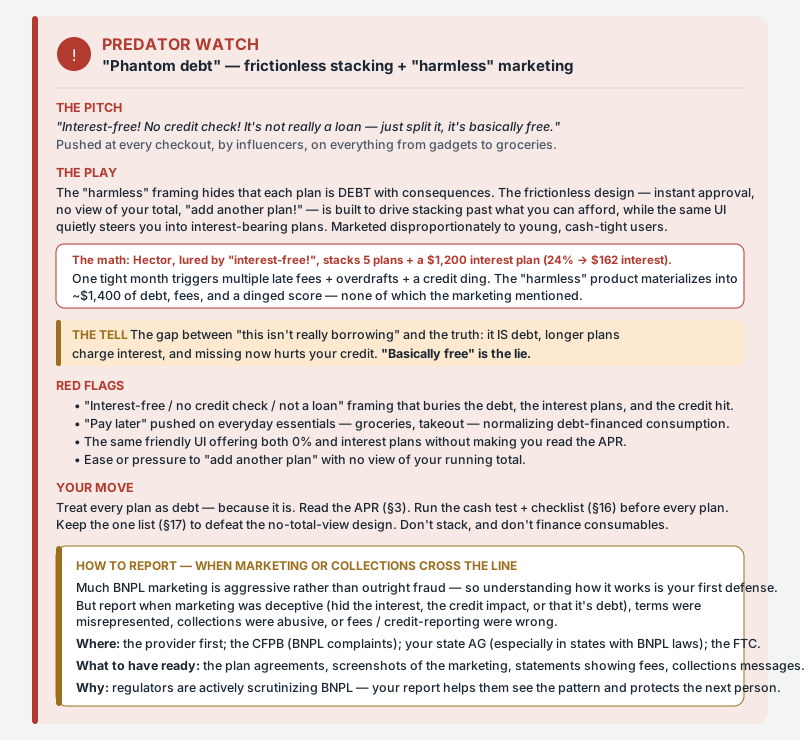
The tell — "this isn't really borrowing" — is the heart of it, and it's worth drawing out because it's subtler than the earlier predators' tells. Lesson 5's deferred-interest trap turned on a single word ("if"); this one turns on a frame. The pitch insists BNPL is not debt — "interest-free, no credit check, basically free, just split it" — and that framing is the lie, because every claim in it is either false or load-bearing in a way the marketing hides. It is debt (each plan is a closed-end loan, §1). "Interest-free" is true only of pay-in-4, while the same friendly interface steers users into interest-bearing plans at 24% (§3). "No credit check" implies no consequences, but missing now hurts your credit and a default goes to collections (§5, §12). The gap between "this isn't really borrowing" and the reality — it is debt, longer plans charge interest, missing hurts your credit — is the entire predatory move. When Hector hears "basically free," he should hear a claim that's engineered to make him stop counting.
Why this rises to "predatory" rather than just "a product with risks" comes down to three things the card lays out. First, the marketing actively obscures that BNPL is debt with real consequences — not by lying about any single term in the agreement (the agreements, as the DWs showed, are honest), but by wrapping the whole product in a "harmless" frame that discourages reading them. Second, the frictionlessness is weaponized: instant approval plus no aggregate view plus "add another plan!" prompts aren't neutral conveniences — they're a design that drives stacking past affordability (§15), and pushing "pay later" onto groceries and takeout normalizes financing consumption a person will have used up before they've paid for it. Third, and most pointedly, this is aimed disproportionately at the financially vulnerable — the young and cash-tight, the population least able to absorb a stacking cascade and most susceptible to "it's basically free." A product that targets the people least able to afford the downside, while framing the downside out of view, has crossed from risky into predatory.
Hector's math shows the materialization. Lured by "interest-free!" framing across providers, he stacks five plans and gets steered into the $1,200 interest-bearing plan ($162 in interest, DW#2). Then one tight month does what a tight month does to a stack: multiple late fees, multiple overdrafts, and a credit ding all at once (§5, §6, §12). The "harmless" product has materialized into roughly $1,400 of debt, plus fees, plus a dinged score — and the reason it blindsides him is precisely that the marketing told him none of this was real. The consequences were always there; the framing just hid them until they arrived.
Your move is the lesson's discipline, applied as armor against the frame. Treat every plan as debt — because it is — which neutralizes the "harmless" framing in one move. Read the APR to tell the free product from the interest one (§3). Run the cash test and checklist before every plan (§16). Keep the one list to defeat the no-aggregate-view design that makes stacking invisible (§17). And don't stack, don't finance consumables. Each of these is a refusal to let the marketing do the deciding.
The How-to-report block carries the lesson's honesty: much BNPL marketing is aggressive rather than outright fraud, so the first and best defense is understanding it — which Hector now does. But it crosses into reportable territory when the marketing is genuinely deceptive (hiding the interest, the credit impact, or the debt nature in a way that misleads), when terms were misrepresented, when collections are abusive (which is governed by the federal Fair Debt Collection Practices Act, regardless of BNPL's other gaps), or when fees or credit-reporting are wrong. The path is the system's recourse stack tuned for BNPL: the provider first, then the CFPB (which takes BNPL complaints and is actively studying the market), the state AG (with real teeth in states like New York that have passed BNPL laws, §13), and the FTC (the deceptive-marketing regulator) — with the plan agreements, screenshots of the marketing, fee statements, and any collections messages in hand. The civic point is concrete: regulators are actively scrutinizing BNPL marketing and practices right now, so a report genuinely helps them see the pattern and protects the next young, cash-tight person handed "it's basically free" at a checkout.
For anyone reading this who's already caught in the stack — who believed "harmless" and now has five plans, a tight month, and a collections message — the next beat is the calm one, and it's for you. That's §19, the reassurance beat.
19. If This Already Happened to You
Some people reading §18 didn't recognize a pitch they're about to face — they recognized their own phone, the five plans across three apps, the tight month, maybe a collections message. This beat is for them, and the core news is genuinely freeing: the problem that feels like a trap is fixed by one free action.
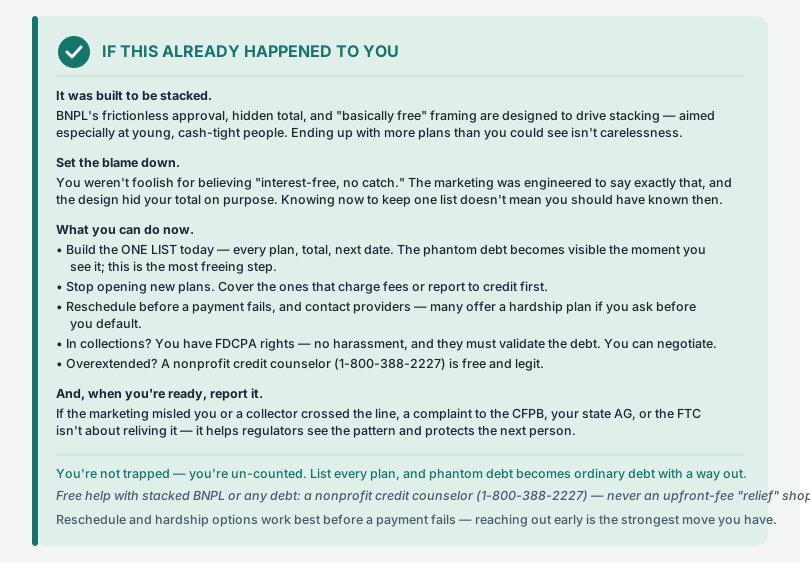
The beat does its four jobs, and the first one matters especially here because phantom debt is designed to make its victims feel uniquely foolish — "how did I lose track of my own spending?" The answer is that it was built to be stacked. The frictionless approval, the absence of any total view, and the "basically free" framing aren't accidents of a product Hector failed to use correctly; they're the design, aimed disproportionately at young, cash-tight people, and ending up with more plans than he could see is the predictable result of that design, not a personal failing. It sets the self-blame down, because "you should have known better" is the wrong lesson when the marketing was engineered to say "no catch" and the system deliberately withheld the one number — the total — that would have let him see the catch. And it reframes reporting as the civic act it is.
But the genuinely freeing part — worth pulling out of the panel — is what you can do now, because phantom debt is unusually recoverable, and most people in it don't realize how quickly the worst feeling lifts.
The single most powerful move is also the simplest: build the one list today. The reason stacking feels like drowning is invisibility — the obligations are scattered, un-summed, lurking. The moment Hector writes every plan into one place — provider, total, next date — the "phantom" evaporates: what felt like a formless dread becomes a concrete number with concrete dates, which is something a person can actually plan around. This is the §17 habit deployed as a rescue rather than a precaution, and it's why the panel calls it the most freeing step. Seeing the total is most of the relief.
From there the moves are ordinary and effective. Stop opening new plans immediately, and triage — cover the plans that charge fees or report to credit first. Use the lever most people don't know they have: reschedule a payment before it fails (most apps allow it), and contact the providers, because many offer a hardship or revised payment plan if Hector reaches out before he defaults — asking early is genuinely the strongest move he has, and it's free. If a debt has already gone to collections, he isn't without rights: the federal Fair Debt Collection Practices Act means collectors can't harass him and must validate the debt on request, and he can dispute or negotiate it. And if he's truly overextended, the legitimate help is the opposite of the predator — a nonprofit credit counselor (1-800-388-2227), free, who'll help him build a plan, never an upfront-fee "debt relief" shop promising to make it disappear.
The throughline of the whole lesson lands gently here. The skill it built — treat every plan as debt, read the APR, keep one list — isn't only armor going forward; it's also the recovery kit for anyone the "harmless" framing already caught, because the central injury (lost visibility) is healed by the central habit (the list). Hector isn't trapped. He's un-counted — and counting, plan by plan, is the way out. The phantom only has power while it stays a phantom.
The next turn is the lesson's protections-and-recourse close — what rights and recourse BNPL users actually have in 2026, gathered in one place, with a live recency check. That's §20.
20. Protections and recourse — what BNPL users actually have in 2026
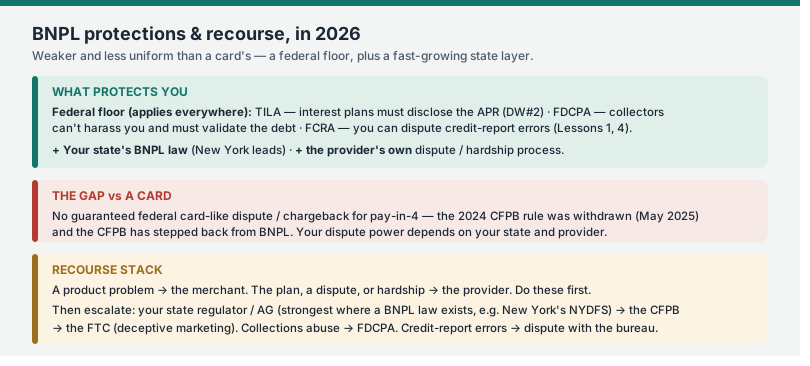
The single most useful frame for BNPL protections is a contrast with the credit card. A card's protections (Lesson 5 §24) are strong, federal, and uniform — the same FCBA dispute rights and chargeback wherever you live. BNPL's are weaker federally, stronger in some states, and dependent on your provider — the locus of protection has shifted from federal-uniform to a state-by-state patchwork. Here's the actual 2026 map:
What protects you — the federal floor — is real but partial. Even after the BNPL-specific rule was withdrawn, several federal laws of general application still cover BNPL, and they matter. TILA governs the interest-bearing loans, which is why DW#2 carried that federal APR-and-finance-charge box — a real BNPL loan must disclose its cost. The FDCPA governs collections, so if Hector's stacked debt goes to a collector, that collector can't harass him and must validate the debt on request (the §19 point). And the FCRA governs credit reporting, so once a BNPL plan reports (§12), Priya can dispute inaccuracies with the bureaus exactly as she would any tradeline (the dispute rights from Lessons 1 and 4). On top of that floor sit her state's law and the provider's own dispute and hardship process. So BNPL isn't a lawless void — the real loans get disclosure, collections are constrained, and credit-report errors are disputable.
The gap — what's missing versus a card — is specific and consequential. Pay-in-4 has no guaranteed federal card-like billing-dispute or chargeback right. The 2024 CFPB interpretive rule that would have given BNPL borrowers those rights was withdrawn in May 2025, and the CFPB has since stepped back from BNPL enforcement — so when a merchant won't refund and the provider won't help, Priya doesn't have a federal lever to compel a reversal the way a cardholder does (§13). That gap is the whole reason a risky purchase belongs on a card. There's also no uniform federal fee cap, periodic statement, or standardized disclosure for pay-in-4 — those, where they exist, now come from the states.
Which is where the real action is. New York has enacted the first comprehensive state BNPL framework — signed into law in May 2025, with implementing regulations proposed by the state's financial regulator (NYDFS) in February 2026 and phasing in. It's substantial: it requires BNPL providers to be licensed by the state, caps and limits fees (including late and penalty fees), mandates clear disclosures of loan terms, sets dispute-resolution standards, adds data-privacy protections, and requires lenders to disclose whether a loan will be reported to the credit bureaus — and it covers both interest-free pay-in-4 and interest-bearing plans. Crucially, this is widely expected to be a model other states follow, precisely because the federal pullback left a vacuum the states are stepping into. The practical upshot for Priya: her protections increasingly depend on where she lives — a New Yorker (or a resident of a state that follows) has meaningfully more than the federal floor, so checking her state's BNPL rules is now worth doing.
The recourse stack follows the pattern from across the curriculum, tuned for BNPL's three-party structure. A product problem goes to the merchant; the plan, a dispute, or a hardship request goes to the provider — and these come first, because most issues resolve there. If they don't, escalate to her state regulator or attorney general — which is now often the strongest lever, especially in a state with a BNPL law like New York's NYDFS — then the CFPB (which still accepts complaints even though its BNPL enforcement is deprioritized), and the FTC for deceptive marketing. Two specialized paths sit alongside: collections abuse is an FDCPA matter (the collector, plus the CFPB/FTC/state AG), and a credit-report error is an FCRA dispute filed with the bureau (Lessons 1, 4).
The honest synthesis: BNPL's protections are real but partial and uneven — a federal floor (TILA on the real loans, FDCPA on collections, FCRA on reporting), a fast-growing state layer led by New York, and the provider's own process — but not the strong, uniform, federal card-like protections. Three practical implications follow. For risky or dispute-prone purchases, prefer a credit card, whose protections are stronger and don't depend on geography (§11, §13). Know your state's rules, because they increasingly determine what you're owed. And — the throughline — because the safety net is thinner, the lesson's discipline matters more, not less: don't overextend, keep the one list, read the APR, and avoid the situations where you'd need strong recourse, since BNPL's is weaker than you might assume. The encouraging direction is that protection is growing and shifting to the states; the catch is that, for now, it's a patchwork.
The three borrowers close the picture. Priya checks whether her state has adopted protections like New York's — if so, she has fee caps and dispute standards; if not, she leans on the federal floor and the provider's process, and is extra careful. Hector, in collections on a stacked plan, is protected by the FDCPA (no harassment, debt validation) and can FCRA-dispute any credit-report error, with deceptive marketing reportable to his state AG and the FTC. Maya simply routes risky purchases to her card for the stronger, uniform protection, reserving BNPL for the low-risk, affordable splits where the thinner safety net is fine.
That completes the lesson's substance — what BNPL is, both its faces, approval, fees, the auto-debit risk, both documents, the card comparison, credit, disputes, overspending, stacking, the decision framework, managing it, the predator, and the protections. What remains is to gather the questions people always ask and let the reader check themselves — the final turn, §21.
21. Most Common Questions
The questions people actually ask about BNPL — paraphrased from the kinds of things that fill personal-finance forums.
Increasingly yes — but it depends. The "invisible" era is ending: FICO's Score 10 BNPL model (fall 2025) is the first to include BNPL data, and some providers report (Affirm to Experian and TransUnion, Klarna to TransUnion; Afterpay not yet). Whether it shows depends on your provider and which score a lender pulls — legacy FICO 8/9 don't count it yet. The safe assumption is that it can affect you: pay on time (helps or is neutral), don't over-stack (a flagged pattern), and above all avoid a default-to-collections, which hurts under any model.
Yes — if you pay all four on time, it's genuinely 0%, no interest or fee. The catches: miss a payment and you get a late fee plus, often worse, a bank overdraft from the auto-debit retry; and the longer monthly BNPL plans aren't free at all — they're real loans at a real APR, often 10–36%. The free product and the interest product wear the same checkout button, so read the APR: "$0 finance charge" means free; a real APR means a loan.
A late fee — typically ~$8, often $0 on a first miss, capped by provider (Affirm charges none on pay-in-4). But the bigger cost is usually your own bank: the failed auto-debit gets retried, and if your account is short, you overdraft (~$35, sometimes more than once). Keep missing and you're locked out of new plans, and after about 30 days the debt can go to collections and hit your credit. The small fee is the trap; the cascade behind it is the real damage. Keep a buffer in the linked account.
Link a funded account you control — a debit card or bank account — and keep a small buffer so an auto-debit can't overdraft you. Do not link a credit card you carry a balance on: that quietly turns your "0% pay in 4" into a loan at your card's ~23% APR, because the money paying each installment is itself borrowed at interest. If you pay your card in full every month a card link is less harmful, but a funded debit account is the cleaner choice.
Stacking is the single biggest BNPL danger. Because each plan is separate and no provider or app shows your total, multiple plans become phantom debt — you lose track of what you owe and which debit hits when, and a tight week can trigger several late fees and overdrafts at once. It's also a flagged behavior under the new credit models. The fix: cap your active plans (say, no more than two) and keep one list of every plan, total, and due date — the aggregate view the system won't give you.
The discipline matters more than the product, but they're good at different things. Pay-in-4 is best for a free, short split of an affordable purchase you'll pay on time and track — and for access if you can't get a card. A credit card paid in full is better for protection (its chargeback is far stronger), reliable credit-building, rewards, and seeing all your spending in one place. For a big or risky purchase you might need to dispute, use the card; for a small planned split, pay-in-4 is fine.
For a normal return: return to the merchant (not the provider), and keep making your scheduled payments until the refund posts — the auto-debits don't stop on their own, and skipping one triggers a late fee on an item you're returning; the refund reduces your balance. The harder case — a merchant who won't refund, or an item that never arrived — is BNPL's weak spot: you don't have a guaranteed chargeback right like a credit card (the 2024 federal rule was withdrawn), so you rely on the provider's dispute process and your state's law. Document everything; for risky purchases, a card's protection is stronger.
Usually yes, and it's often smart. For pay-in-4, you can typically pay the remaining installments early in the app, which removes any miss-risk. For an interest-bearing monthly plan, you can prepay with no penalty and save the unearned interest — the finance charge shrinks the sooner you finish. Confirm there's no prepayment penalty (most BNPL loans don't have one), then pay ahead whenever cash allows.
Check yourself
Six questions across the lesson — tap an answer to see how you did:
Check yourself — Buy Now, Pay Later
Six questions across the lesson — tap an answer to see how you did.
1. Which of the following best describes the structural difference between a pay-in-4 BNPL plan and a credit card?
2. Priya misses a $50 BNPL installment. Her bank charges a $35 overdraft fee when the provider retries the debit. How much has a $50 obligation actually cost her so far?
3. Hector links his credit card (which he carries a balance on) to his pay-in-4 plan. What happens to his "0%" rate?
4. Hector has five BNPL plans across three apps. No single screen shows his total. What does this situation illustrate?
5. Priya sees a $50 top for "$12.50 × 4" on a BNPL screen. She wouldn't buy it at full price today. What should she do?
6. In 2026, which BNPL provider reports loan activity to credit bureaus — on-time payments and missed ones?
That closes Lesson 6. The lesson opened with one claim — that BNPL has two faces, a free six-week split and a real loan at interest, hidden behind the same friendly checkout button — and everything since has been making both faces, and the machinery behind them, legible. Priya, paying her four installments on time and tracking them, gets a genuinely free cash-flow tool and accessible credit she might not otherwise have; Hector, lured by "it's basically free" into five stacked plans and an interest-bearing loan, discovers that frictionless borrowing is still borrowing, materializing into phantom debt, fees, and a dinged score. The product itself is neither good nor bad — it's a narrow tool that rewards being treated as what it is and punishes being treated as "free money."
The single transferable instinct, the one that survives even if every detail fades: "buy now, pay later" is still borrowing — name every plan as the debt it is, read the APR, and keep one list. Read the APR and you'll always know which of the two faces you're looking at. Keep one list and the phantom debt that catches people simply can't form. Treat each plan as debt and the "harmless" framing loses its power. Everything else in the lesson — the auto-debit buffer, the cap on plans, the cash test, the document-reading, the credit and dispute realities, the predator's tell — is in service of staying on the tool side of that line, and finding the way back if you've slipped to the trap side.
Key Takeaways
- Pay-in-4 is genuinely free if every payment lands on time — "buy now, pay later" is still borrowing, and the four installments are a real commitment even when each one feels small.
- The interest-bearing monthly plan is a real loan at a real APR. Read the finance charge field before tapping: $0.00 means free; any real number means you're borrowing at interest.
- Link a funded account and keep a buffer. An auto-debit retry against a short account is the BNPL injury most people never see coming — it turns an $8 late-fee situation into ~$93.
- Phantom debt is real debt. Multiple BNPL plans across providers add up to a total nobody shows you — build one list: every plan, provider, amount, and next due date.
- Run the cash test before every plan: would you buy this at full price with cash right now? If no, the split is masking an affordability problem, not solving one.
- BNPL's consumer protections are weaker than a credit card's. For risky or dispute-prone purchases, use the card — its chargeback is far stronger than any BNPL dispute process.
Quiz — 6 Questions
Answer one at a timeWhich of the following best describes the structural difference between a pay-in-4 BNPL plan and a credit card?