Personal Loans
Unsecured installment loans from banks, credit unions, and online lenders — origination fees, APR comparison, prepayment penalties, and when a personal loan beats a credit card.
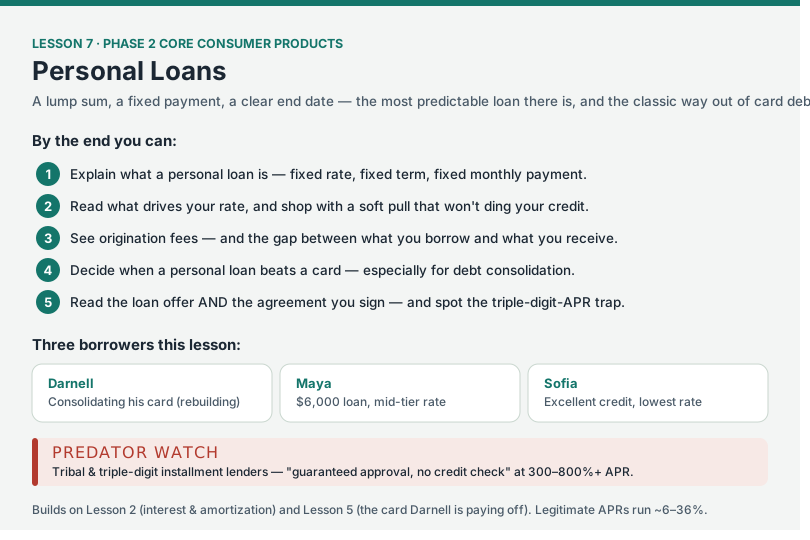
- Define a personal loan as a fixed lump-sum installment loan (usually unsecured) and explain how the four levers — principal, rate, term, and monthly payment — interact.
- Compare secured vs. unsecured personal loans and explain how collateral changes rate, risk, and the realistic options available at different credit tiers.
- Identify what drives rate across credit score bands and explain the credit-union 18% federal cap as a concrete door for fair- and poor-credit borrowers.
- Explain the origination fee's "proceeds gap" — how it separates what you borrow from what you receive — and demonstrate why APR-vs-APR is the only valid loan comparison.
- Apply Darnell's consolidation math to evaluate when a personal loan actually saves money versus when it costs more, and identify the one risk that undoes the win.
- Read a complete loan offer disclosure and a complete loan agreement/promissory note field by field, including the federally mandated TILA box and default clause.
- Recognize the tribal/triple-digit installment lender predator, perform the five-second NMLS check, and know the ACH revocation right, state usury cap, and reporting path.
Opening
Darnell ends Lesson 5 carrying a $2,000 balance on a card charging 22.99%. He's heard there's a cheaper, more predictable way to clear it — borrow a fixed sum, pay it off in equal monthly chunks, and be done on a known date. That's a personal loan, the most straightforward loan in this whole course, and the one most people reach for when they want to consolidate debt or cover a large one-time expense. This lesson is about how it works, what it really costs, when it's the smart move — and the triple-digit-APR trap that targets exactly the borrowers, like Darnell, who need it most.
1. What a personal loan is — the most predictable loan there is
A personal loan is the plain-vanilla loan: you borrow a fixed lump sum, it lands in your bank account, and you repay it in equal monthly payments over a fixed term at a fixed rate — and when the last payment clears, you're done, with nothing left open. Most personal loans are unsecured, meaning there's no collateral behind them (no house, no car the lender can take); they're backed by your promise to pay and your credit. That's the whole shape, and its appeal is exactly its predictability — the opposite of the revolving, open-ended card Darnell is trying to escape.
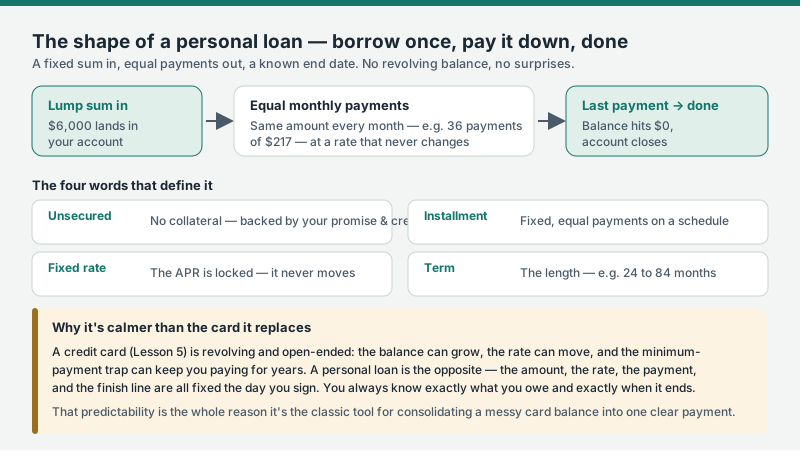
The thing to hold onto is that everything is fixed the day you sign — the amount, the rate, the monthly payment, and the finish line. That's the exact opposite of the card Darnell is escaping, where the balance can grow, the rate can move, and the minimum-payment trap can stretch a debt across years. With a personal loan he knows on day one that he'll pay, say, $217 a month for 36 months and then owe nothing — which is precisely why it's the classic tool for turning a revolving card balance into one predictable payment with an end date. To see how those four fixed levers interact, it helps to put real numbers on them.
2. The anatomy — four levers that set your payment
Every personal loan is built from four numbers: the principal (how much you borrow), the APR (the yearly rate), the term (how many months), and the monthly payment that falls out of those three. Change any one and the others move — a longer term shrinks the monthly payment but grows the total interest; a lower rate does the opposite. Maya is taking a $6,000 loan to cover a used-car repair; drag the levers and watch what she'd actually pay:
Personal loan calculator — Maya's $6,000 car repair
Drag the three levers. The monthly payment, total interest, and total cost update together.
Monthly Payment
$217
Total Interest
$1,809
Total Cost
$7,809
At 18% over 36 months, that's ~$217/mo and ~$1,809 in interest to borrow $6,000. A longer term lowers the payment but raises the interest; a lower rate lowers both.
At her mid-tier 18% over 36 months, Maya's $6,000 repair costs about $217 a month and roughly $1,808 in interest — a total near $7,808. The lever worth understanding is the term: stretching to a longer term makes the monthly payment look friendlier but quietly grows the total interest, because she's renting the money longer (the Lesson 2 lesson, applied here). The honest move is to pick the shortest term whose payment she can comfortably afford — not the longest one that makes the monthly number small. And one important caveat the calculator hasn't shown yet: this is the cost of the loan amount alone. Many personal loans also carry an origination fee that changes what actually lands in her account — which is §5, and one of the most-missed costs in the whole product. First, though, the number that determines almost everything here: the rate, and what sets it.
3. Secured vs unsecured — collateral changes the deal
Most personal loans are unsecured — backed only by your promise to pay and your credit, with no asset attached. But some are secured, meaning you pledge collateral (a savings account or CD, sometimes a vehicle) that the lender can take if you stop paying. The trade is straightforward: collateral lowers the lender's risk, so a secured loan carries a lower rate — but a missed-payment default can cost you the asset, not just your credit. For a borrower rebuilding like Darnell (580), a secured loan is often the difference between an affordable rate and a punishing one.
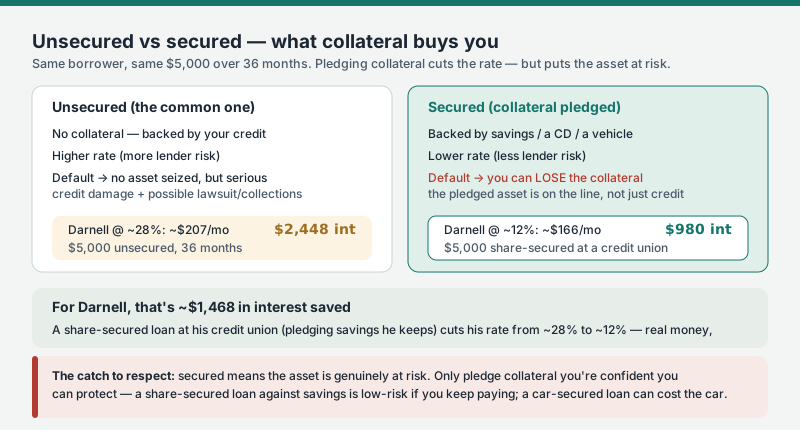
For Darnell, the gap is concrete: the same $5,000 over 36 months costs about $2,448 in interest unsecured at ~28%, but only ~$980 secured at ~12% — roughly $1,468 saved by pledging collateral. A share-secured loan at his credit union, backed by savings he still keeps, is the low-risk version of this — he keeps paying, keeps his savings, and gets the lower rate. The catch deserves respect, though: with a secured loan the asset is genuinely on the line, so a car-secured loan can cost the car if he defaults. The rule is to only pledge collateral you're confident you can protect. But notice what's really driving that $1,468 swing — it's the rate, and the rate isn't random. It's set mostly by one number.
4. What drives your rate — the same loan, very different prices
The single biggest lever on a personal loan's rate is your credit score, and the spread across the tiers is dramatic: the identical loan can cost one borrower a few hundred dollars in interest and another several thousand. Slide through the score bands and watch the same $10,000 loan reprice — Sofia, Maya, and Darnell are marked at their tiers:
Your score sets your rate — the same $10,000 over 36 months
Drag the score. The tier, the typical APR, and what the loan actually costs all move together.
Darnell 580 · Maya 690 · Sofia 770
Tier
Good
Typical APR
~18%
Payment
~$362
Interest
$3,015
At a good score (~690), ~18% means ~$3,015 in interest on the same $10,000. Raising your score one tier can save thousands on the identical loan.
The spread is the whole point: the same $10,000 loan costs Sofia (exceptional, ~9%) only about $1,448 in interest, costs Maya (good, ~18%) around $3,010, and costs Darnell (poor, ~28%) roughly $4,900 — a swing of more than $3,400 for identical money, decided almost entirely by a three-digit number. Two practical consequences fall out. First, raising your score even one tier before borrowing is worth real money — for a planned, non-urgent loan, a few months of on-time payments and lower utilization (Lesson 4) can pay for itself many times over. Second, credit unions are capped at 18% APR by federal law, which makes them frequently the best door for fair- or poor-credit borrowers — Darnell's ~28% from an online lender could become ~18% (or less, secured) at a credit union. That gap between his card rate, his unsecured rate, and his secured-or-credit-union rate is exactly what makes his consolidation question genuinely interesting rather than automatic — which we'll settle with real math in §7. First, the fee that quietly changes what he actually receives.
5. The origination fee — what you borrow vs what lands in your account
Here's the cost most people miss, because it doesn't arrive as interest. Many personal loans charge an origination fee — typically 0% to 8% of the loan amount — and it's usually deducted from the proceeds, meaning the lender skims it off the top before depositing the rest. So you receive less than you borrow, but you owe (and pay interest on) the full amount. Run Maya's numbers:
The proceeds gap — Maya borrows $6,000, but receives less
The origination fee comes off the top. You repay the full amount; you only get to keep what's deposited.
Fee
$300
You Receive
$5,700
You Owe (& Pay Int. On)
$6,000
The $300 fee never reaches her, yet she repays the full $6,000 plus interest on all of it. This is exactly why the APR runs higher than the quoted rate.
Need a specific amount in hand? To actually receive $6,000, she'd have to borrow ~$6,316. Many credit unions charge no origination fee — worth seeking out.
Maya's 5% origination fee on $6,000 is $300 — and it never reaches her. The lender deposits $5,700, but she repays the full $6,000 plus interest on all of it. Two things follow that matter at the comparison stage. First, the fee is exactly why the APR is higher than the quoted interest rate — the APR (Lesson 2) bundles the origination fee into the yearly cost, so the honest way to compare two loans is APR against APR, never rate against rate, because a "low-rate" loan with a fat origination fee can cost more than a higher-rate loan with none. Second, if she actually needs $6,000 in hand, she has to borrow about $6,316 to net it after the fee. The clean move: many credit unions and some online lenders charge no origination fee at all, so it's worth shopping specifically for that — which raises the question of how to shop without wrecking your credit in the process.
6. Prequalify vs apply — shopping without the credit ding
Shopping for a loan sounds like it should hurt your credit, and that fear keeps people from comparing offers — which is the costliest mistake of all, since §4 showed how much rates vary. The good news: you can shop almost entirely for free.
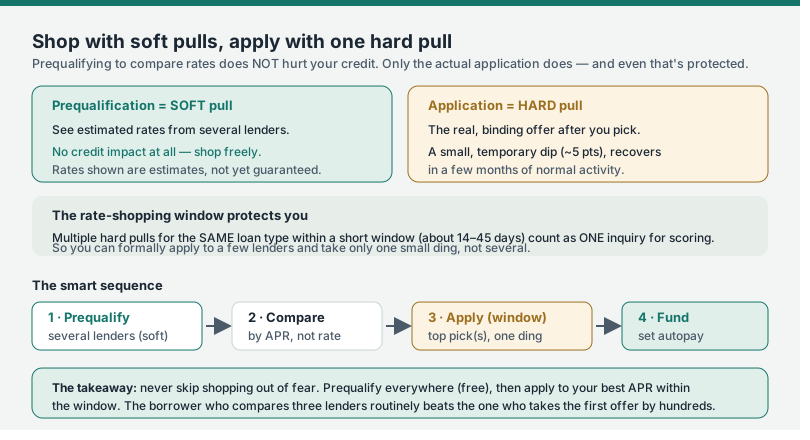
The distinction that frees Maya to shop is prequalification versus application. Prequalifying is a soft pull — it shows her estimated rates from several lenders with zero impact on her credit, so she can compare as widely as she likes. Only the actual application is a hard pull, and even that is just a small temporary dip (~5 points) that recovers in a few months. The protection most people don't know about is the rate-shopping window: multiple hard inquiries for the same loan type within roughly 14–45 days are counted as a single inquiry by the scoring models, specifically so that comparison-shopping isn't punished — so she can formally apply to two or three lenders and take only one ding. The sequence is the lesson: prequalify everywhere for free, compare on APR, then apply to the best within the window. Skipping the shopping is the real mistake; the borrower who compares three lenders routinely beats the one who grabs the first offer by hundreds of dollars. With the rate understood and the shopping done, Darnell is finally ready to answer the question he came in with — whether to consolidate.
7. Debt consolidation — the headline use, and Darnell's honest math
The most common reason people take a personal loan is debt consolidation: replacing high-interest revolving card debt with one fixed-rate installment loan — ideally at a lower rate, always with a clear payoff date. It's a genuinely powerful move, but it is not automatically a win, and Darnell's case shows exactly why. He has his $2,000 card at 22.99%, and whether consolidating helps depends entirely on the rate he can actually qualify for. Slide it and watch:
Consolidate Darnell's $2,000 card (22.99%) — does it help?
Pick the loan rate he qualifies for and the term. It only saves if the loan rate beats the card.
Keep the Card (22.99%)
$787
~$787 over the same term
Consolidation Loan
$603
~$603 over the same term
This is the honest finding the marketing never mentions: consolidation only helps if the new rate actually beats the old one, and for a rebuilding borrower it sometimes doesn't. At an unsecured ~28% — a realistic rate for Darnell's 580 score — consolidating his $2,000 card would cost him more than the 22.99% card he's leaving, because he'd be trading a high rate for a higher one. The move only works through a lower-rate door: a credit union (capped at 18% by law) saves him roughly $180, and a share-secured loan at ~12% saves nearly $400. So the rule is to check the rate against the weighted rate of what you're paying off — and never assume "consolidation" means "cheaper." The textbook win, for the record, is the other borrower: someone with a good score and several high-rate cards (say $15,000 across cards at 24%) who consolidates into one 14% loan and saves thousands plus the chaos of five due dates. And the risk that undoes all of it: running the cards back up after consolidating, which leaves you owing the loan and fresh card debt. Consolidation is a tool for discipline, not a substitute for it. Knowing when it wins means knowing what it's competing against.
8. When a personal loan is the right tool
A personal loan competes with several other ways to borrow for the same jobs, and the best choice depends on the job. Side by side:
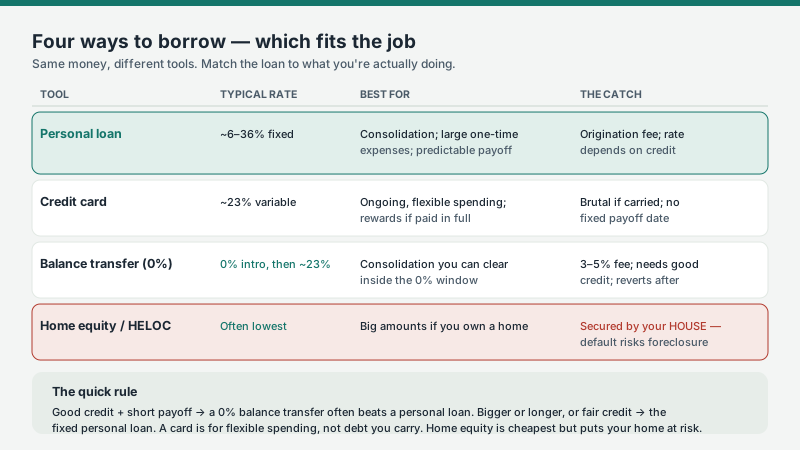
The personal loan's sweet spot is clear once it's lined up: it wins for consolidation and large one-time expenses where you want a fixed payment and a guaranteed end date, especially at fair-to-good credit. But it isn't always the best tool for the job. For a borrower with good credit who can clear the debt inside a promo window, a 0% balance transfer (Lesson 5) often beats it — pay a 3–5% fee instead of a year of interest. For ongoing, flexible spending, a credit card is the right instrument (just never carried). And home equity is usually the cheapest money of all — but it's secured by your house, so a default risks foreclosure, which is a different order of risk entirely (a later lesson). The quick rule: short payoff and good credit lean toward the transfer; bigger, longer, or fair credit leans toward the fixed loan; a card is for spending you'll clear, not debt you'll carry. With the when settled, the rest of the lesson is the how — walking the process and reading the two documents Darnell will actually hold.
9. The application process — step by step
The process is more approachable than it looks, and Darnell can do most of it without ever touching his credit. Having decided in §7 that consolidation only pays off through a lower-rate door, he walks it like this:
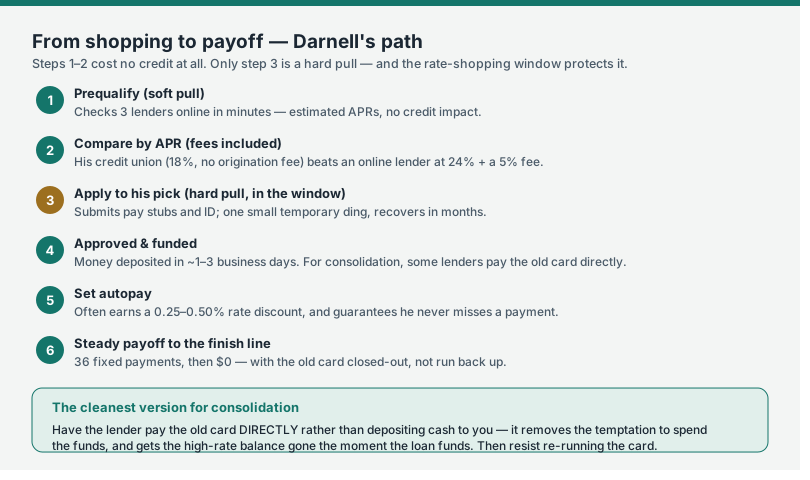
The shape of it is reassuring. The first two steps — prequalifying and comparing — cost Darnell nothing in credit, because prequalification is a soft pull (§6). Only step 3, the actual application, is a hard pull, and the rate-shopping window from §6 keeps even that to a single small ding if he applies to two lenders. Two details reward doing deliberately. First, autopay usually earns a 0.25–0.50% rate discount and removes any chance of an accidental missed payment — free money plus protection, so there's rarely a reason to skip it. Second, for consolidation specifically, the cleanest version is to have the lender pay the old card directly instead of depositing cash into his account: it erases the high-rate balance the instant the loan funds, and removes the temptation to spend the money on something else. Every number that decides whether this loan is a good deal lives in one document he sees before committing — the loan offer — so reading it correctly is what separates a confident choice from a hopeful one.
10. Document Walkthrough — the loan offer (the document you compare)
Where Darnell meets it, and how (venue and mode). When he prequalifies on a lender's website or app, each one returns a loan offer summary — a digital disclosure shown on screen and usually emailed, laying out the full terms of that lender's offer. This is the document he reads to compare and decide, before any binding application. It isn't the contract he signs (that's §13's walkthrough); it's the shopping document, and reading it right is what lets him choose on the real number — the APR — rather than the headline rate. Here is the complete offer, exactly as it would appear:
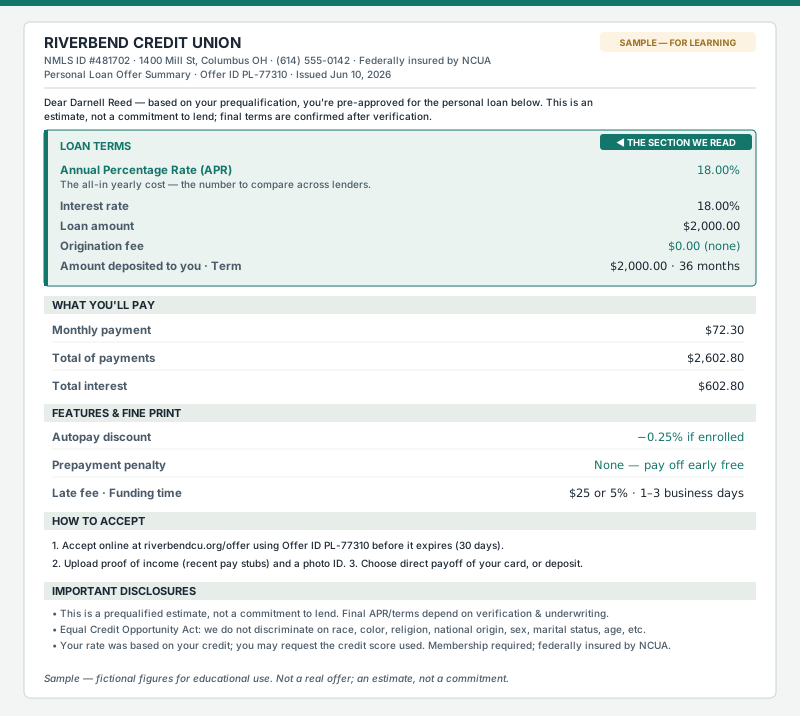
Here is the complete, total-coverage breakdown — every line on the page, in reading order, each explained so a first-timer actually understands it.
Masthead — who is making the offer
Lender — Riverbend Credit Union: the institution that would be lending the money. Confirming exactly who you'd borrow from is the first step, because the name is what you check against the licensing record below.
NMLS ID — #481702: NMLS is the Nationwide Multistate Licensing System, a public government registry that every legitimate consumer lender must enroll in and display a number from. Darnell can enter this number at the free public lookup, nmlsconsumeraccess.org, and confirm the lender is real, licensed in Ohio, and has no disciplinary record. It's a genuine five-second safety check — and it matters because the predatory lenders in §11 deliberately operate without a verifiable NMLS ID, so its presence is reassurance and its absence is a reason to stop.
Address & phone — 1400 Mill St, Columbus OH · (614) 555-0142: a real, physical, contactable location. A lender that publishes a street address and a working phone number is one both he and regulators can actually reach — another quiet legitimacy signal.
"Federally insured by NCUA": the National Credit Union Administration is a U.S. government agency that guarantees the money members deposit at the credit union, up to $250,000, even if the institution failed — the same protection the FDIC gives bank deposits. It tells Darnell this is a regulated, insured institution answering to a federal authority, not an unaccountable online operation.
Offer ID & issue date — PL-77310 · Jun 10, 2026: the reference number he uses to accept, and the date the expiration clock starts from.
Greeting — what this document is (and isn't)
"Pre-approved… an estimate, not a commitment to lend": the single most important framing on the page. The rate and terms shown are a genuine offer based on his prequalification, but not yet a final, binding contract — the lender still has to verify his income and pull his full credit before locking them in. So he treats these numbers as a reliable basis for comparison while understanding the final figures (in the §13 agreement) could shift slightly after verification. He's choosing here, not yet signing.
Loan Terms — the section this lesson reads (tinted, tagged ◀)
Annual Percentage Rate (APR) — 18.00%: the all-in yearly cost of the loan, expressed as one percentage that bundles together the interest rate and any required fees (Lesson 2). This is the number to compare across lenders, because it captures true cost in a single figure — a loan with a lower interest rate but a hefty origination fee can carry a higher APR, and the APR is what exposes that. The one habit to keep from this lesson: compare the APR line, not the rate line.
Interest rate — 18.00%: the rate charged on the borrowed balance itself, before fees. It's identical to the APR here for a specific reason worth understanding — because this loan has no origination fee. On a loan that charged one, the APR would sit noticeably above the interest rate, and the gap between these two numbers is itself the tell that a fee is buried somewhere.
Loan amount — $2,000.00: the principal — the actual sum borrowed, which he's using to pay off his card. Every interest figure on the page is calculated from this number.
Origination fee — $0.00 (none): an origination fee is an upfront charge some lenders skim off the top of a loan for processing it (§5), typically 0–8% of the amount. This offer has none — a real advantage of the credit-union door; at a fee-charging lender, a 5% fee here would have meant $100 taken before he saw a dollar.
Amount deposited to you — $2,000.00: what actually lands in his account. With no origination fee, it equals the full loan amount, so there's no "proceeds gap" (§5).
Commonly confused with the loan amount. They match only when the fee is zero. The instant a fee exists, the deposited amount drops below the loan amount even though he still owes — and pays interest on — the full loan amount. Seeing them equal here is the visible proof there's no fee.
Term — 36 months: the fixed length — the number of monthly payments before the loan is fully paid and the account closes.
What You'll Pay — the real cost, in dollars
Monthly payment — $72.30: the exact amount auto-charged each month, identical every time. Notably, it's less than the ~$77/month he'd pay to clear the same balance on his 22.99% card over the same period — the visible sign the lower rate is doing real work.
Total of payments — $2,602.80: every dollar he hands over across all 36 months ($72.30 × 36). This is the "what will it cost me in total" figure, and seeing it spelled out heads off the common shock of realizing a loan costs more than the sum borrowed.
Total interest — $602.80: the pure cost of borrowing — total of payments minus the $2,000 borrowed. This is the §7 figure that confirmed consolidating saves him versus the card's ~$786, and the number to weigh against alternatives.
Features & Fine Print — the terms that change the deal
Autopay discount — −0.25% if enrolled: the lender shaves a quarter-point off his rate just for setting up automatic payments. It's a small free reduction and it guarantees he never misses a payment by accident — so there's rarely a reason not to take it.
Prepayment penalty — None: a prepayment penalty is a fee some lenders charge if you pay a loan off early, to recoup interest they'd otherwise have collected. This loan has none, so every extra dollar he throws at it goes straight to knocking down principal and saving interest — paying ahead of schedule costs him nothing.
Worth checking on every loan. "None" is the borrower-friendly answer, but it is not guaranteed elsewhere — some lenders do charge to pay off early, which quietly punishes the exact responsible behavior of escaping debt faster. Always find this line before signing.
Late fee — $25 or 5% of the payment: what he's charged for a late payment — the very thing autopay is designed to prevent.
Funding time — 1–3 business days: how soon after acceptance the money is disbursed, or his card is paid directly.
How to Accept — the path forward
Steps 1–3 (accept online with the Offer ID before it expires; upload pay stubs + photo ID; choose direct card payoff or deposit): the §9 process written onto the document itself — the concrete actions that turn the estimate into a funded loan. The choice in step 3 matters most: electing to have the lender pay his card directly is the cleanest consolidation move, because it erases the high-rate balance the instant the loan funds and removes the temptation to spend the cash elsewhere.
Important Disclosures — the legal footer that protects him
"A prequalified estimate, not a commitment to lend": repeats, in the binding fine print, that final terms depend on verification and underwriting — so the offer is a dependable starting point, not an ironclad guarantee.
Equal Credit Opportunity Act notice: ECOA is a federal law, and this line tells Darnell what it guarantees — it is illegal for any lender to deny him a loan or charge him worse terms because of his race, color, religion, national origin, sex, marital status, age, or because he receives public assistance. His application must be judged on his finances alone. Why it's worth real money: if he were ever denied or given worse terms, this law gives him the right to demand the specific reasons in writing and to report the lender to a regulator if those reasons look like discrimination. Its presence also signals a lender operating under federal consumer-protection law — the very framework predatory lenders structure themselves to escape.
"Rate based on your credit; you may request the score used": this tells him his 18% was set specifically by what his credit report and score showed — exactly why his rebuilding 580 score lands at 18% rather than Sofia's 9% — and that he has the right to obtain, for free, the exact score the lender used. That's useful twice: it shows how close he is to the next score tier where the rate would drop (§4), and it lets him verify the lender priced him off accurate data, because an error on his report dragging his score down would mean a mistake — not his real finances — was costing him money every month.
"Membership required; federally insured by NCUA": a credit union is a not-for-profit, member-owned alternative to a bank, so he must join before borrowing — usually an easy step like opening a small savings account or qualifying through where he lives or works. The NCUA insurance (explained in the masthead) confirms his deposits are federally guaranteed. This is part of the same regulatory framework that caps credit-union rates at 18% and tends to make their terms fairer to begin with.
Read in full, the offer is a complete decision on one screen — the terms he compares and the boilerplate that proves the lender is real and his rights are intact — explained to the point a first-timer finishes understanding it rather than skimming a label. The single habit that makes the comparison safe is reading the APR line across lenders, since that one number already contains the rate, the fee, and the real cost.
11. Predator Watch — the triple-digit installment lender
This is the trap built for exactly Darnell's situation: a borrower rebuilding from a 580 score, turned away or intimidated by mainstream lenders, who then sees an ad promising approval with no questions asked. The predator here isn't selling a product — it's selling desperation relief, at a price hidden until it's too late.
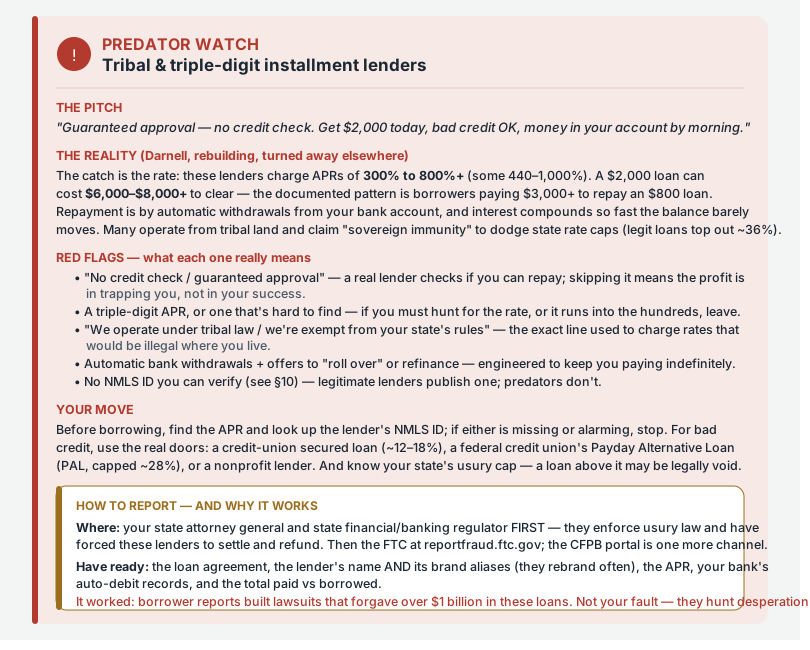
The number that makes this the worst trap in the lesson is the APR: legitimate personal loans top out around 36%, but these lenders charge 300% to 800% and beyond, which turns a $2,000 loan into $6,000–$8,000 to clear — the documented pattern is borrowers paying over $3,000 to repay an $800 loan. They get away with rates that would be illegal in most states by operating from tribal land and claiming "sovereign immunity" — the legal argument that they answer to tribal rather than state law and so aren't bound by state rate caps. The defense is concrete and worth doing before signing anything: find the APR (if it's triple-digit or hard to locate, walk), look up the NMLS ID (the §10 check — predators don't have a verifiable one), and remember that the real doors for bad credit do exist — a credit-union secured loan, a federal credit union's Payday Alternative Loan (capped at about 28%), or a nonprofit lender. And one fact that flips the power back: a loan charging more than your state's legal usury cap may be legally void, meaning you may not actually owe it — which §12 develops.
Paired with that warning, for the borrower who's already in one:
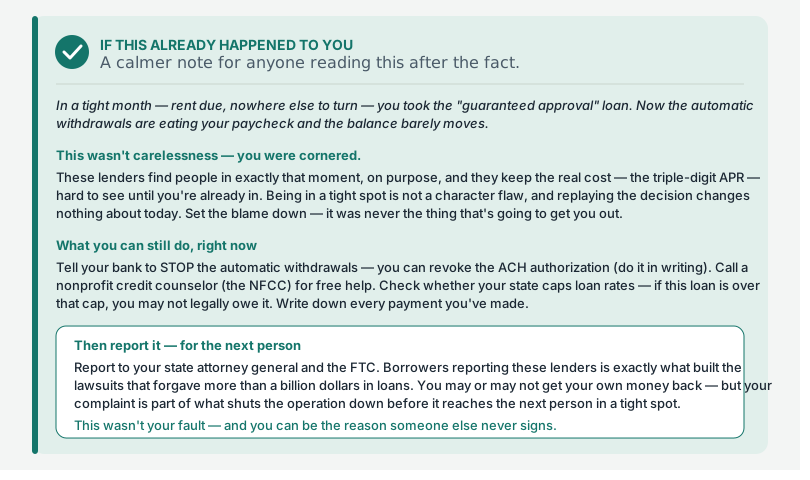
The reassurance beat does the job the warning can't: it speaks to the person already inside the loan, who's likely blaming themselves for a decision made under pressure. The truth it offers is that being cornered isn't carelessness — these lenders are engineered to find people in a desperate month and to keep the real cost hidden until the auto-debits start — and that self-blame is the one thing that won't help them get out. What will help is concrete and immediate: revoke the ACH authorization at their bank to stop the automatic withdrawals, get free help from a nonprofit credit counselor, and check their state's rate cap, because a loan above it may not be legally owed. And reporting it isn't a chore — borrower complaints are literally what built the lawsuits that forgave over a billion dollars in these loans, so it's the move that protects the next person. Which leads directly into where to take that complaint, and the legal lever that makes it powerful.
12. Where to turn — the recourse stack, and the usury cap that can void the loan
For an ordinary personal loan a problem is rare, but for an abusive one the ladder here has two rungs far more powerful than a complaint form — one that stops the bleeding today, and one that can erase the debt entirely.
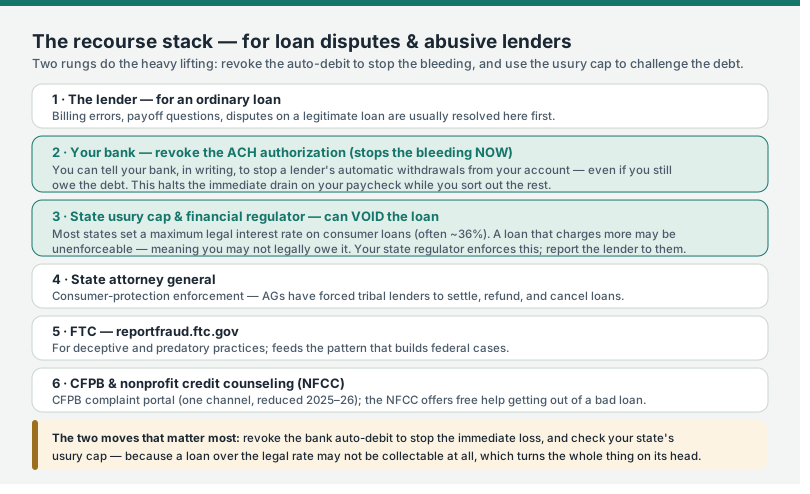
Two rungs on this ladder do the real work. The first is revoking the ACH authorization at your bank — ACH is the system lenders use to pull automatic payments from your checking account, and you have the right to tell your bank in writing to stop those withdrawals, even while you still owe the debt. That single step halts the immediate drain on your paycheck and buys time to handle the rest. The second is the state usury cap — most states set a legal maximum interest rate on consumer loans, often around 36%, and a loan that charges more than that cap may be unenforceable, which means a court may rule you don't legally owe it. This is why the state attorney general and state financial regulator come first in this stack rather than the federal agencies: they enforce the usury laws, and they're the offices that have repeatedly forced abusive lenders to settle, refund, and cancel loans outright. The lever that feels like the borrower's weakness — a too-high rate — is in fact the legal weapon that can void the whole loan.
13. Document Walkthrough — the loan agreement & promissory note (the document you sign)
Where Darnell meets it, and how (venue and mode). After he accepts the offer from §10, the lender sends the loan agreement and promissory note — the binding contract he e-signs (or signs on paper at the credit union). This is the legal document, not the estimate: the offer was what he used to choose, this is what he's bound by. Its heart is the federally required Truth in Lending Act (TILA) disclosure box — the same standardized box from Lesson 2, here embedded in the full contract. Reading it confirms the deal matches the offer and that nothing changed after verification. Here is the complete agreement:
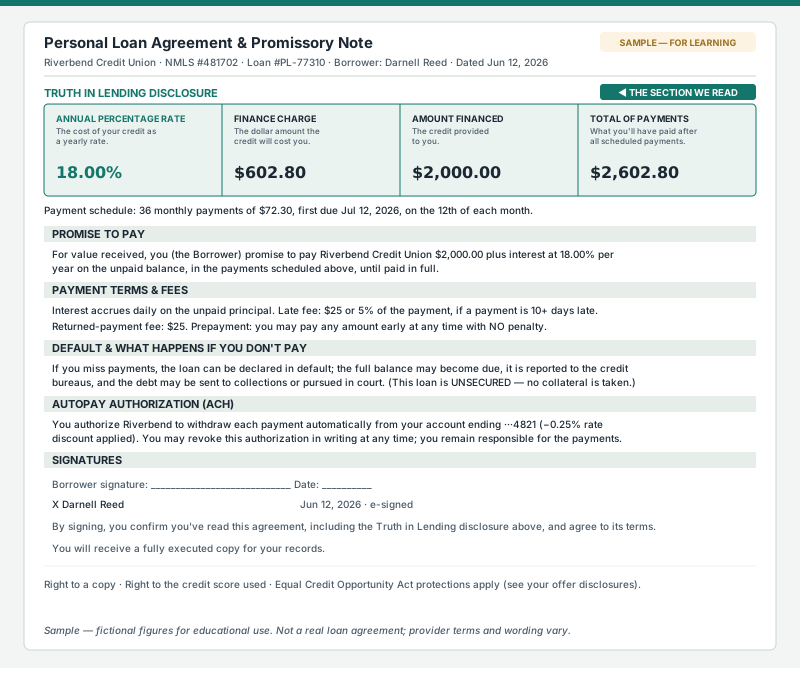
Complete total-coverage breakdown, in reading order, each line explained so a first-timer finishes understanding it.
Masthead — what this document is
"Personal Loan Agreement & Promissory Note": two things in one document. The agreement sets out the terms; the promissory note is the part where Darnell legally promises to repay — it's what makes the debt enforceable. Signing this is the moment the loan becomes real and binding, unlike the offer, which was only an estimate.
Lender, NMLS #481702, Loan #PL-77310, borrower, date: identifies who's lending, the same verifiable license number from the offer (so he can confirm it's the same legitimate institution), the loan's reference number, and the date the clock starts.
Truth in Lending Disclosure — the section this lesson reads (tinted, tagged ◀)
This is the federally mandated TILA box — by law, every consumer loan must present these four numbers in this exact standardized format, specifically so borrowers can compare loans and can't be surprised by hidden costs. Reading these four boxes is reading the true cost of the loan:
Annual Percentage Rate — 18.00%: labeled by the box itself as "the cost of your credit as a yearly rate." This is the all-in yearly cost (rate plus any fees), and it matches the offer — confirming nothing crept up after verification. It's the number to have compared across lenders.
Finance Charge — $602.80: "the dollar amount the credit will cost you." This is the total interest and fees Darnell pays for borrowing — the cost of the loan expressed in actual dollars rather than a percentage. Seeing it as a flat dollar figure is powerful: it's the price tag on the borrowing itself.
Commonly confused with the total of payments. The finance charge is only the cost of borrowing ($602.80); it is not the total he'll pay. The amount he borrowed is separate and gets added to it.
Amount Financed — $2,000.00: "the amount of credit provided to you." This is the actual loan principal he receives — here the full $2,000, because there's no origination fee reducing it.
Total of Payments — $2,602.80: "what you'll have paid after all scheduled payments." This is the complete sum leaving his pocket over the life of the loan, and it's simply the Amount Financed ($2,000) plus the Finance Charge ($602.80) — the two prior boxes added together. This is the "what does this loan cost me, all in" number.
Payment schedule — 36 monthly payments of $72.30, first due Jul 12: spells out exactly how the Total of Payments gets paid — how many payments, how much each, and when they start. No ambiguity about what he owes or when.
Promise to Pay — the binding core
"You promise to pay… $2,000.00 plus interest at 18.00% per year… until paid in full": this is the promissory note language — the actual legal promise that turns the disclosure above into an enforceable obligation. The phrase "on the unpaid balance" matters: interest is charged only on what he still owes, so as the balance shrinks each month, the interest portion of each payment shrinks too (the Lesson 2 amortization principle), which is exactly why paying extra early saves money.
Payment Terms & Fees
"Interest accrues daily on the unpaid principal": interest is calculated each day on what he currently owes. The practical upshot: paying a few days early, or paying extra, genuinely reduces the interest because it lowers the balance the daily calculation runs on.
Late fee — $25 or 5% of the payment, if 10+ days late: the charge for a late payment, and the grace window (10 days) before it applies — the thing autopay is set up to prevent.
Returned-payment fee — $25: charged if an autopay attempt bounces because the account was short — a reason to keep a cushion in the linked account.
Prepayment — no penalty: he can pay any amount early, any time, free. This confirms the offer's promise in the binding contract: extra payments go entirely to knocking down principal, with nothing lost to a prepayment fee.
Default & What Happens If You Don't Pay
The default clause: this section, which people skip, is the one that explains the real stakes. If Darnell misses payments, the lender can declare the loan "in default," which can trigger three things: the entire remaining balance can be demanded at once (not just the missed payment), the default is reported to the credit bureaus (damaging his rebuilding score), and the debt can be sent to collections or pursued in court. Understanding this isn't meant to scare him — it's so he knows that a missed payment is serious and that contacting the lender early (Lesson on hardship, later) beats going silent.
"This loan is UNSECURED — no collateral is taken": confirms there's no asset the lender can seize (no car, no house), because he didn't pledge one. The consequences of default are credit damage and legal collection, not repossession — the §3 distinction, now stated in the contract.
Autopay Authorization (ACH)
The ACH authorization: ACH is the bank-to-bank system that pulls his payment automatically each month. By signing, he's authorizing those automatic withdrawals (and earning the −0.25% discount for doing so).
The line worth knowing: "you may revoke this authorization in writing at any time." This is the same right from §12 — he can tell the lender (and his bank) to stop the auto-withdrawals. On a legitimate loan he still owes the payments and would arrange another way to pay; the reason it matters is that it's the exact mechanism that lets someone stop an abusive lender from draining their account.
Signatures
The signature block and "by signing, you confirm you've read… the Truth in Lending disclosure… and agree to its terms": his signature is legal consent to everything above, and it specifically affirms he saw the TILA box. The note that he'll receive a fully executed copy matters — he should keep it, because it's his proof of the agreed terms if anything is ever disputed.
Footer — right to a copy, right to the score used, ECOA protections: a final reminder of the rights established in the offer (§10) — his copy, the credit score that priced the loan, and his protection against lending discrimination — carried into the binding document.
Read in full, the agreement is the offer made binding, with the TILA box as its verified heart and the default and ACH clauses spelling out the real stakes and the real escape hatch — explained to the point Darnell signs understanding what he's agreeing to, which is the entire goal.
14. Most common questions
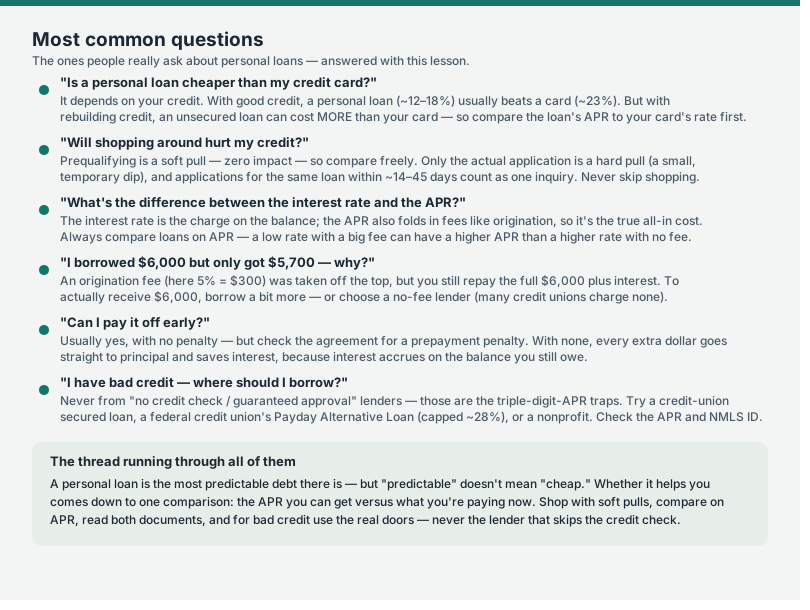
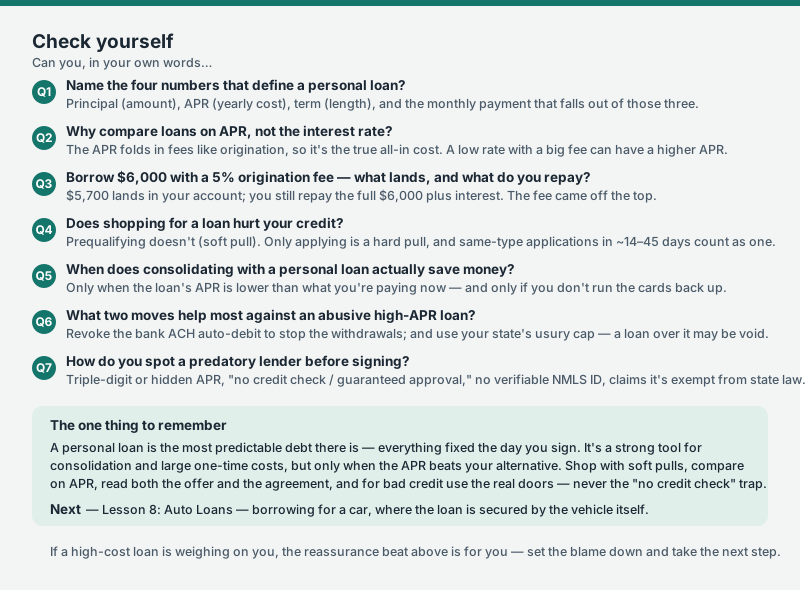
15. Check yourself
Key Takeaways
- Compare on APR, never on rate — APR bundles the origination fee in, so a "low-rate" loan with a fat fee can be more expensive.
- Consolidation only helps if the new rate actually beats the old one — for a rebuilding borrower at ~28% unsecured, it can cost more than the card.
- Prequalify everywhere for free (soft pull), then apply to the best offer within the 14–45 day rate-shopping window (one hard-pull ding).
- A triple-digit APR lender is a predator — a $2,000 loan can become $6,000–$8,000 to clear. The five-second defense: look up the NMLS ID and find the APR before signing.
- You can revoke ACH authorization at your bank to stop automatic withdrawals, even while still owing the debt — and a loan above your state's usury cap may be legally unenforceable.
- The TILA box in the loan agreement (APR, finance charge, amount financed, total of payments) is the federal checkpoint that confirms the deal matches the offer and nothing changed after verification.
Quiz — 5 Questions
Answer one at a timeMaya takes a $6,000 personal loan at 18% APR for 36 months. Which number should she compare across lenders to find the best deal?